Leah Buletti, News Editor
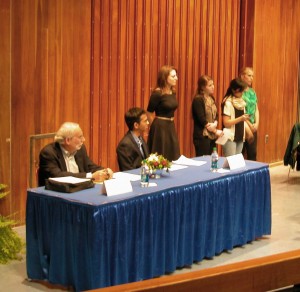
A panel on the Affordable Care Act (ACA), colloquially known as Obamacare, drew about 120 students to Hoyt Auditorium on Monday, Oct. 15 for a discussion about the legislation in light of the upcoming presidential election. The panel was sponsored by GlobeMed, College Republicans, College Democrats, Undergraduate Council of Economics and Finance and the Newman Community.
The panelists, who each examined the ACA from a different perspective, included History Professor and health policy expert Ted Brown, Political Science Professor Avidit Acharya, Emergency Medicine Professor Sandra Schneider and Marvin Mich, a theologian with a background in bioethics.
Each panelist was given 15 minutes to speak about the ACA before the event segued into discussion based on questions and comments from the audience.
Each panelist agreed that while the ACA is flawed, it is a start to ending a problem. All four thought that the best possible solution would be a single-payer system and that the problem is that there is no political power behind this plan. While President Barack Obama himself has acknowledged that this course of action would be more effective, he and his team believed that the ACA would get passed more quickly instead of holding out for the single-payer system.
Brown spoke first, quickly articulating that he is mostly critical of the act because it does not cover enough people.
“The [ACA] does not establish health care as a right,” he said, citing the estimated 23 to 25 million Americans who are currently without coverage. Brown added that too much power is given to private insurance and pharmaceutical companies and that “those who pushed for this system caved in and gave up too much to get it to pass.”
Acharya looked at the act from an economic perspective and described specifically how it will impact the federal budget. It will reduce the deficit by $200 billion and will transfer money from the wealthiest Americans to insurance companies, he said. The bill does nothing to reform many of the inefficiencies currently plaguing patients, but the promise of the pilot projects it launches could prove to be very useful, he added.
Schneider spoke next and also criticized that the money does not go toward paying the doctors but rather toward the insurance companies. She pointed out that the United States is the only developed country that does not provide total care for its citizens and that Americans “treat it as a right but pay for it as a privilege.”
Mich discussed how the Catholic Church has problems with some of the requirements that the legislation mandates. He pointed out that as the largest nonprofit healthcare provider, the Church has considerable sway. He also said that the government tried to mediate between competing ideas and was working for the common good but “fell short.”
Konowitch is a member of the class of 2015.
