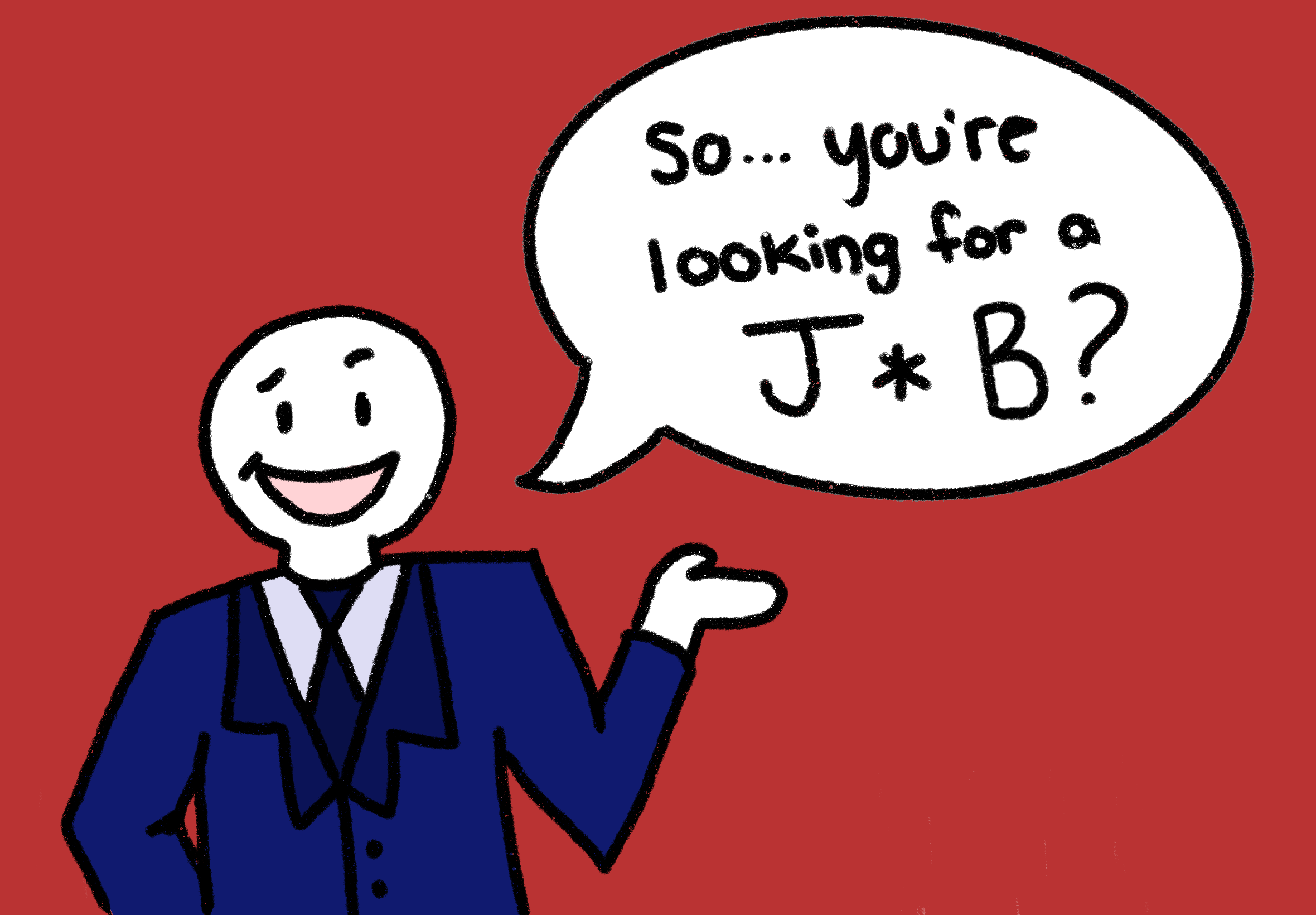
So, you have a degree in Biochemistry and English. You served in student government for four years, clustered in Astrophysics, and speak passable German. In other words, you’re unemployed.
You wake up on Tuesday to four emails from Handshake. The subject lines promise salvation: “Jobs in Your Field Near You!” You open them. Unpaid internship, unpaid internship, entry-level job that wants five years of experience, job making bombs, sketchy gig work, unpaid internship. Defeated, you switch tabs to a list of graduate programs. You look at tuition rates. You look at your wallet. You find a whole, crisp $3.79 which consists mostly of quarters and a $1.04 Barnes & Noble gift card. A tiny tumbleweed rolls past, and you stare, disturbed. Did you put that in there? Did the wallet create that itself? You reopen the job boards. You have countless job boards. Every time you complain about the market, you are recommended a new job board. ‘Have you tried Indeed?’, they ask. ZipRecruiter? Lensa? Jobmaxxer? FleepFlorp? You roll your eyes. Of course you’ve tried FleepFlorp.
You open an incomplete BladeSmart sales associate application. Your resume and cover letter extol your lifelong passion for mid-range kitchen knives. You have already attached them as PDFs. Now, all that remains are the short answer questions. The first couple are normal, as they always are.
1. What about our company’s values most attracts you? (150 words)
2. What is your greatest professional weakness? (100 words)
Then they get more specific, and stranger.
3. How did you hear about our company? (50 words)
-
- Was it David? David Castellano? (Y/N)
- If yes, describe the nature of your relationship. (200 words)
You don’t know any Davids; you heard about the company on FleepFlorp. You type N and advance to the riddles. You hate the riddles.
4, If your father was turned into a ring-tailed lemur (ring-tailed lemurs are classified as an invasive species) (also, in this scenario Madagascar has closed its borders, preventing ecological reintegration) would you have the strength to do what needs to be done? You are equipped with a BladeSmart kitchen knife. The lemur (your father) will be conscious and able to feel pain throughout the entire process. (300 words)
You refer to the company values. Would showing mercy prove proficiency in customer service? Or would granting a swift death be evidence of initiative? Your head hurts. Your father isn’t a lemur. You aren’t sure what kind of world BladeSmart is preparing for, nor what your role would be in it. Either way, you don’t think it’d be selling knives.
You won’t kill for $17.50 an hour, you decide, no matter how environmentally necessary. You return to your inbox. The army wants nuclear engineers. Forklift certification classes are 50 percent off. Teach For America needs you to move to Memphis. You hover over the forklift classes, considering. Your dreams of $22/hr are interrupted by a phone call. You pick up, hoping it’s a callback. It’s not. It’s your least employed friend with some bullshit.
“Yo, I’m gonna go spy on the geese at the park with these binoculars I found. You free? I’ll bring a Costco hotdog.”
The offer is nonsensical, but tempting. You think about forklifts, lemurs, and David Castellano. You think about half of a Costco hotdog. One wins out.
“Yeah, okay. I’ll clear my schedule.”
You reach for your keys and close your laptop. FleepFlorp can wait.