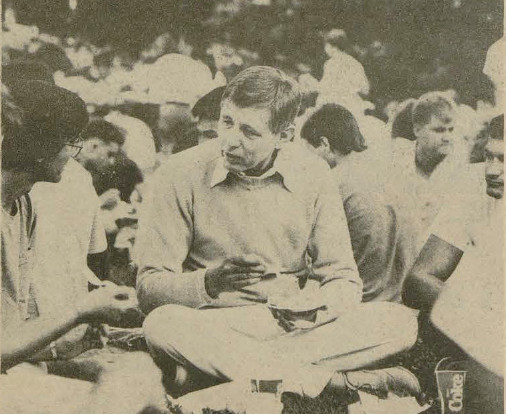
When UR president Dennis O’Brien took office in 1984, the Campus Times called him “a masterful craftsman of showmanship.” Rodnell Claboine, then SA president, continued that O’Brien was “candid and personable,” “humorous and tangible,” and “simply a winner.”

When he took office, O’Brien’s goal was to improve the university’s national standing, streamline its operations, and increase transparency. He offered regular “Presidential Forums,” essentially town halls where all interested students and faculty could ask whatever they wanted and receive honest answers from their university’s chief executive.
But by 1987, O’Brien faced his share of backlash. After UR failed to make U.S. News and World Report’s list of the top 25 schools in the nation, the Campus Times reported that O’Brien “felt the manner in which the survey was conducted, as well as the UR’s lack of name recognition, contributed to the university’s absence from the list.”
So, O’Brien championed an effort to change UR’s name to the more prestigious sounding “Eastman University.” After his administration drew fire for stiff tuition increases and continued business with South Africa despite apartheid, this slight to the school’s identity was the last straw for many students.
A December 1987 issue of “Against the Current,” a short-lived counter-cultural publication on campus made this dissent clear. “Dennis O’Brien was hired to take the lead and do something dynamic,” wrote Jon Silver, the Coordinating Editor for the publication. “People jumped on the bandwagon with great anticipation. Slowly, but surely, the one solid ice mass has polarized and disintegrated.”
Silver concluded his article ominously. “Conflict may be a healthy experience as long as the cost of conflict is recognized and accepted. In the case of the UR, change in leadership might not be so bad either.”
Critically, O’Brien did not double down against the students’ criticisms. Rather, he honestly listened to their complaints.
O’Brien abandoned the push for the name change, strengthened the programs he founded like Take Five, and served until his 1994 retirement. Today, we have a residence hall on campus named after him.
O’Brien was a rare example of a university president who listened to his students. Of course, every leader will be met with controversy, but it’s how they respond to that controversy that cements their legacy.