After a long, cold, snowy Rochester winter, spring is slowly making its way back into the city. Days are getting longer, the temperature is warming up, and any snow announced in the forecast isn’t sticking to the ground.
But, as per usual in Rochester, spring weather can be unpredictable. One day it’s warm and sunny, while other days can be overcast with short(ish) showers. But after spending time outdoors (when the weather is permissible) and observing the resident birds on campus, I can tell that a lasting spring is coming soon.
From the crack of dawn, songbirds have become much more vocal. Songbirds such as robins, cardinals, mourning doves, and song sparrows have been perching out on nearby trees and singing to attract potential mates and establish territories. When the weather is warm and especially when the ground is wet from a recent rainstorm, robins have been foraging the ground and plucking fresh earthworms when they crawl out. Elsewhere, some robins have been gathering nesting material from the ground, such as grass, twigs, and reeds. The resident goldfinches, who were previously in their drab, golden-brown plumage for the winter, are starting to molt, gradually transitioning to their signature bright yellow plumages with black caps for breeding season.
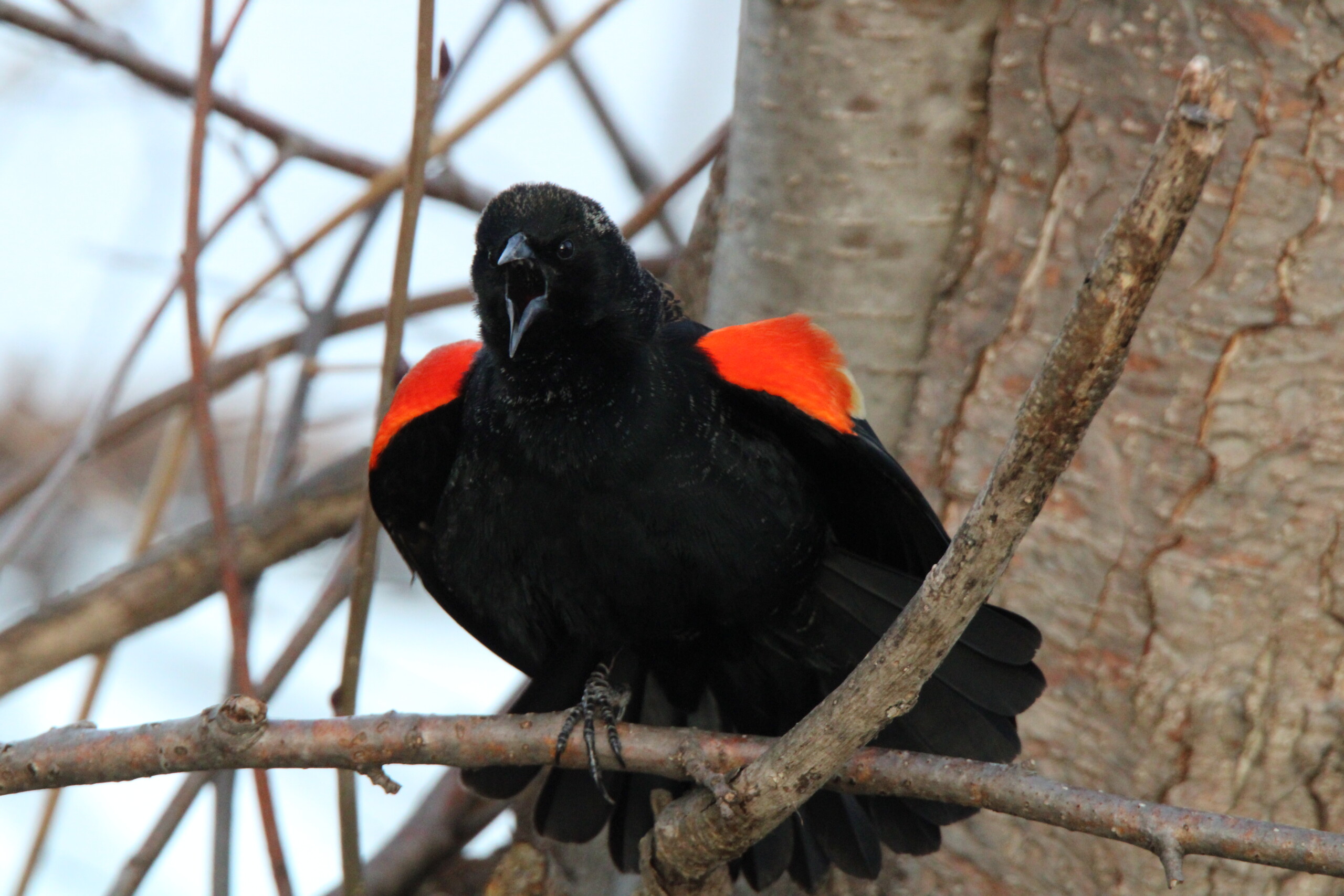
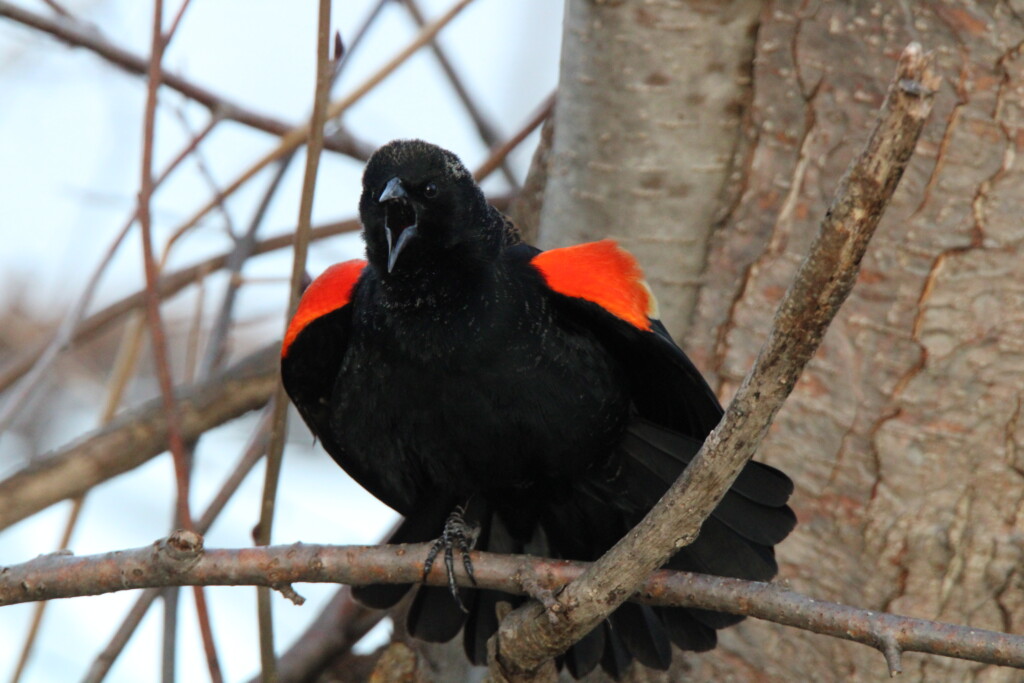
Speaking of which, every time I walk by the Genesee River on the Genesee Riverway Trail, in the areas near the footbridge by the First-Year Quad, the Interfaith Chapel, and the Engineering Quad, I have found one particular songbird’s presence to be a striking sign of spring. Red-winged blackbirds are among one of the earliest songbird migrants to arrive up north for breeding. True to their name, their most well-known features include the males’ shiny black plumage and bright red and orange patches on their upper wings, called epaulets. Females, on the other hand, are darker brown overall with lighter streaks in their plumages and sometimes have subtle red patches on their wings, depending on their environments, so they can camouflage themselves, their nests, and their young from predators. Both sexes have a short, stocky build and possess a long, conical bill for catching insects. As I walked by the river, I could hear the males’ loud, buzzy “konk-la-REEEE” call, which they use to ward off other species or rivals from their territories and woo any nearby females.
Right off the trail, I could see two male blackbirds who were just entering the breeding season. Both were visibly transitioning from the nonbreeding season, as one displayed a few light red and silver flecks on his feathers, which are features of nonbreeding males, and another was molting, as seen by the visible bald patch on the top of his head. I could spot them calling out nonstop and fighting each other every few minutes as they took off into the air, sparring mid-air and chasing each other. In the field of reeds in the river, I could spot one or two males pursuing a female, distinguished from the males by its darker brown plumage with lighter streaks and subtle or lack of red patches on their wings.
Songbirds are not the only bird groups that are in the midst of this seasonal change. During the winter, migratory ducks such as common mergansers, hooded mergansers, and buffleheads have been shown to remain in this area. Recently, when I have gone out onto the Genesee Riverway Trail, I’ve spotted these ducks less and less frequently as they have been preparing for their journey back up North, close to the Arctic, to breed.
The Canada geese have been busy preparing to raise the next generation of geese here on campus. During the days after spring break ended, around the cove off the Genesee River right next to the footbridge, I saw at least one pair searching for a safe, quiet place to nest. A couple days later, they had officially chosen their nesting spot in this zone; I saw the female incubating her eggs in that stretch of land between the cove and the river while her mate walked around the area to forage and protect her from any predators or rivals. Witnessing these nesting Canada geese was a breathtaking experience, but also a rather nerve-wracking one. I’ve seen at least one Canada goose pair with about half a dozen goslings stroll around the footbridge as pedestrians, cyclists, and scooter riders pass by. I’ve seen how the parents courageously defend their goslings from anyone who walks near with a glare and a hiss and, if anyone walks too close, by charging at or nipping them.
Despite Rochester’s unpredictable weather as winter turns to spring, the birds around campus have shown me that spring has truly arrived. Resident birds and migratory birds who are making their way up north are preparing to raise the next generation of birds, and I look forward to witnessing what’s to come in the next few weeks of spring for Rochester’s birdlife.