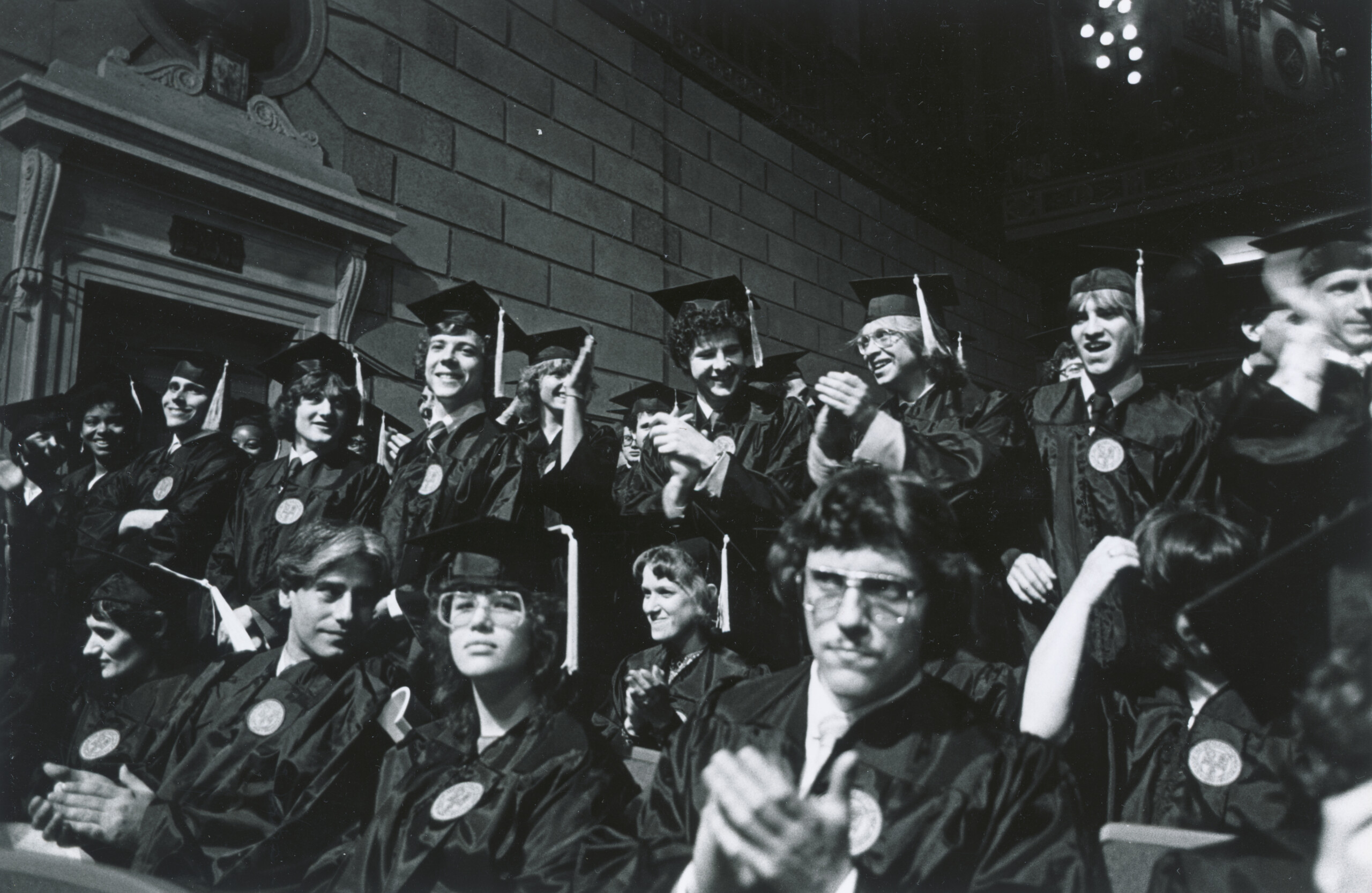
URochester’s annual Senior Week always features a full lineup of celebrations for the graduates leading up to Commencement. The Class of 2026 will have the chance to travel to local favorites — including the Rochester Lilac Festival, the Memorial Art Gallery, Deer Run Winery, and a Rochester Red Wings game — and enjoy on‑campus events such as the Picnic with the President, Trivia Night, Rush Rhees Library Tower Tours, the New Alumni Welcome on Wilson Quad, and more. The contemporary week-long fun is deeply embedded in the history of URochester culture, even though Senior Week and Commencement traditions have changed dramatically over time.
To check out some of those changes, I visited the Department of Rare Books and Special Collections in Rush Rhees Library to speak with Melissa Mead, the John M. and Barbara Keil University Archivist and Rochester Collections Librarian, about how Senior and Commencement Week traditions have evolved since the University’s 1850 charter. Together, we explored archival programs, photographs, letters, and other University ephemera that trace the history of URochester’s graduation rituals, revealing how the University’s identity has shifted in the last century.
Special Collections has preserved Commencement programs and week‑of schedules dating back to 1860, offering a clear record of how URochester’s graduation culture has evolved. Long before today’s Senior Week of winery trips, tower tours, and citywide outings, celebrations were far more formal, condensed, and institutionally focused. Programs from the 1920s depict carefully structured weekends of ceremonies, alumni reunions, religious observances, concerts, receptions, athletic events, and other class rituals, framing Commencement as both an academic milestone and a major social occasion for the University community.
A 1924 Commencement program, for example, outlined events running from Thursday, June 12 through Monday, June 16. Festivities included an Eastman School of Music concert in Kilbourn Hall, fraternity baseball games, class reunions, baccalaureate services held by then-University President Benjamin Rush Rhees, and Commencement exercises held at the Eastman Theatre. Alumni receptions and dinners at the Memorial Art Gallery further emphasized the central role alumni culture played in URochester’s early Commencement traditions.
These early celebrations also reflected a university in transition. During the 1920s, the developing River Campus was commonly referred to as “Oak Hill,” named after the former Oak Hill Country Club property that the University purchased in 1922 as it prepared to relocate the College for Men from Prince Street. Archival Alumni Day materials from this period portray Commencement Weekend not only as a graduation ceremony, but as a broader institutional celebration tied to the University’s evolving campus identity, alumni culture, and expansion into what would eventually become today’s River Campus.
Archival records from early Commencement Weekends reveal the evolving culture and identity of URochester, while also highlighting the divisions that marked student life in the early twentieth century. Gender played a role in shaping graduation traditions, as the University’s historical separation of male and female students often influenced Commencement rituals and social celebrations, especially during the early to mid-twentieth century.
URochester officially admitted its first class of women — which included 33 students — in 1900, a milestone achieved in large part through the efforts of Susan B. Anthony and other advocates for women’s higher education. Yet even after coeducation formally began, many Commencement traditions continued to distinguish between male and female students through separate programming, organizations, and social customs.
Programs from the 1920s and 1950s depict a graduation culture heavily shaped by fraternity and sorority life, alumni and alumnae associations, and the University’s division between the College for Men and the College for Women. The 1925 Commencement Weekend program, for example, included separate Alumni and Alumnae Commencement Dinners held on Monday following the Commencement Ceremony. Other events throughout the period included fraternity baseball games, sorority reunions, and alumni programming. By 1950, Commencement schedules also featured formally titled joint events such as the “Alumni-Alumnae Commencement Dance” and “Alumni-Alumnae Centennial Dinner,” reflecting both greater integration within Commencement celebrations and the continued institutional distinction between male and female student communities.
That same year, the University commemorated the fiftieth anniversary of women’s admission with a “50th Anniversary Luncheon for College for Women,” further underscoring how gender continued to shape graduation culture well into the mid-twentieth century. As University culture evolved, these mid‑twentieth‑century traditions began to mirror broader changes unfolding across American higher education, as institutions gradually moved away from rigidly gendered student structures toward a more integrated campus life.
By the latter half of the twentieth century, shifts in campus culture were also reflected in a more standardized Commencement structure. The 1976 program — running from Friday, May 7 through Sunday, May 9 — followed the now‑familiar rhythm of Class Day, rehearsal, and the Sunday ceremony, with diploma and departmental events afterward. Nearly three decades later, a 2005 Campus Times Commencement issue showed a similar three‑day format, but with the weekend beginning to incorporate activities that resemble today’s Senior Week. These included Rush Rhees Tower Tours, a trip to the Lilac Festival, an international student reception, and even a “senior gift fund” initiative that echoes the modern Senior Donor Celebration. These additions marked a shift toward a more expansive, experience‑focused lead‑up to Commencement, setting the stage for the fully-branded Senior Week.
In the years that followed, these early additions gradually unified the more expansive celebration students now recognize as “Senior Week.” The structure of Commencement itself had long been compact — 1976 programs, for example, showed the main ceremony and all departmental diploma ceremonies occurring on the same day — so the shift toward a longer, more varied lead‑up emerged not from changes to Commencement but from the growing desire to create shared senior experiences. This evolution became even more visible during the COVID‑19 era, when what grew to a traditional seven‑to‑eight‑day Senior Week was shortened, prompting the Class of 2022 Council to adopt a model of “intentional programming.” They curated high‑demand events such as canoeing and kayaking, Day at the Vineyard, Library Tower Tours, and trips to the Seneca Park Zoo to ensure the week still felt meaningful and communal. URochester’s Commencement Weekend, which began as a single‑day ceremony and expanded into a multi‑day celebration well before 2020, thus continued to evolve into the student‑driven Senior Week known today, with the Class of 2022 marking a clear turning point into its modern form.
As Senior Week has settled into a more intentional, student‑centered format, each graduating class has continued to shape the tradition in its own way. Now that the Class of 2026 has reached its final spring on campus, this week has become a fully-developed, multi‑day celebration — one that has blended long‑standing favorites with newer traditions that reflect the character and priorities of this year’s class.
The 2026 program offers a full week of events that blend Rochester‑specific outings, campus gatherings, and milestone celebrations marking the transition from student to alum. Alongside longstanding favorites like the Lilac Festival trip and Tower Tours, the schedule features more recent additions such as the Clubhouse Fun Center, Paintball, Radio Social, and Beerfest. Together, these activities show how Senior Week has become both a capstone experience and a reflection of the University’s evolving student culture.
Across more than a century of Commencement Week traditions, URochester’s celebrations have steadily evolved from a single ceremony‑centered day to a weekend, and eventually to a weeklong series of experiences that reflect the changing character of student life. What began as a tightly structured academic ritual gradually opened into a broader celebration of community, place, and transition — first through scattered additions like Class Day and festival outings, and later through the more intentional, student‑driven programming that defines Senior Week today.
The Class of 2026 schedule makes this evolution unmistakably clear. Its blend of long-standing traditions with newer, more recreational offerings reveals a senior experience shaped as much by shared joy and local exploration as by formal milestones. In this way, Senior Week has become both a capstone and a cultural snapshot: a reflection of how Rochester students build community, honor their time on campus, and mark the threshold between undergraduate life and the life beyond.