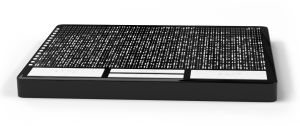
Courtesy of Samantha Piccone
Two teams of students from UR were selected to travel to the Cornell Cup in May 2014 to participate in the technology design competition hosted by the Cornell University Systems Engineering.
The two teams’ unique inventions have caught the attention of the competition organizers and earned them spots as Cornell Cup finalists.
Team URead Braille has received this honor once before. They attended last year’s Cornell Cup and earned an honorable mention, despite presenting their concept in the absence of a functional prototype.
“The competition is about embedded computation, which means you have some kind of
artifact which has a computer inside of it that does neat things,” Associate Professor of Computer Science and team advisor Randal Nelson said. “The concept [of URead Braille] is to be able to display a web page as a page of braille dynamically, without having to print it.”
One member of the team, senior Christina Kayasatha, commented on the uniqueness of the team’s design.
“The idea is [that] you want to be able to display text using braille, but in order to do that the format is very different,” she said. “We’re modelling it after a braille book.”
The project started in fall 2012, when last year’s team united to brainstorm potential ideas. They developed an interactive device that allowed blind users to read PDF files and interact with them. The end goal is to create a product that allows users to surf the web using braille. However, interpreting web pages introduces a host of user interface and other technological issues.
The design requires a surface that responds to the text and provides tactile feedback.
“It’s just a grid of solenoid actuators,” Kayastha said. “If you have a solenoid and you have a magnet inside of it and you pass a current through it, it will pulse up or down.”
Although it’s possible to produce a pulse, the hardware would require a constantly raised surface.
“Obviously we couldn’t keep a current going through all of them because for a full page there could be 3,600 pins at least,” senior Samantha Piccone said. “The goal is to pulse it up once and then make it stick.”
The team hopes to present a prototype of their product in an effort to improve upon their performance last year.
Haptech, the other team attending the Cornell Cup, will use haptic feedback in their project. Haptic feedback is a form of tactile feedback technology that incorporates the application of vibrations to alert the user.
The project will use multiple Kinect sensors to generate a 3D model of an individual within a virtual environment. The goal is to use this feedback to create a virtual environment that the user can directly interact with.
Sophomore Morgan Sinko describes the technology as “tracking a suite of sensors on the person’s body.”
This allows them to “track collisions and other interactions within the virtual environment. This sends a signal to a collection of piezo-electric actuators on a set of gloves on the user and gives haptic feedback to simulate sensations such as passing/catching a ball or shaking someone’s hand,” he said.
The team is also experimenting with a rig that could extend across the user’s entire torso.
This will be Haptech’s first appearance at the Cornell Cup.
Smith is a member of the class of 2014.