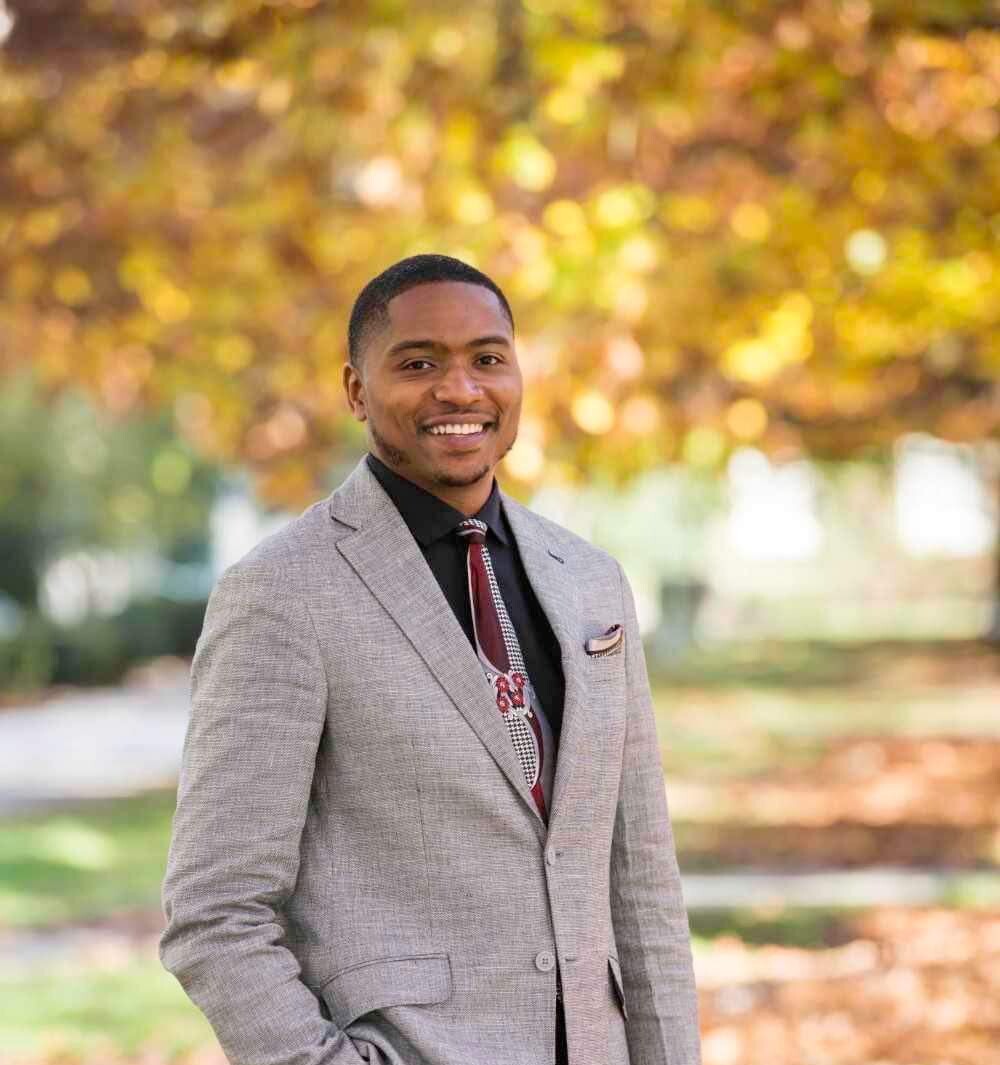
When Cory Hunter was an undergraduate at the Eastman School of Music, he remembers seeing hardly any faculty of color and having no classes with professors of color himself. Two decades later, when he received an offer to return to the University, Hunter was given the opportunity to become the kind of professor he once rarely saw.
Now, with a dual appointment as Associate Professor of Music in the Arthur Satz Department of Music and Associate Professor of Musicology at Eastman, Hunter has received tenure, marking a new chapter in a career shaped by gospel music, scholarship, ministry, and teaching.
Hunter grew up in a Black church singing gospel music, which he described as something “near and dear” to him. His passion for voice led him to the Eastman School of Music, where he received his Bachelor of Music in Vocal Performance in 2006. Hunter later answered a call to ministry, studying at Yale Divinity School and the Yale Institute of Sacred Music before becoming an ordained minister.
It was at Yale that Hunter began seriously considering pursuing a Ph.D., and noticed a gap between the gospel music he had known throughout his life and its presence in academic scholarship. He went on to pursue his Doctorate in Musicology at Princeton University, where gospel music became a focus of his scholarship.
Since gospel music had been such an instrumental part of his upbringing, Hunter saw an opportunity to contribute to its study.
“This is an area where I can make a contribution,” Hunter said. “I’ve grown up listening to this music, and I can make an impact.”
A central goal of Hunter’s scholarship is demonstrating that gospel music is worthy of the same rigorous intellectual inquiry that is applied to other musical traditions. He described himself as a kind of “middleman” who could help translate the depth of gospel music into academic discourse.
After receiving his Ph.D. in 2016, Hunter held postdoctoral fellowships at the University of Virginia and Brandeis University before returning to Rochester as a postdoctoral fellow at the Frederick Douglass Institute for African and African American Studies. In 2019, he moved into his dual-appointment tenure-track faculty position in the Arthur Satz Department of Music.
Looking back on his time as a student at Eastman, “It’s good to be back. It’s a familiar place,” Hunter said.
When asked about his current experience as a professor at Rochester, Hunter immediately broke into a smile.
“I’m not trying to flatter you, but [URochester] students are by far the best I’ve ever taught,” he said.
Returning to Rochester also gave Hunter an opportunity to give back to a community that had shaped him. Having experienced a lack of faculty representation himself as an Eastman student, Hunter recognized what his presence could mean for students of color.
“I knew I could be present and visible for students of color coming along,” Hunter said.
That sense of purpose extends into the classroom. Hunter approaches music in an intersectional way, encouraging students to consider not only how music sounds, but what it can reveal about race, gender, sexuality, class, and the social and political environments in which it is created.
“Students come to my class not realizing you can analyze music from a social [and] political, race [and] class perspective,” Hunter said. “I teach in an intersectional manner.”
His scholarship directly informs that approach. In studying genres such as gospel and blues, Hunter considers questions ranging from Black women’s agency to expressions of gender and sexuality within music. For Hunter, these questions allow students to look beyond the notes themselves and examine the cultural forces surrounding them.
“That’s how my scholarship and my teaching overlap,” he said.
And for Hunter, the reward comes when that way of thinking begins to resonate with a student.
“The reward I get from teaching is when I see that lightbulb moment,” Hunter said, “and see that I have impacted how a student thinks about a particular issue.”
After years spent working toward tenure, Hunter described reaching the milestone as both fulfilling and a relief.
“You work for decades to get to this point,” Hunter said. “It lets you know personally and professionally that your colleagues value the work you’ve done.”
For Hunter, that recognition goes beyond his scholarship. He said receiving tenure reassured him that his colleagues value his teaching, his presence in the department, and the changes he has helped bring about during his time at URochester.
Professionally, tenure also lifts some of the pressure that comes with working toward the milestone.
“You don’t have that time clock on you breathing down your neck,” Hunter said. “I can just breathe a little bit.”
That breathing room has given Hunter an opportunity to consider not only what he wants to accomplish next, but how he wants to spend his time as a scholar. Rather than constantly working toward the demands of tenure, he can now think more deliberately about how he wants to prioritize teaching, research, ministry, and other parts of his life.
“It’s more about what I want to do than what the institution wants me to do,” Hunter said.
For Hunter, that freedom is especially meaningful because academia represents only one part of his life. Alongside his work as a professor and scholar, Hunter is a minister and musician — roles that have continued to intersect throughout his career.
“Honestly, when you’re pre-tenure, there’s not much of a balance,” Hunter said.
Working toward tenure taught him to become intentional about saying no, even when doing so meant disappointing people in either academia or his church community. Rather than trying to pursue everything at once, Hunter said he has learned to prioritize different parts of his life during different seasons.
Although he has not had as much time for performance in recent years, music remains part of his daily life. He continues to vocalize and has begun devoting more attention to playing piano by ear. He also continues to preach, bringing the skills and knowledge he has developed as a scholar into his ministry.
For Hunter, academia and ministry are not separate pursuits. His research informs his teaching and preaching, while his upbringing in the Black church and lifelong relationship with gospel music continue to shape the questions he explores as a scholar.
“Being an academic and a minister go very, very well together, actually,” Hunter said.
With the tenure process behind him, Hunter is already thinking about what he wants to do with that newfound freedom.
He has been using his time to work on his current project called “Spiritual Realness in Black Gospel Music Discourse and Practice,” which, according to his university biography, provides “a theoretical framework for studying how Black gospel artists construct realness.”
Alongside this endeavor, Hunter hopes to develop new courses that would give URochester students additional ways to explore music within its cultural and social contexts. Among the possibilities he is considering are courses on hip-hop, jazz, and blues — ideas he said he had little time to develop while meeting the demands of tenure.
Beyond the classroom, Hunter is already considering publishing a second book centered on race and gospel music, continuing the scholarly work that began with the music he grew up hearing in the Black church.
For Hunter, then, tenure represents less of an endpoint than an opportunity to decide what comes next. After years spent balancing the expectations of academia with teaching, ministry, and music, he now has more freedom to determine how those parts of his life fit together — and where they might take him next.