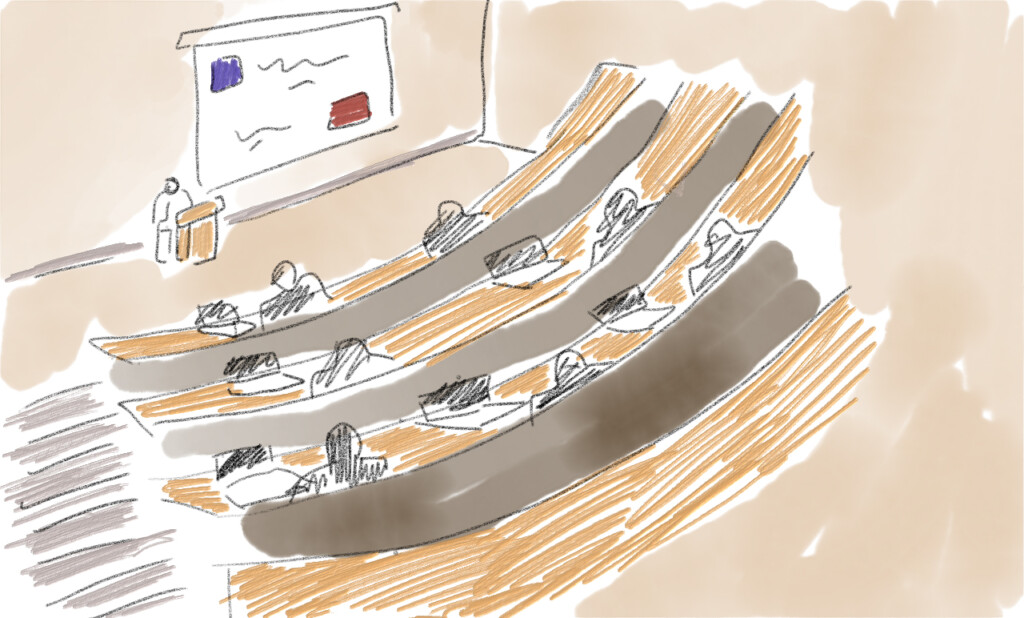
There are many different approaches to how to give a lecture: between slides with words, slides with photos, a combination, or neither, every professor has their own way of teaching. I am in a double degree program with American Sign Language (ASL) and Brain and Cognitive Sciences (BCS), and I have experienced a variety of lectures. My BCS classes primarily use images and diagrams, supplemented by explanatory captions, and I feel like this style is the one that works for me. I know some of my friends in the BCS degree program dislike this and prefer slides to explain themselves more explicitly in words, using less images, and others are the opposite; solely wanting photos and very few words. The appeal of both sides is understandable.
Images are certainly useful in the moment, but they very easily become a tool only for the professor’s verbal lecture: without sufficient explanation on the slides themselves, those who missed the verbal explanation will be left in a poor position to understand the material later on. Each student is different and approaches learning in their own way, and likewise professors have their own personal preferred teaching methods, but ultimately I think that, for the sake of review and studying, it is better for slides to only use images and diagrams that can be clearly explained within the slides themselves.
ASL is different though, because the majority of photos are a demonstration of vocabulary, used as a representation of the meaning of the sign we’re learning based on the surface-level interpretation of the image. That makes the most sense for a signed language class, because you can point at the photo and sign it to the class, and they can respond with the appropriate sign or sign sequence. I don’t know many schools with a BCS program, but I know that ASL programs differ significantly between schools. When I was doing my college applications, I was looking at the interpreting program at the University of Northern Colorado. I thought that’s what I wanted to do, but I wasn’t able to find classes I liked and their whole undergraduate program, for any major, wasn’t what I was looking for. The interpreting program was cool, but most of their language classes were taught by hearing professors, and all of their other, non-language classes were taught by hearing professors as well.
At URochester, on the other hand, all of the language, linguistics, and history classes related to ASL are taught by deaf professors. There are a few classes that are cross listed, and taught by hearing professors, but these classes do not represent the primary experience in the department.
Our neighbors at Rochester Institute of Technology (RIT) share their campus with the National Technical Institute for the Deaf (NTID), and so make even greater efforts towards the use of ASL in education, not just within the ASL and interpreting-related programs, but across degree programs that a wide variety of deaf students participate in. I don’t know much about these programs, but from what my ASL professors have said about the RIT program, it is primarily deaf professors for all their degrees within the NTID school.
With all of this being said, I know a bunch of people enjoy their professors and how they teach, as well as some people who dislike the teaching style of their majors. URochester offers so many amazing and unique programs, as well as different tracks that the students can divulge into.
Which major is the right one for you?