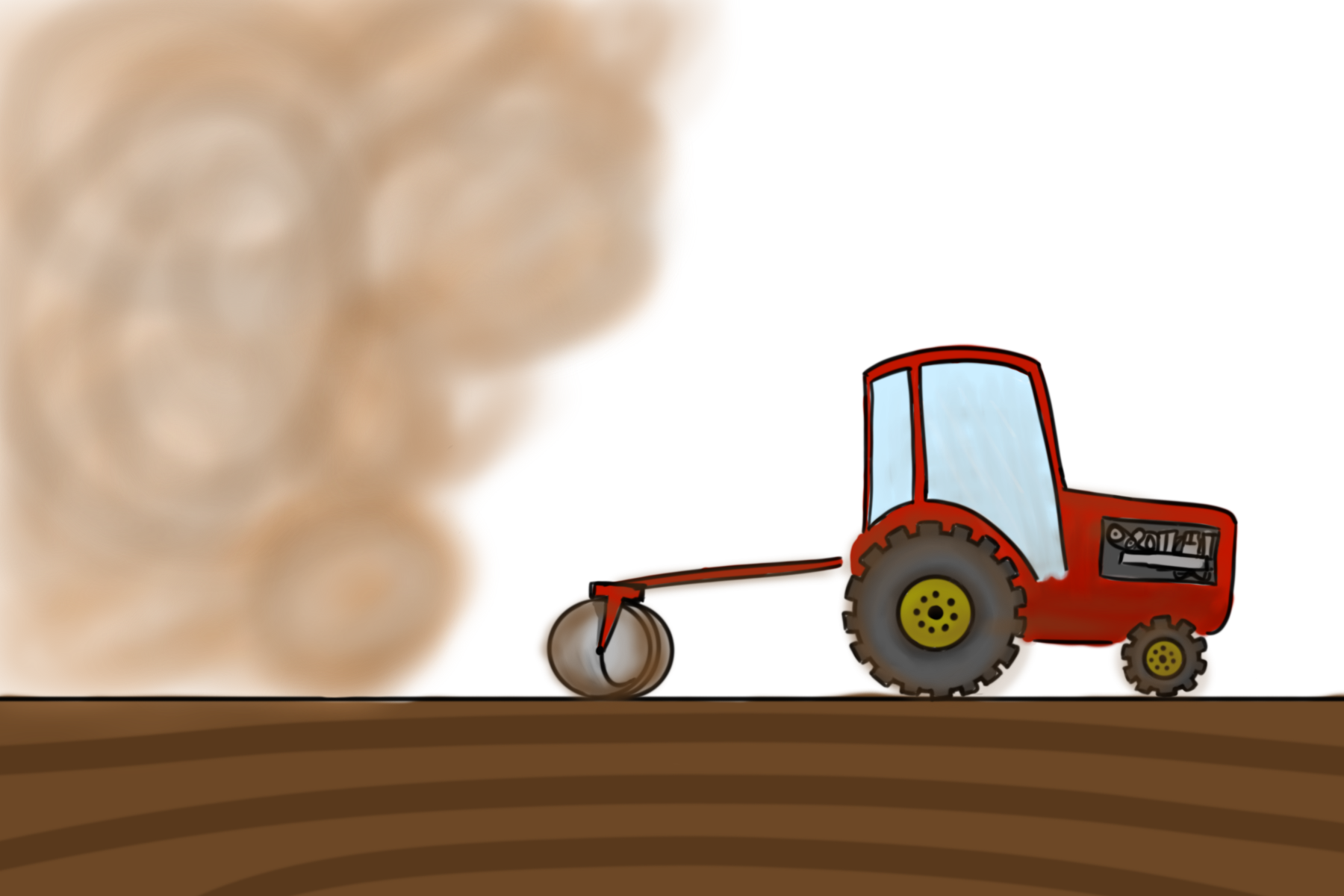
We teach the Dust Bowl as a cautionary tale. In every American history class, we learn how farmers in the 1920s and 1930s tore up millions of acres of native grassland across the Great Plains to plant wheat, how the deep-rooted prairie grasses that held the soil and trapped moisture were replaced by shallow crops and bare fields, and, when drought came in 1930, how the exposed topsoil turned to dust. Black blizzards rolled across the country, darkening skies from Texas to Washington, D.C. Crops failed. Families fled. Congress responded by creating the Soil Conservation Service in 1935, which established effective soil management laws and regulations and we moved on. Lesson learned. Except we did not learn it.
The Midwest has lost approximately 57.6 billion metric tons of topsoil since large-scale farming began roughly 160 years ago. That figure comes from a series of studies led by geoscientists at the University of Massachusetts Amherst (UMasss), published in the journal Earth’s Future. They found that Midwestern topsoil is eroding at an average rate of about two millimeters per year, which nearly doubles what the U.S. Department of Agriculture (USDA) considers sustainable. The USDA’s own erosion estimates are between three and eight times lower than what the researchers measured. This is happening despite the conservation programs we put in place after the Dust Bowl.
The major driver of erosion would normally be wind or drought, but similar to the Dust Bowl, the main driver of erosion for farmland is tillage (plowing). When farmers drag plows through fields, they move topsoil from high ground into low ground, flattening the landscape and exposing soil to the elements. The USDA does not explicitly include tillage erosion in its models, which means the agency has been drastically underestimating how fast we are losing the ground beneath our food crops. In their most recent work, the UMass team showed that Midwestern soil is eroding between 10 and 1,000 times faster than it did before agriculture began. The rate that the USDA considers the upper limit of sustainability is, on average, 25 times higher than what is actually sustainable.
Generating just three centimeters of topsoil takes about a thousand years. We are burning through it in decades.
But soil is only half of the problem. Beneath the Great Plains sits the Ogallala Aquifer, one of the largest freshwater reserves in the world, stretching from South Dakota to the Texas Panhandle across eight states. It supports roughly 30% of all U.S. crop and livestock production and provides drinking water to 82% of the people living above it. It is also disappearing. In Kansas, about 30% of the aquifer has already hit what researchers call “Day Zero,” the point where wells run dry. The Texas Water Plan projects the Ogallala’s water levels will drop by 52% before 2060. Scientists estimate it would, at this point, take natural processes around 6,000 years to refill.
Sadly, and maybe ironically, this is not caused solely by climate change. Research published through the American Bar Association shows that federal farm subsidies and the tax code create a cycle of overproduction that intensifies water use. Irrigation accounts for roughly 90% of all Ogallala withdrawals. Farmers are not draining the aquifer because they need to; they are draining it because the system pays them to.
Now add climate. The ongoing megadrought affecting the western United States and Mexico has persisted for more than two decades and is likely the most severe in 1,200 years, according to the Organisation for Economic Co-operation and Development’s 2025 Global Drought Outlook. Climate change has intensified it by an estimated 42%. Warmer temperatures increase evaporation, dry out soil faster, and make periods of low rainfall far more destructive. The U.S. Environmental Protection Agency notes that more severe drought and heat stress threaten crop yields across the country, and that the frequency and severity of these events are expected to grow. The same land that blew away in the 1930s is drying out again, only this time, the water table beneath it is vanishing too.
The Dust Bowl happened because we stripped the land, ignored the science, and assumed the good years would last. Today, we are depleting topsoil at rates the USDA itself underestimates. We are draining an aquifer that cannot refill on any human timescale and watching drought cycles intensify over the same geography. The ingredients are the same. The scale is larger.
We have solutions. No-till farming, already practiced on about 40% of Midwestern cropland, can dramatically slow erosion. The UMass researchers found that full adoption of no-till methods would extend current soil fertility for centuries, compared to a single century of continued loss under current practices. Cover crops, crop rotation, and smarter water policy can reduce both soil loss and aquifer strain. But none of this happens without pressure. Congress needs to reform agricultural subsidies so they reward conservation instead of overproduction. States need to coordinate groundwater management across the Ogallala region instead of letting each jurisdiction drain independently. The USDA needs to update its erosion models to include tillage.
We cannot keep teaching the Dust Bowl as history while repeating it as policy. The soil is thinner, the water is lower, and the climate is less forgiving than it was a century ago. If we do not change course, we will not need a textbook to study the next Dust Bowl.