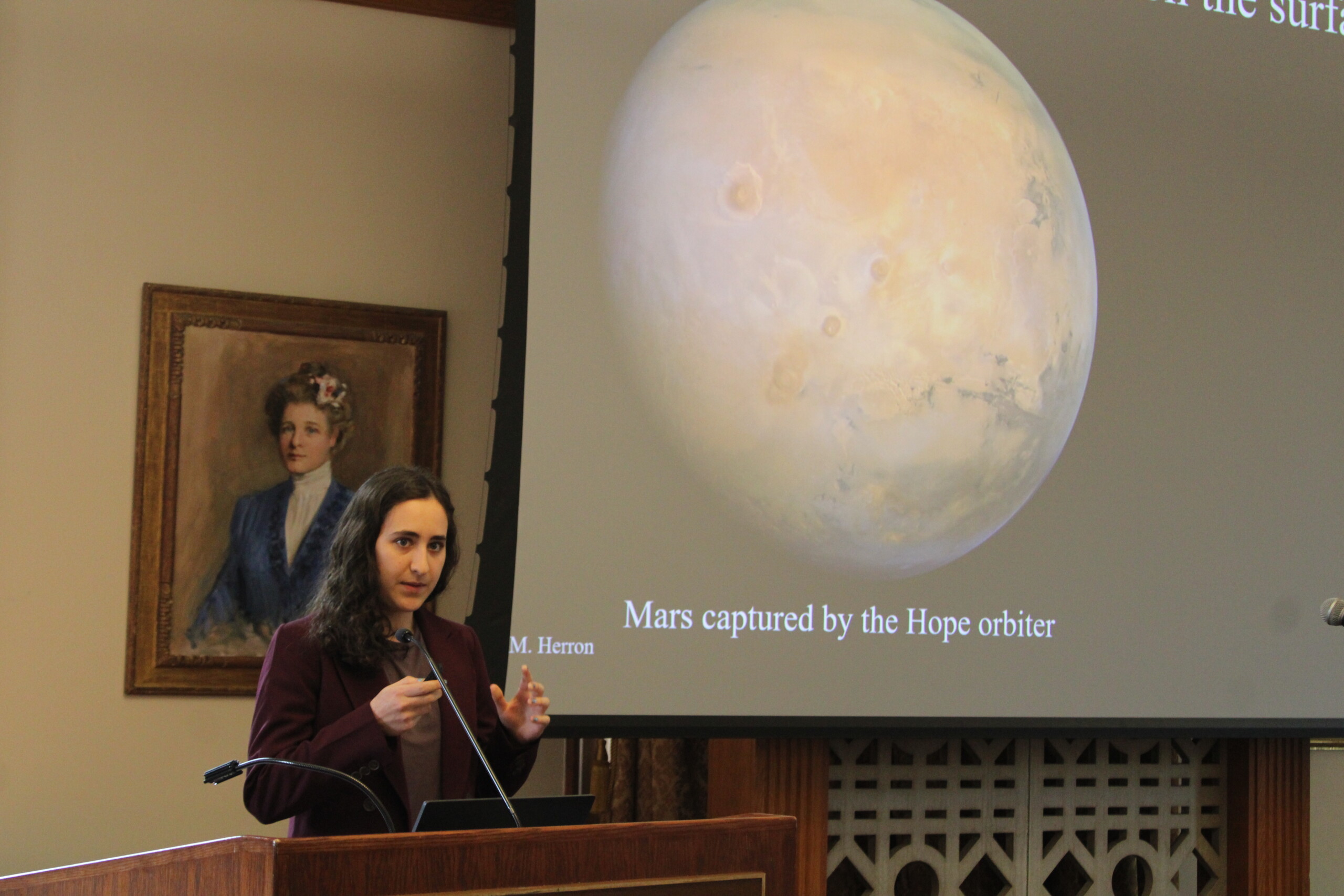
As the academic year winds down, undergraduate researchers at the University are presenting the results of months of work during Celebrating Research Week (CRW). Kicking off with the Research Poster Expo on April 10, the week featured events including Lightning Talks and the Research Symposium, where students presented projects across disciplines with peers, faculty, and the broader community.
Among them was senior psychology major Naima Petersen, whose honors project examines how romantic relationships shape — and are shaped by — the way couples interact with their pets.
Petersen described how she became interested in this research project after encountering a student who opted to adopt a dog with his partner.
“He was a grad student who was getting married, and his wife wanted a dog and he has an avoidant/anxious attachment style,” Petersen remarked. “He thought the dog would make it worse for their relationship. He was proven wrong.”
She examined how people with avoidant attachment styles, who tend to feel uncomfortable with emotional intimacy, and anxious attachment styles, who often fear losing their relationships, experience different levels of satisfaction with their partners and their dogs. She found that insecure attachment styles were linked to lower satisfaction with both. Additionally, those who reported higher satisfaction with their partners reported greater satisfaction with their dogs. She plans to continue this research later this year.
While it is unknown whether adopting a pet can lead to romantic relationships, Peterson suggested that those who are satisfied spending time with their pets can develop a similar dynamic with their partners. “It helps you be more palpable talking about things that are more personal,” she said.
Senior Maya Glasman, a Psychology and Brain and Cognitive Science major, took on a project that explored human behavior. This undertaking was a capstone project for her Research Methods in Psychology course with Professors Karl Rosengren and Daniel Mruzek, where she learned how to design her own research project. Students, including Glasman, were assigned different organizations to work on the project with, and hers centered on the impacts of a nature-based learning curriculum for elementary school-aged children in Rochester.
Glasman worked with groups of fourth and fifth grade students at Anna Murray-Douglass Academy No. 12, a local Rochester public school. Due to this school’s large population of students whose first language is Spanish, she worked with bilingual students. She observed the students taking part in the activities that were centered on nature in 90-minute sessions; the first 20 minutes were spent inside a nature center, with nature-themed activities and live animal exhibits, while the remaining 70 minutes were spent outdoors. To measure the students’ levels of engagement in these nature-based activities, the students filled out short questionnaires with questions that asked them how much they learned from the activities, plus general math or science-related questions. Teachers were given their own surveys, on which they recorded their own observations on the students’ engagement with the activities.
Shifting from psychology to public health, Senior Hana Zhang, a Health Policy major, explored the effects of and preventative care for lead poisoning in Rochester, which has been a prevalent public health issue. Despite the improvements in housing infrastructure to prevent this illness, Zhang notes that lead poisoning still occurs today.
“Rochester has done a better job of preventing [lead] exposure, but we want to learn more about how we can help these caregivers once [their dependents] are diagnosed and how to provide that support,” she said.
Zhang interviewed families in Rochester with members who have confirmed high blood lead levels, specifically asking caregivers how well the healthcare system supported them and if they had access to care. It was then determined that caregivers felt respected when their needs were valued by healthcare providers and organizations and that they were willing to support caregivers in treating their children’s illness.
“Caregivers felt more empowered when they had shared decision-making. It’s not just about policies or protocols, it’s about people. And we need better care for not only [patients, but also] the parents, so they can provide better care for the kids,” Zhang illustrated.
For Zhang, taking on this research project enabled her to empathize with and fully understand the lives of underprivileged citizens as a healthcare worker. “I never had to worry about what was in my pipes of water. I never had to worry about what water I was drinking or what was in my home,” she said. “It really does make you think of privilege and it helps you empathize with people who aren’t as privileged.”
Junior Miriam Herron, a Geoscience major, undertook a project based on astrobiology, a subject she has not explored before. As part of an internship with Carnegie Science in Washington, D.C., this research project seeks to determine the sources from outside Earth, such as from meteorites and meteorite impacts. The interns examined samples of a meteorite that formed a crater in Sudbury, Canada, and determined whether the type of carbon was able to support life forms outside Earth. They performed Raman spectroscopy, which is when the structure and properties of the material are determined by emitting beams of blue light onto the sample; the data is visualized as peaks on a chart and the material of the substance can be determined based on the size of the peak.
Herron and her colleagues then determined that the type of carbon which this sample was made from could potentially support life forms, but the origin of these life forms are yet to be concluded. “Temperature and pressure conditions surrounding impact can lead to carbon formation…and that could produce a habitable environment,” Herron remarked. “There was probably more than one origin for the carbon. And so, it could have been life and meteorite transport or abiotic [originating from non-living things] formation. There’s a lot going on at Sudbury and multiple origins for carbon and just a lot of interesting things to dig into.”
For Herron, the main highlight of taking on this project was being able to apply her knowledge of the different sciences to explore this new topic.
“It was cool being able to connect to the geology of the rocks that I was looking at with life or chemistry,” she said. “The reason I like geoscience is because it combines all of these other sciences like physics, chemistry, biology, and just, like, everything.”
Through projects spanning psychology, public health, and the natural sciences, students participating in Celebrating Research Week demonstrated how undergraduate research can inform their academic development and future career goals. These projects gave students the opportunity to immerse themselves in fields and ideas that interest them, and to share those discoveries with an audience of their peers.