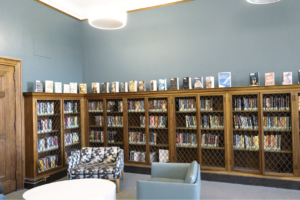
Edward G. Miner Library, located on the first floor of URMC, serves as the medical center’s main academic health sciences library, with patrons including patients, staff, students, and faculty. Established in 1925 as part of URMC, Miner Library was built originally in the middle of the medical center to symbolize unity, bringing together the clinical and educational missions of the institution.
The History of Medicine section in Miner Library boasts an extensive collection of manuscripts and books in the medical field. According to Head of History of Medicine, Anna Smith, “We have books that date back to the 1480s … and then we have faculty papers from Med Center faculty dating back to 1925, when the Med School started.”
The History of Medicine section has other material as well, such as archival material for nearby hospitals and other material related to the history of the area connected to medicine, nursing, or dentistry.
For URMC’s 100th anniversary, the Miner Library’s History of Medicine section is putting different parts of URMC’s history on display with its current exhibit — “A Century of Research and Education Innovation” — and two future exhibits: one about Strong Memorial Hospital and another exploring the student experience at URMC.
Describing the exhibit, Centennial Archivist and UR alumna Katelyn Gibson said, “This one here [the current exhibit] is basically research and education, so focusing on the School of Medicine and Dentistry and the School of Nursing, looking at some of the key milestones, sort of key individuals who helped shape and grow the institution.”
Gibson said that it was “a challenge” to put together the materials for the exhibit, since History of Medicine has so much material, and there were so many people who influenced URMC. The curation involved selecting significant past events for URMC “that shaped what we do. Things like winning Nobel prizes, things like key research initiatives, things like that that really bring in people, get people excited about research.”
The exhibit’s offerings are varied. A small selection of the material on display include photographs of founding faculty of URMC, a nurse’s cap from the 1920s, and documentation about the impact of World War II on URMC.
One of Gibson’s favorite items, though, dating to 1948, is a pair of film strips. One of the strips shows a photograph of a woman drinking, while the other is an x-ray of her. The History of Medicine has turned this item into a bookmark as well.
There’s plenty more to see at the exhibit, which is located in the History of Medicine’s space within Miner Library — which is open from 10 a.m. – 4 p.m., Mon. – Fri.
The History of Medicine section is helping celebrate the centennial with more than just its exhibits, though, having provided material for other departments. They also provided photographs for the atrium of the Miner Library too, according to Smith. “Pretty good chance if there’s a black and white photo around, it’s … probably from us,” Gibson said.
Gibson also said, discussing the importance of History of Medicine, that “we’ve gotten a lot of people just sort of coming and being like, ‘Do we even have pictures of what this looked like in the 1920s and what this looked like in the 1950s?’ and ‘When did my department start?’” She emphasized the value of people and a space that can provide this information.
Gibson has assembled what she calls a “research guide” for anyone interested in centennial research. “Here’s a bunch of cool faculty collections, … here’s a lot of the publications we have, here’s how to contact us if you want to learn about your department’s history, want to learn about any aspects of the institution’s history,” she explained.
The whole of Miner Library had its own Centennial event too — a birthday party in October.
“It was very festive and celebratory,” Associate Dean of Miner Libraries, Jennifer Raynor reminisced. “I’m very proud of the team here at Miner Library and proud of the history of the Medical Center, … in celebrating a hundred years. It’s a big milestone and there is much to celebrate. Many, many innovations happened here and we continue to support the discovery of new science.”