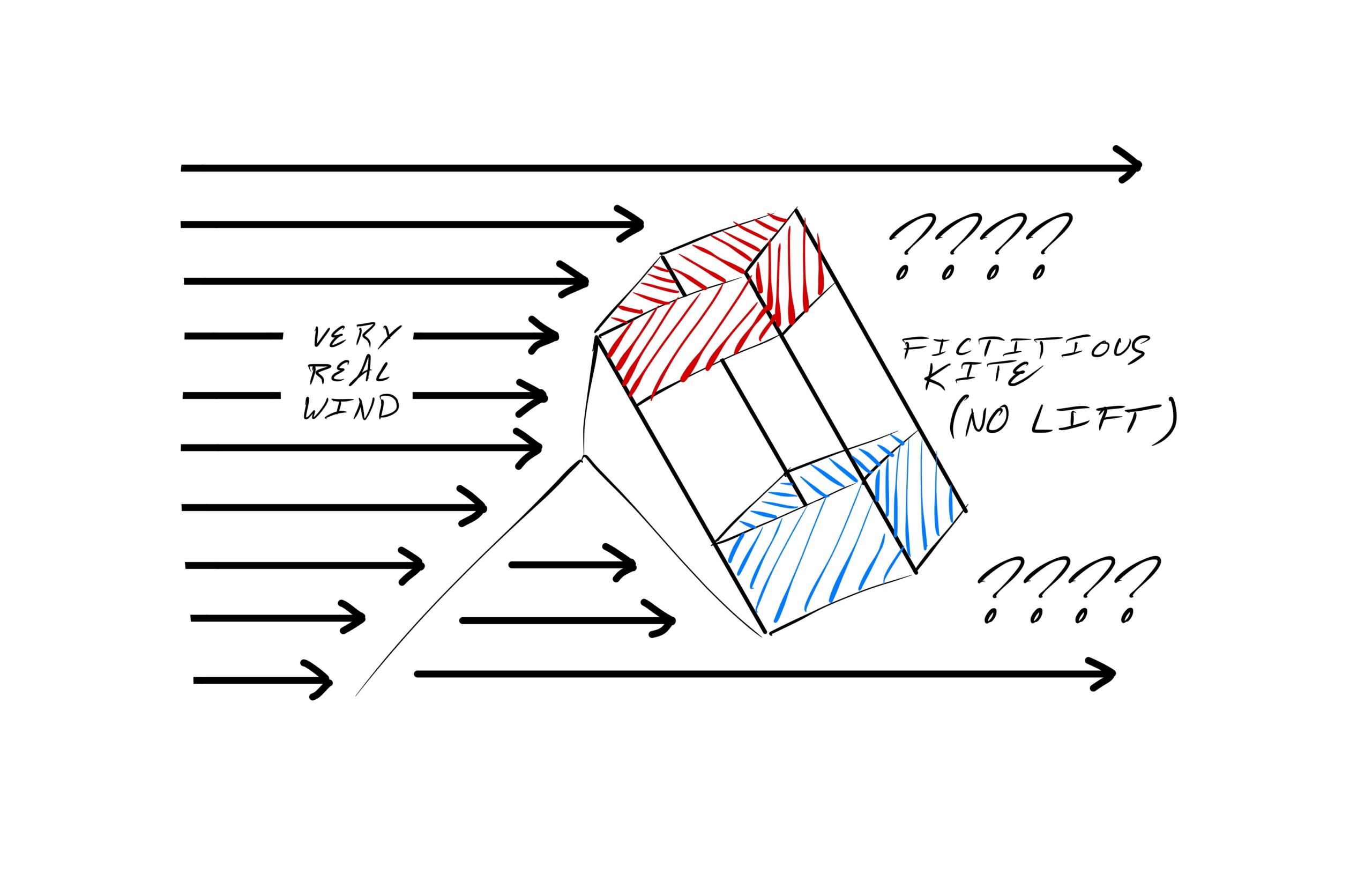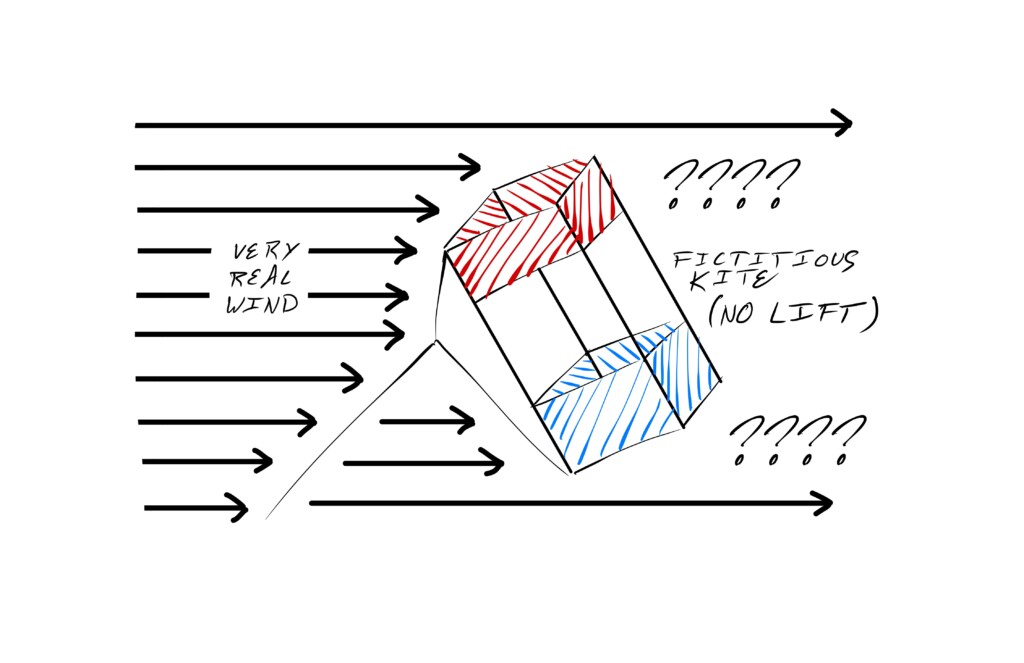
Imagine, if you will, a strange object sitting still in the sky. No wings, no engines, no sound. Just a single fabric-covered frame, floating in the sky, mocking the laws of physics. It’s not a bird, not a plane even, but a box kite, challenging everything you thought you knew about flight. As you gaze upward, you’re forced to confront a burning question: how does it stay aloft? Welcome, dear reader, to a dimension where logic bends, equations fail, Bernoulli rolls in his grave, and the impossible dances on the breeze. You’ve just entered… the Box Kite Zone.
Have you ever seen a box kite? Box is a bit of a misnomer, as the “boxes” in question are just rings of fabric stretched over a square frame: A box without the top or bottom. This is a form of kite that can allegedly fly. Apparently it has distinct advantages over other flavors of kite, such as being simple, strong, stable, and efficient. But I’m looking at this alien skeleton of an aircraft, which clearly does not have any form of wing whatsoever and all I can wonder is how it can stay in the air.
I googled it and the brilliantly useless AI generated primary result blessed me with the following wisdom: “Box kites fly by using the wind to create lift, which overcomes the force of gravity.” Thank you AI. Very cool. I never would have thought something that flies, by definition, has a lift component.
The second result, from an actual website, was slightly less useless: “When wind, or air, moves around the kite’s structure it causes a difference of air pressure!” The phrase “difference in air pressure” sounds suspiciously like a wing, otherwise known as the thing that box kites clearly do not possess! So what in the blackmagic antigravity sorcery is going on here?
To answer this question, I cornered my mechanical engineering major roommate the second he emerged from his room. He was not at all surprised by my confusion (although seemed concerned by my bloodshot eyes and recent sleeping habits), citing how the Bernoulli equation (the equation that’s supposed to explain exactly how planes and kites and whatnot fly) is only just a theory and does not do a great job at explaining exactly how planes and kites and whatnot fly.
Circling back to my initial question regarding the specifics of the lift generated by a box kite, the official answer is that the box kite as a whole somehow functions as a wing, but that sounds like a coping mechanism for the systemic failings of aerospace engineering. I believe the real answer to be somewhere between “wind makes large stiff light fabric go up” and “?????????”