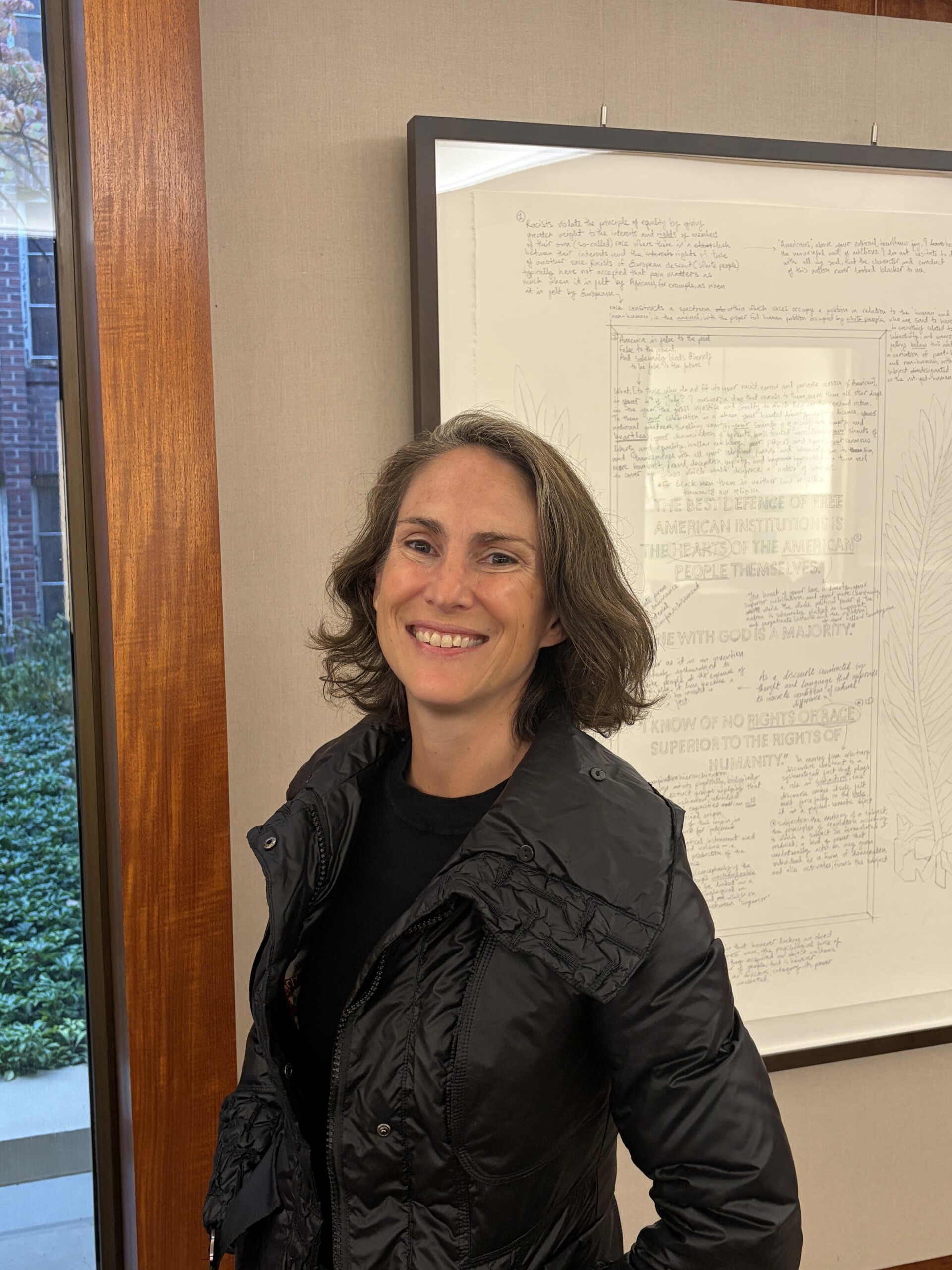
“Fiction is psychology in so many ways. Every character is a study.” – Lauren Acampora
Lauren Acampora, author of four books, the most recent of which — “The Animal Room” — was published in June of this year, came to URochester this past week for the Plutzik Reading Series. Before the reading, the English Creative Writing: Seminar in Fiction and I sat down with her to discuss her writing process, inspiration for this newest collection, and her unique and complex characters.
Acampora began her college career writing poetry but reading fiction, before switching to prose. She explained: “I was wondering why am I writing something I’m not reading — So I said I need to get over my fear of writing fiction. I started with short stories.” As she continued her writing career, she attended Brooklyn College’s MFA program, where she was surrounded by other writers.
Now, Acampora has published two novels and two short story collections, all featuring a linked narrative structure, where characters and perspectives overlap between the books. The characters from one book are viewed in the next from new perspectives, examining their interconnections and changes throughout time.
“The kaleidoscope of reality is captured really well in this format,” Acampora said. “If this person passes through many people’s viewpoints, then we may get a better sense into who they really are.”
Acampora’s first published collection, “The Wonder Garden,” began as a novel, which she ultimately scrapped. Instead, she decided to take “the original seed that gave the novel life” and turn it into the short story “The Wonder Bird,” which became the inspiration for the collection. The idea for “The Wonder Bird” came from a friend of hers whose father wanted to travel to Mongolia and become a shaman: “He was a regular, white-collar guy, who believed he had a gift.” From there, the linked format of her collection developed. Acampora said this change “freed” her up as she began to focus on individual characters from this original story, each with their own perspectives and experiences.
“Fiction is a long game. You need to know when to hold and when to fold them. Whatever gave you the spark, don’t let that go. Maybe the form isn’t right — If the spark is there, no one else can tell that story but you,” Acampora said. “Sometimes you need to put it away and then come back to it.”
When writing her stories, Acampora usually has some ending in mind, though oftentimes the story changes as she continues writing and editing. She claims she tends to veer towards “dramatic endings,” perhaps due to a self-proclaimed lack of patience, a desire for “a dramatic bang.” Or perhaps it is because of a “need to keep up” with the world. “I keep setting things on fire in my stories,” she said.
One story in particular, “Shelter,” from her most recent collection, finishes with a house fire, which threatens the haven the main character, Jeanne, has created. Acampora’s editor originally had an issue with the fire, saying “there were too many” in the book, so she tried to change it. “But I couldn’t, I didn’t want to — so instead, I just doubled down on it — so instead of getting rid of it, I [made] this book about fire,” Acampora said. “That is one thing that sets humans aside from animals. We set things on fire. We destroy things — animals aren’t like that.”
Her new collection, “The Animal Room,” came out earlier this year and explores the complex relationships between animals and humans, asking what truly differentiates us, where the lines blur, and how location and community factor into world view. For this collection, Acampora did extensive research into subjects such as K9 police units, fish tank maintenance, and TripAdvisor reports on safaris.
“I learn so much about the world through research,” she said. “I realize I know nothing about what is going on in the world, and I want to write about it.”
Often her research mixes with her lived experiences, such as in the case of “Shelter” and “Pack.” The original seed for “Shelter” came from her family’s experience attempting to adopt a dog, during which the foster owners denied their request. “Pack” features details Acampora learned from a police dog demonstration as well as extensive research into the breeding and training for K9 units.
“The Animal Room” takes place in the suburb of Old Cranbury, following the perspectives of the inhabitants. Acampora became fascinated with exploring the dynamics between neighbors within suburbs after moving to one herself from the city. She started questioning how older residents viewed transplants, how the property boundaries create distinct lines between people, yet a closeness that is inescapable.
“Just like in this first story, this transplant from the city comes to the suburbs and finds out her neighbor is bow hunting in her backyard and thinks the worst of him. And then we hear from him at the end of the book [with the message that] we are all more than one thing, layered. Writing these things about the suburbs specifically, we have property boundaries — there are rules and guidelines. Where we live we have a shared well, so we do all seep into each other’s lives metaphorically.”
Acampora plans to write more interconnected works, hoping to have a book which brings all her characters together. While the time and relationships may change, her characters will still feature the complexity and dynamics which she has come to be known for.
“My imagination will take a character I come across, often naturally, and think about what drives them,” Acampora said. “I take a piece of myself and put into their characters, so I sympathize with them, and hopefully also the reader does as well. All the characters are blind. Just like how we are blind.”