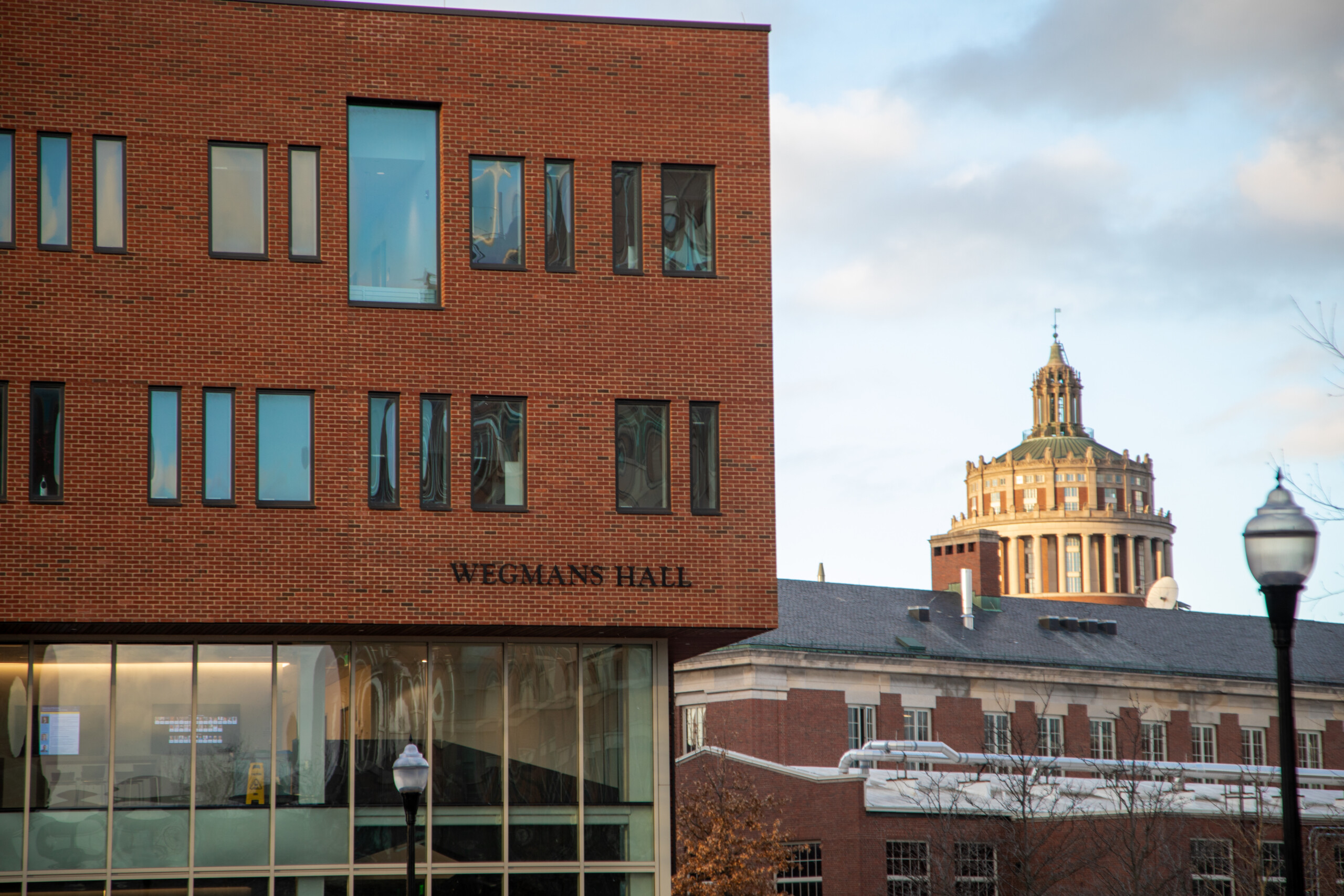
Sonia Mittal began her lecture on Wednesday evening in Wegmans Hall by sharing footage from Jan. 6, 2021. These videos — of crowds pressing past barricades and into the U.S. Capitol — have circulated widely over the past five years. For Mittal, however, these visuals are also her professional history. As a former Senior Counsel and Assistant United States Attorney for the District of Columbia, she helped prosecute cases arising from the attack.
Mittal drew on her experience at the Department of Justice, describing the scale of the Jan. 6 prosecutions, which involved nearly 1,600 criminal cases. While the events were widely characterized as an unprecedented attack on democratic institutions, the legal system approached them through existing statutory frameworks. Many defendants were charged with offenses such as trespassing or destruction of property, crimes that typically carry relatively short recommended sentences.
“There is no ‘attempted coup’ clause in the Constitution,” Mittal noted, emphasizing that courts are designed to apply established law rather than adjudicate political meaning. For her and her colleagues, the prosecutions required balancing urgency with procedural restraint — a tension she suggested is inherent to the rule of law.
Mittal, now a Clinical Lecturer in Law and Associate Research Scholar at Yale Law School, delivered this year’s Cutler Lecture, titled “An ER for the Rule of Law: Lawyering in an Era of Democratic Erosion.” Sponsored by the URochester Democracy Center and the Department of Political Science, the talk examined how legal institutions respond to moments of political strain — and what those responses reveal about the strengths and limits of courts in a constitutional democracy.
At Yale, Mittal co-directs the Peter Gruber Rule of Law Clinic, which engages in litigation and research related to constitutional governance. The clinic, she described, often operates in a rapid-response capacity, likening the long days of “cold dinners and missed bedtimes” to that of a shift at the emergency department. The team addresses cases that carry implications beyond the individuals directly involved, with the work feeling immediate and continuous.
Her federal involvement in the Jan. 6 prosecutions was one of the key reasons why Mittal joined the clinic as a co-instructor this past year. Since 2021, Mittal said, debates surrounding the cases have extended beyond the courtroom. She pointed to concerns about declining public trust in institutions, increased threats against judges, and broader questions about how criminal law is used in politically charged contexts. According to statistics shared during the lecture, reported threats against members of the judiciary have risen significantly in recent years.
Mittal framed these developments within a broader concept she studies: democratic erosion. Rather than describing democracy as something that fails suddenly, she characterized erosion as a gradual weakening of institutional norms, including expectations surrounding prosecutorial independence, judicial credibility, and the nonpartisan application of law.
Mittal acknowledged that courts are limited tools. Judges, she said, are typically cautious about expanding legal doctrines in response to political controversy. Criminal law, too, is a blunt instrument — one that can address specific violations but may not resolve deeper societal conflicts.
During her lecture, Mittal continuously returned to questions she encourages her students to ask when evaluating contemporary developments: “Is this normal? Is this something we could expect from a country with strong rule-of-law traditions? What do we do with this information?” These questions are designed to assess whether certain actions align with longstanding democratic and legal traditions, or whether they signal shifts in institutional practice. Identifying such changes, she suggested, can be challenging, particularly amid fast-moving news cycles.
Mittal’s experience working at Yale provided an additional dimension to the discussion. Mittal described her students as often feeling “overwhelmed and exhausted” by the pace and tone of political discourse. At the same time, she emphasized that institutions of higher education play a formative role in shaping future lawyers, policymakers, scholars, and citizens.
Universities, she suggested, are spaces where research, debate, and professional training intersect. In that capacity, they contribute to the development of legal norms and civic expectations that extend beyond campus. Mittal also noted her participation in a group of Senior Democracy Scholars, which includes URochester Political Science Professor Gretchen Helmke. The group aims to situate contemporary U.S. developments within comparative and international frameworks.
Rather than offering prescriptive solutions, Mittal concluded by emphasizing the long-term nature of institutional work. The rule of law, she suggested, is maintained not only through court decisions, but through sustained professional commitment and civic engagement across generations.
As Mittal concluded her lecture, the metaphor of the emergency room re-emerged — not as a declaration of crisis, but as a reminder that legal systems are designed to respond to acute challenges while remaining anchored in established procedures. For students in attendance, the evening provided an opportunity to consider how those systems function under strain, and how universities contribute to the ongoing study and practice of democratic governance.