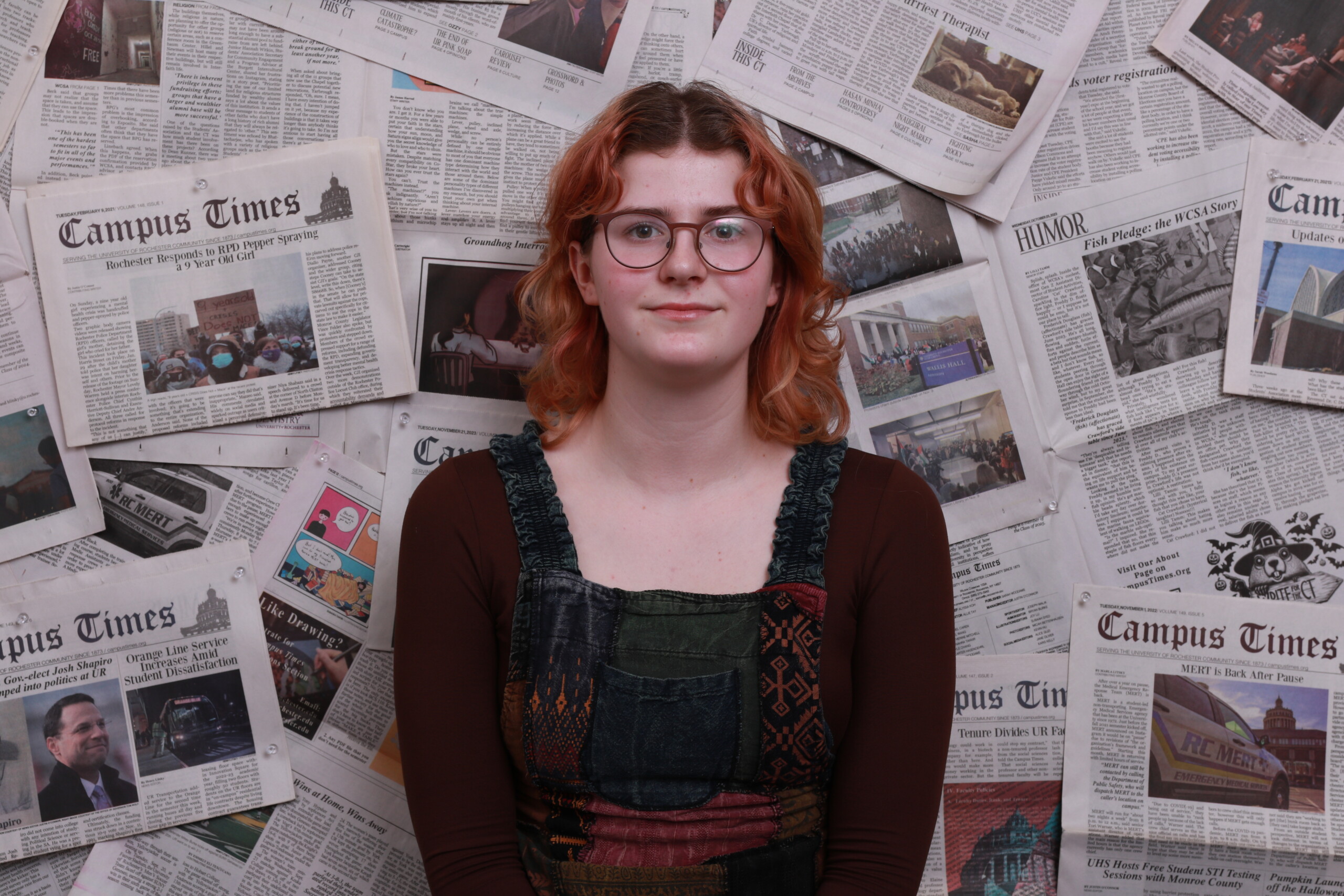
Dr. Erin Anderson will begin as the new William and Sheila Konar Director of the Center of Urban Education Success (CUES) Aug. 15. CUES is a program run by the Warner School of Education and Human Development, which focuses on educational development programs in schools in urban settings. Anderson has an extensive background in urban education research, leadership and leadership development, and K-12 practice, which makes her a fitting replacement for former Director Dr. Shaun Nelms.
Dean of the Warner School Melissa Sturge-Apple commented, “We were looking for someone who’s visionary and strategic, and kind of wants to think about what the next 10 years of CUES and urban education work and transformation looks like.”
Anderson’s research — which centers on leadership development and the systems-level changes needed to improve educational outcomes, especially in historically underserved communities — made her an especially attractive candidate.
“The biggest levers for change in schools are school and district leaders,” Anderson said. “I have been very interested in trying to understand how we prepare them to lead within the school system, in ways that will lead to the types of outcomes that we’re hoping for in schools.”
According to Anderson, the most essential aspects of improving education programs are knowing the needs of the school districts and the greater community and promoting equity.
Anderson described her approach to education as “very user-centered,” emphasizing that her first priority will be listening.
“When I arrive, the first thing that I will do is talk to as many people as possible and ask people what they want and what they feel like they need,” Anderson said, adding that she hopes to meet with faculty, district leaders, and community members early in the transition.
Nelms served as the chair for the committee searching for his successor. In chairing the committee, Nelms hoped to signal to the candidates that the University of Rochester would welcome and support the new Director. “[In] the interview process, we also included not just Warner faculty, but other faculty members throughout the university who are also engaged in community partnership and community-engaged work,” explained Nelms.
By ensuring that members of the committee come from varying academic backgrounds, serve different roles in the University, and will maybe help Anderson do her work, Nelms “wanted [the candidate] to understand that this work is not done in a silo, that you have partners across the university that will help to synergize and bring this work forward.”
Nelms worked closely with philanthropists William and Sheila Konar, whose support helped establish the center. Sheila Konar, who died in 2021, was “especially interested in literacy and helping provide resources for reading programs for Rochester area kids,” according to WXXI. “She wanted to help make sure that every child in Rochester not only had a great education but appreciated and loved reading.”
This passion manifested itself in a partnership between the University and East High School, which in the past decade has become a nationally recognized model for secondary school turnaround and sustained university engagement in urban education.
That relationship has already produced tangible results. “At one point, the graduation at East was 29%, and at its highest point, it was 86%,” Nelms said. The partnership between URochester and East High is officially over, but Nelms emphasized the importance of maintaining a working relationship with the city school district, “so that they can continue to explore and expand upon some of the work that we accomplished over those 10 years,” Nelms said.
Anderson plans to uphold the relationship between CUES and East, and to strengthen community-rooted partnerships. Anderson understands Rochester as a city willing to take on this complicated work. “I see Rochester as a place that really seeks to address our complex societal problems in important ways,” Anderson said. “I see that in the philanthropic world, and I see that in the school system.”
More than a dozen students from East High now sit enrolled on campus at the University of Rochester — a pipeline Nelms hopes will only grow. “I would love to see more students from the Rochester communities, you know, urban, rural, and suburban, who have a connection to the University of Rochester through our various programs to become full-time students here at the university,” Nelms said. “I think they have a unique perspective on life and education that will benefit all students here.” His vision extends beyond East, to any underfunded community that has yet to see itself reflected in University life. “These kids are excelling academically,” he said. “And what we’ve proven is that if you give the kids the right resources and the right structures and the right people, [those] kids can thrive in any environment.”