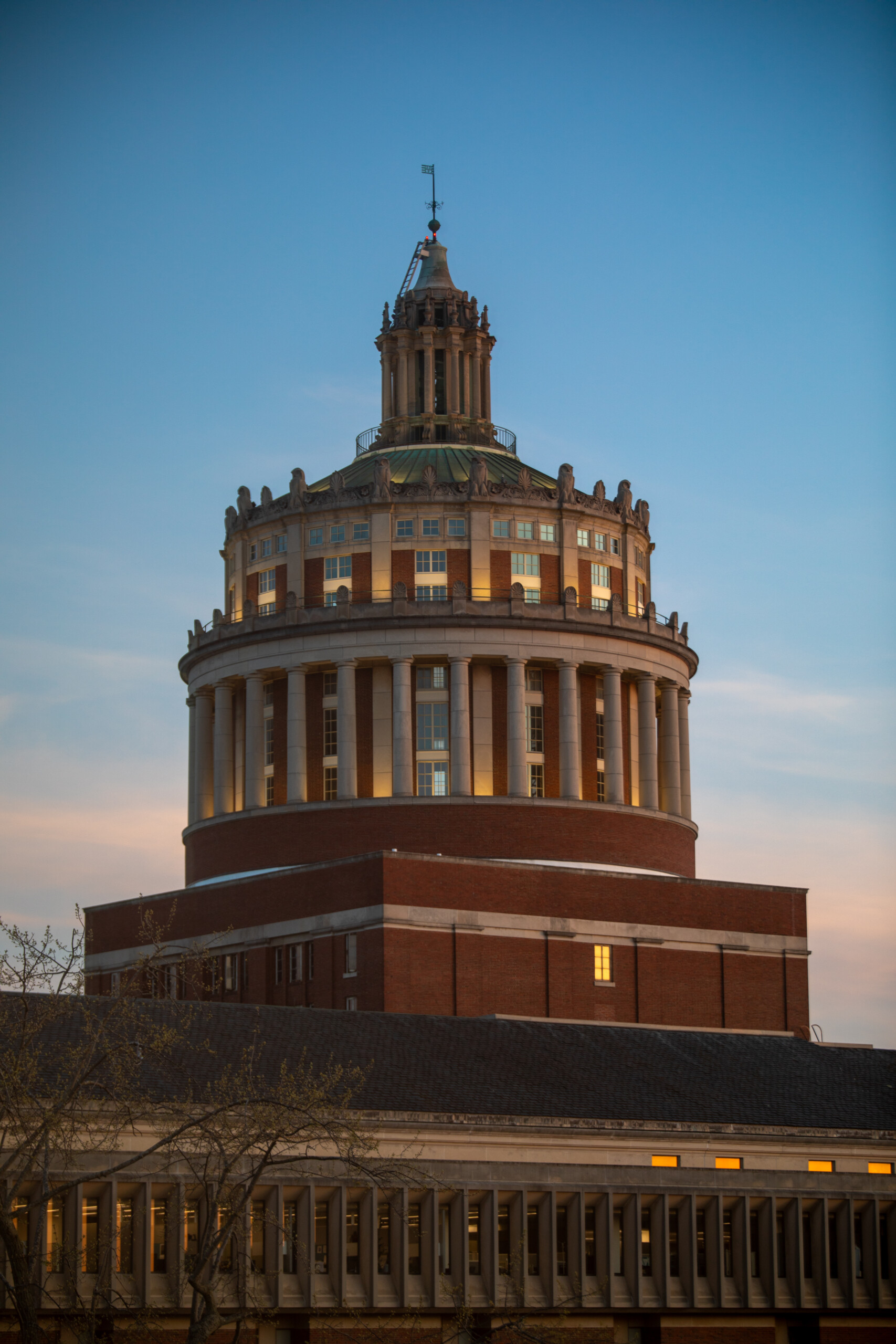
Since the onset of the World Wide Web and with the rise of artificial intelligence (AI), students have shifted from accessing information in-person through libraries and books towards reading and conducting research online. Yet for URochester’s incoming librarian Timothy McGeary, the growing demand for libraries as spaces for preservation, access, innovation, and collaboration proves they are far from obsolete.
When McGeary begins his tenure in March in the role of Andrew H. and Janet Dayton Neilly Dean of URochester Libraries, he will bring with him his experience of a career shaped by the changing role of libraries in a digital world. At Duke University, where he currently works, McGeary has helped oversee the systems and services that support teaching, research, and scholarship, for example, by digitally preserving data and developing new software.
Across leadership roles at Duke, the University of North Carolina at Chapel Hill, and Lehigh University, McGeary has emphasized collaboration and innovation in support of digital scholarship. Those priorities, he says, will continue to guide his approach as he steps into a leadership role at URochester.
As librarian and Neilly Dean, McGeary will serve as chief strategist and advocate for library services, from collections to digital infrastructure to research and academic partnerships. His role will also include strengthening the URochester Libraries’ visibility and engagement across campus and beyond.
For McGeary, doubts about the relevance of libraries in the digital age are nothing new. “This question is one that has likely been asked of libraries with every new major innovation over centuries,” McGeary said, citing historical shifts in how information is recorded and who controls its preservation.
Rather than seeing emerging technologies as threatening libraries, McGeary sees them as an opportunity to reflect on libraries’ enduring role and ability to adapt alongside change. He experienced this himself as an undergraduate in the early days of the internet, and he recalled widespread skepticism about whether libraries would remain necessary once information became accessible online. However, according to him, in the past 30 years, “libraries have continued to be in high demand.”
While the visible role of libraries has shifted, McGeary emphasized that librarians’ “less visible” work has also shifted. For example, librarians utilize machine learning to create search and recommendation systems, and they must license digital journals and databases in order for communities to access them. To McGeary, the modern academic library encompasses three ideas: people, place, and partnership. “The library as people, [librarians and staff,] is core to the mission of the university,” he said. “The library as a place is a central grounding for intellectual and collaborative life … and the library as a partner reflects the priorities of the university for research and scholarship.”
For students, McGeary hopes the library is more than a quiet place to study. He wants students to see it as a gateway to new ideas and as a space where asking for help is encouraged. “Asking the first question is the breakthrough to future success,” he said, noting that library staff are eager to help students navigate research challenges, unfamiliar tools, or emerging technologies.
McGeary also sees libraries playing a critical role in helping students navigate misinformation, information overload, and the growing presence of AI in academic work. “We have a responsibility to be a trusted authority,” he said. “We want students to learn skills and gain confidence as they work with information, how to test credibility, [and] use sources responsibly.”
That responsibility, he explained, extends across disciplines and reinforces the library’s place at the center of academic life.
Looking ahead to his new role, McGeary said what drew him to URochester was a shared commitment with the school to students and scholarship, as well as the vision of a unified library system. “The goal to develop one library for one university is something I believe in,” he said.
As he prepares to arrive on campus, McGeary said he is eager to learn more about both the culture in libraries and across the whole campus. “It warmed my heart to see how many students were in the library and how many different types of activities were happening,” he said. He also said he looks forward to exploring how the University and city collaborate to support the broader Rochester community.