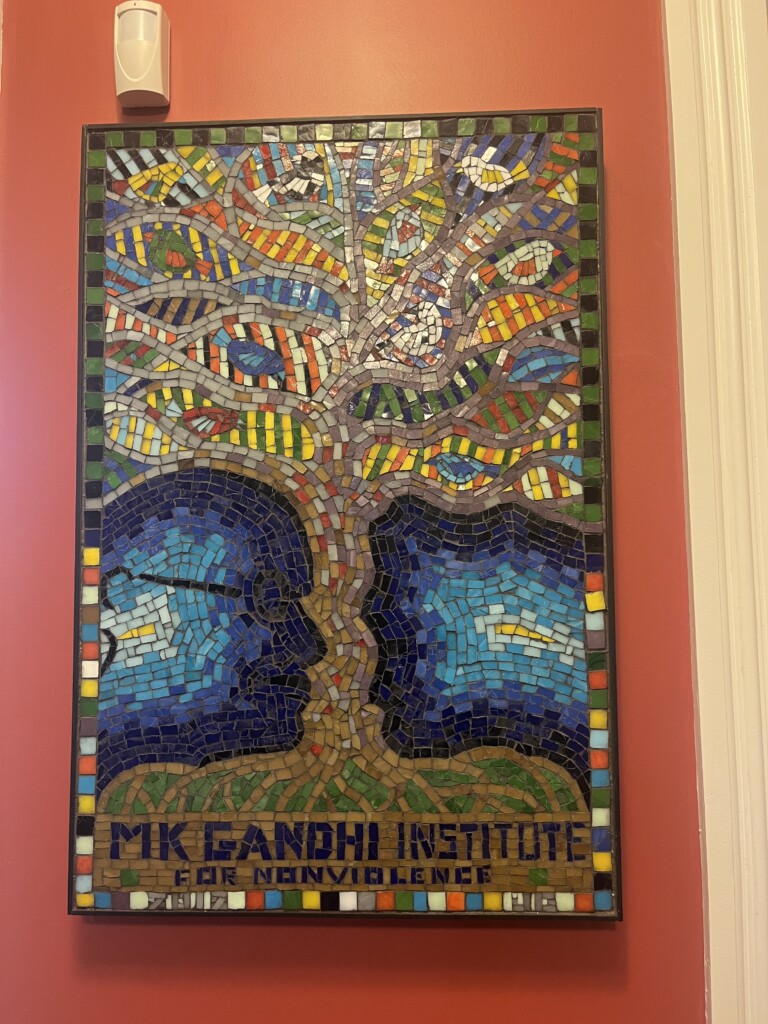
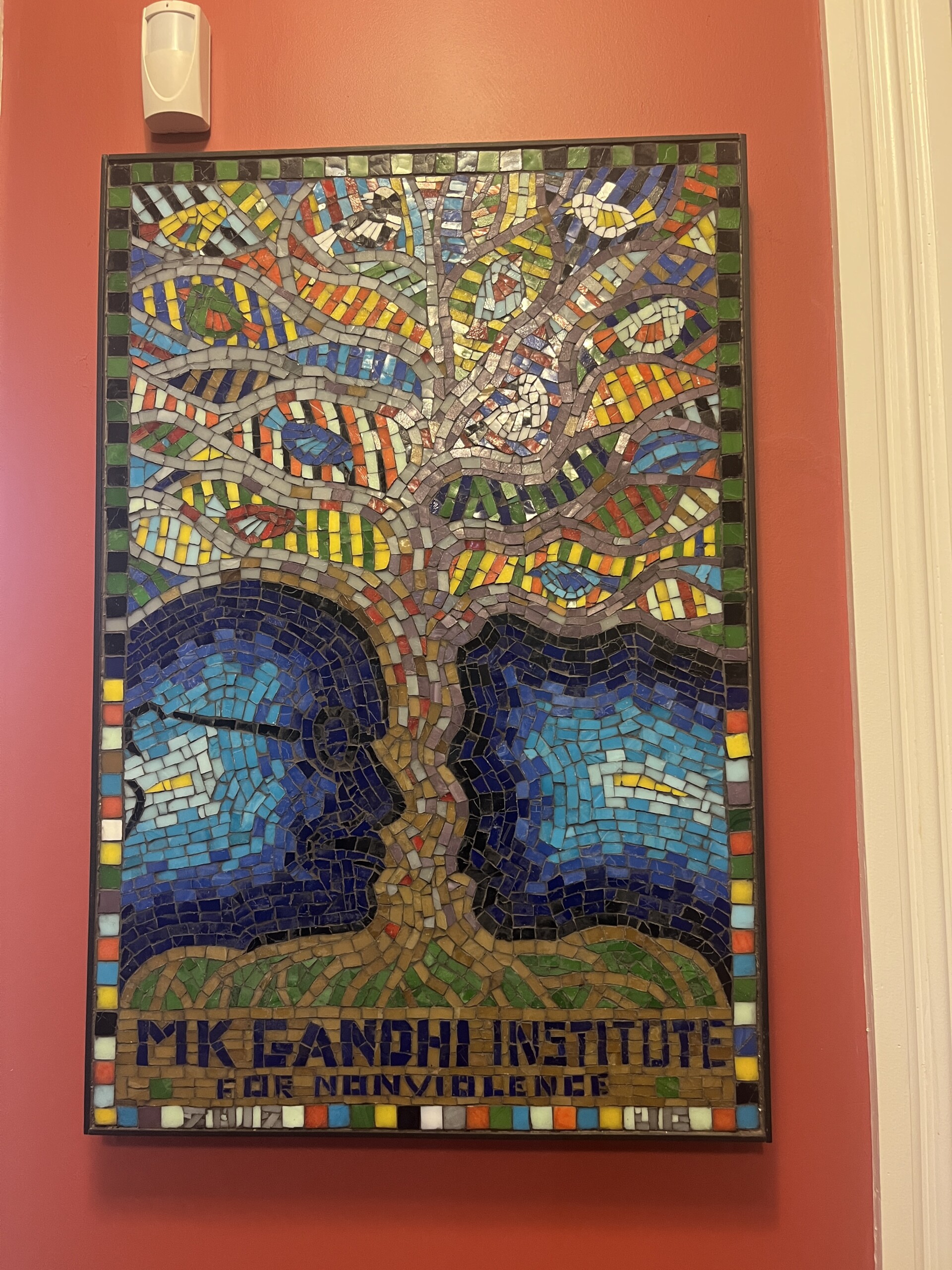
A colorful mosaic depicting Gandhi hung up near the entrance of the Institute.
People likely do not think of the UR and Mohandas Karamchand Gandhi in the same sentence, but the M.K. Gandhi Institute for Nonviolence, a cozy house bordered by a spacious community garden, has intrinsic ties to the University. Founded by Arun Gandhi, grandson of the Indian anti-colonial movement activist Mohandas K. Gandhi, and located at 929 South Plymouth Avenue, the M.K. Gandhi Institute has found its home in Rochester as an organization advocating for and teaching nonviolence. The Institute pays homage to the teachings of Gandhi and prominent Civil Rights activist Martin Luther King Jr. through community involvement, in the form of workshops, community dinners, volunteer work, and work with the Rochester City School District and several other local organizations.
The Gandhi Institute was founded in 1991 in Tennessee before eventually moving to Rochester in 2007 due to founder Arun Gandhi’s desire to be near the University for its medical facilities. It was housed in the Interfaith Chapel for years before relocating to its current spot in Plex Neighborhood in 2012, reflecting their goal to be more involved in the community.
When entering the Institute, visitors are welcomed with a warm presence: walls filled with photos of Gandhi taken by American journalist Margaret Bourke-White and paintings inspired by the Institute’s mission statements by various artists donated to the Institute. Here, nonviolence is not just a philosophy but a daily practice, one lived out through dialogue, collaboration, and connection. The walls are filled with not only artwork and photos, but also advice from learning how to grieve to resolving conflict.
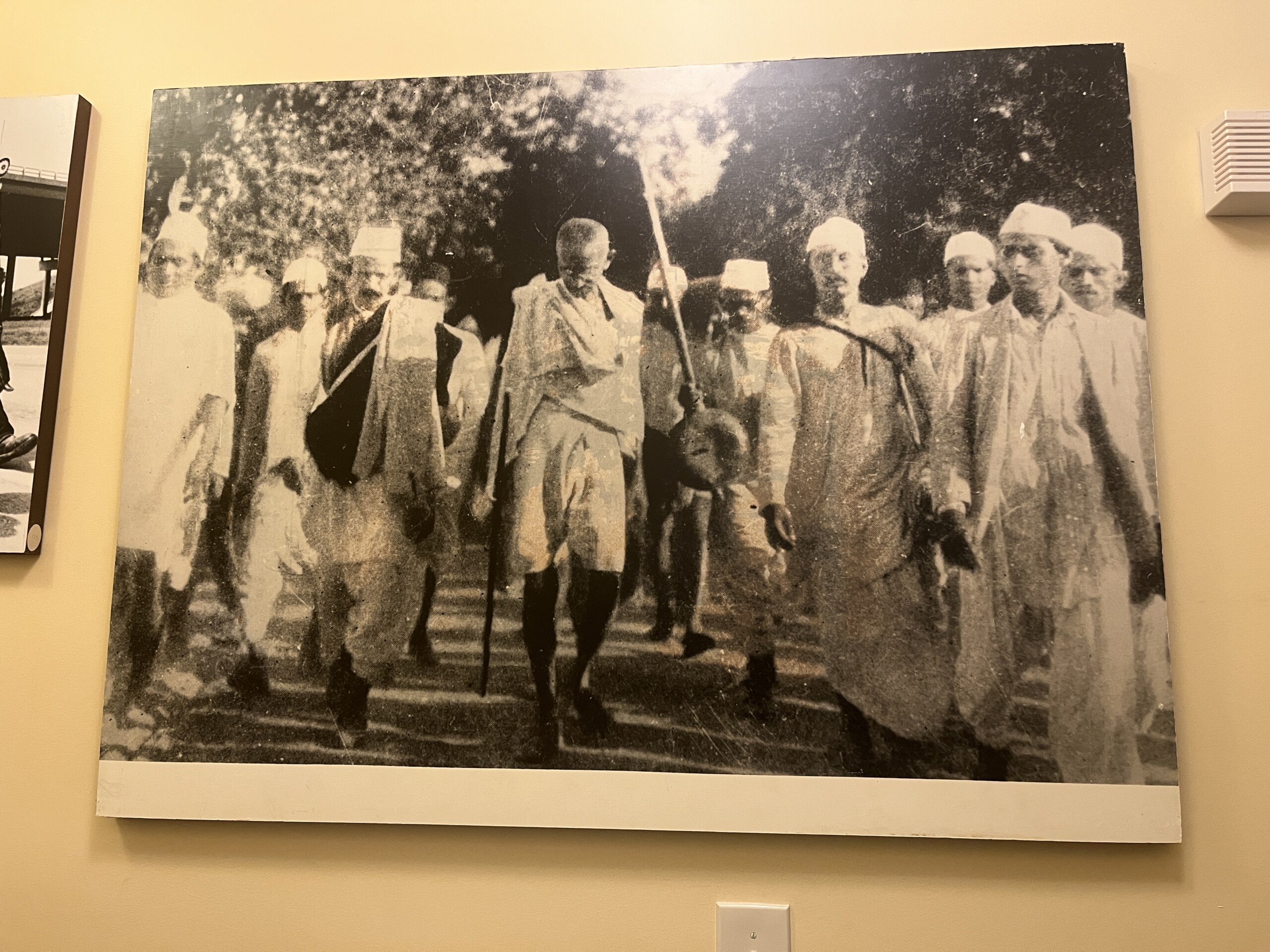
Pictures taken by American photographer Margaret Bourke-White stud the walls of the Institute.
As the website says, “The Gandhi Institute collaborates with local organizations, academic institutions, students, and committed peacemakers in nonviolence education, restorative practices, environmental sustainability, and racial justice.” The four pillars that the Gandhi Institute is built on all connect with the overarching theme of nonviolence and in their mission of “increasing peace,” according to the M.K. Gandhi Institute’s Director of Community Connections, Katie Thomas.
The directors of the Institute find this mission statement relevant to their own lives as well. The groundings of Gandhi and King’s teachings align with their beliefs and goals in their own journeys. For Director of Learning and Education Alexandria Hoang, “[the Institute]’s been really helpful because it keeps me social. It keeps me connected to my community members. It helps me see faces more often … I think that’s really important, especially in this digital age that we’re living in.” To its staff members, the mission of the Gandhi Institute, of Martin Luther King Jr., and of living a nonviolent life, is not just what they want to teach others but also a life that they themselves aspire to lead.
The Institute prides itself on solidifying its presence in the community through its welcomeness and accessibility, according to Executive Director Erin Thompson, opening its doors to fellow neighbors and community members. “Everyone is welcome,” he said. “And that’s emphasized. I think over the years, the Institute has earned a reputation as being a place where we explore ideas, where we look at differences of opinion with curiosity, where conflict is able to be transformed into something constructive.” At its core, the Institute seeks to unite people and empower them to take ownership of their own lives. That balance between community and personal self-reliance reflects a central theme in Gandhi’s foundational teachings.
Workshops are one of the Institute’s most visible ways of carrying out its mission, and they hold them across Rochester — from URMC to schools, churches, and youth programs. Popular sessions include de-escalation training, which focuses on calming tense situations, reducing harm, and helping people walk away with dignity and respect. Workshops often include role-play exercises modeled after civil right–era training, reflection writing, and even playful activities to help participants build resilience.”
These workshops are intended to prevent people from freezing in tense scenarios. Director of Advancement at the Institute and ’24 Eastman alumni Michael Jones recalled people saying, “‘I’ve done de-escalation training, but when it happened, I just didn’t.’ So the act of actually practicing in a safe environment makes it so [they’re] a little bit less likely to freeze.” In light of this, the workshop aims to gain the practice of calming tricky situations down and getting out safely.
He elaborated that “we all go through conflicts in life, little to small, and it just takes the smallest thing for some people on a bad day for things to blow up.” Other popular workshops include practicing skills such as nonviolent communication and engaging in difficult conversations which further teach participants to transform moments of conflict into opportunities for connection and proactive dialogue.
Community trainer Jonathan Jones connects the roleplay to the teachings of MLK. He explained, “To train the people to do the [civil rights movement] sit-ins and all that, they went through … intense roleplays.” In addition to their workshops, community trainers utilize increasing levels of intensity in their roleplays to make it more applicable to real life. “We call it life-lifting weights … when you find yourself in this situation in real life, you would be able to just act on what you’ve been practicing in a safe environment.”
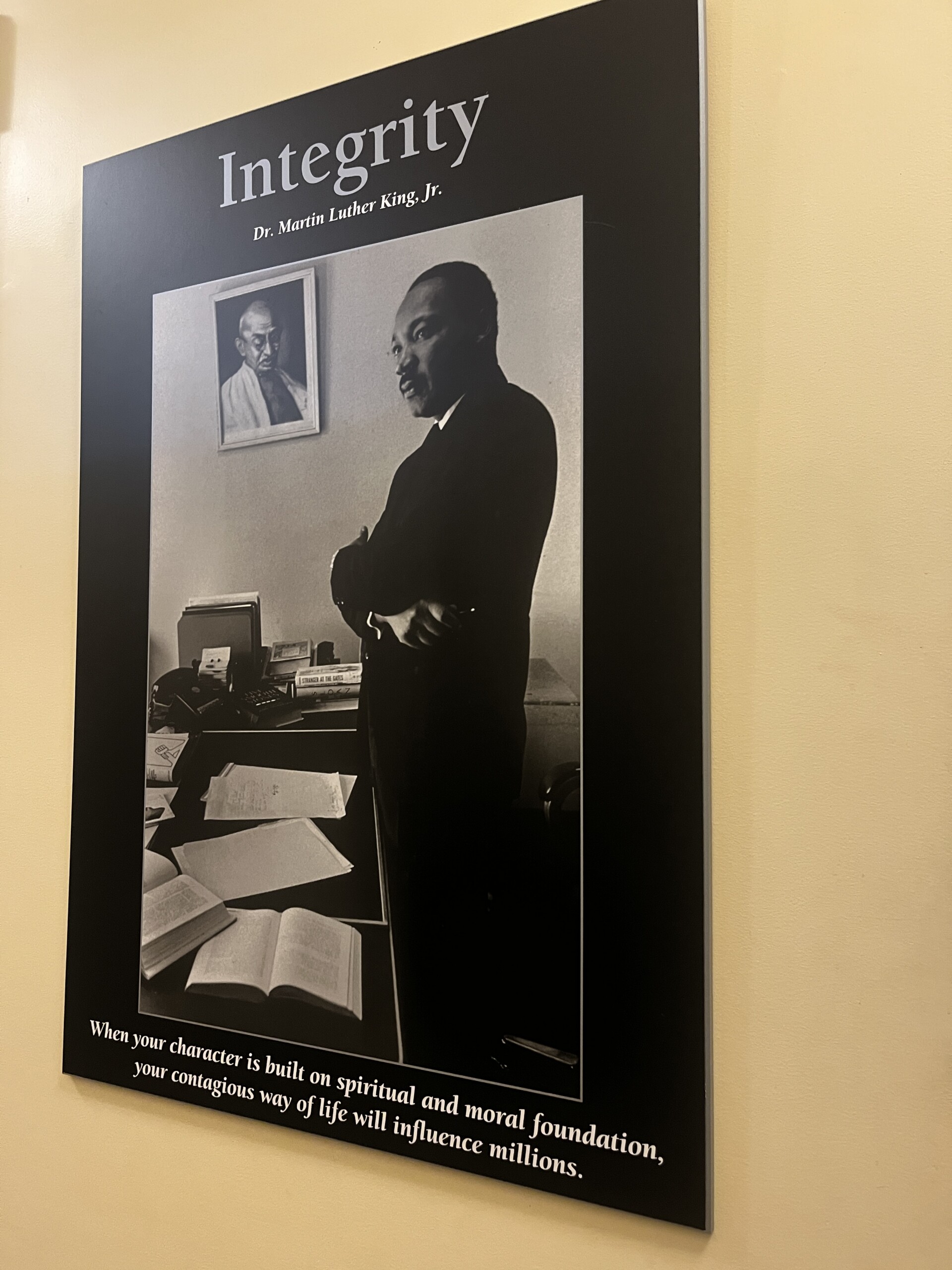
MLK stands in his office with a photo of Gandhi hung up on the wall. Kingian philosophy, the teachings of MLK, takes on Gandhi’s philosophy of nonviolent resistance.
Beyond formal workshops, the Institute strengthens community ties through community dinner tables, online grief circles, and its large community garden, which all draw in neighbors, students, and local groups. Partnerships span a wide range — from grassroots, food pantries to youth organizations like 4-H clubs, libraries, queer artists, and the University’s Center for Community Engagement. Through these efforts, the Institute has solidified a recognizable presence throughout Rochester.
While the Gandhi Institute is named after M.K. Gandhi and follows his and King’s teachings, Thompson noted that the Institute itself focuses more on their teachings and the wisdom in their methods than the lives of the individuals themselves. Thomas added, “we really try not to put them on a pedestal, because they are, at the end of the day, humans who have really wonderful, beautiful ideas about nonviolence, but that’s what we’re focusing on.” Along with King and Gandhi, the Institute also takes inspiration from a variety of nonviolent thinkers and from indigenous wisdom. “We’re not necessarily inventing the wheel. We’re not necessarily teaching these brand new ideas and topics. It’s more like we’re creating a space to uncover a lot of these things that already are inherently in us.” In doing so, the Institute’s focus on strengthening people’s connection to themselves and to those around them takes center stage.
Inside the house on South Plymouth Avenue, nonviolence isn’t just taught — it’s practiced. Staff members operate on a hybrid schedule but remain grounded in shared values: intentional communication, constructive feedback, and mutual care. Regular check-ins, a thoughtful feedback system, and even shared chores help maintain a culture of accountability and respect. Inside is a shoes-off policy as the floor is made of bamboo, showing respect for the living space as well. Mondays and Wednesdays serve as connection days, encouraging staff to be physically present in the house to talk, collaborate, and support one another. Former Postdoctoral Associate at URMC Dr. Wendy Gonaver and recent member of the Institute described the Institute’s internal environment as one where “each person speaks as long as they want, responding to a thoughtful prompt.” This intentional way of working reflects Gandhi and King’s teachings on constructive programs, showing that nonviolence is not only a method for addressing external conflict but a way of structuring everyday relationships. Thompson notes that the workplace functions through a deep degree of trust: each person fills in the gaps to advance their shared mission. “We try to embody what it is that we facilitate to others.”
Looking ahead, the Institute’s staff are mindful of the emerging challenges facing Rochester. Katie Thomas noted a growing sense of isolation — especially lingering in the years after COVID-19 — which the Institute hopes to counter through programs that rebuild in-person connection. The Institute’s Jonathan Jones emphasized the need to address rising violence and hunger in the city, pointing to the community garden and nonviolent communication training as ways to strengthen relationships and resilience. For Thompson, a major concern is the way young people are growing up online amid the rapid rise of AI; he hopes to encourage more face-to-face communication and help youth cultivate a sense of worth beyond digital metrics. Gonaver noted Monroe County’s recent report where they identified three public health issues prevalent in the county: maternal mortality, racism, and poverty. “I’m interested in how the Gandhi Institute, the programs that it already has and how it might grow in the future will address those problems,” Gonaver said.
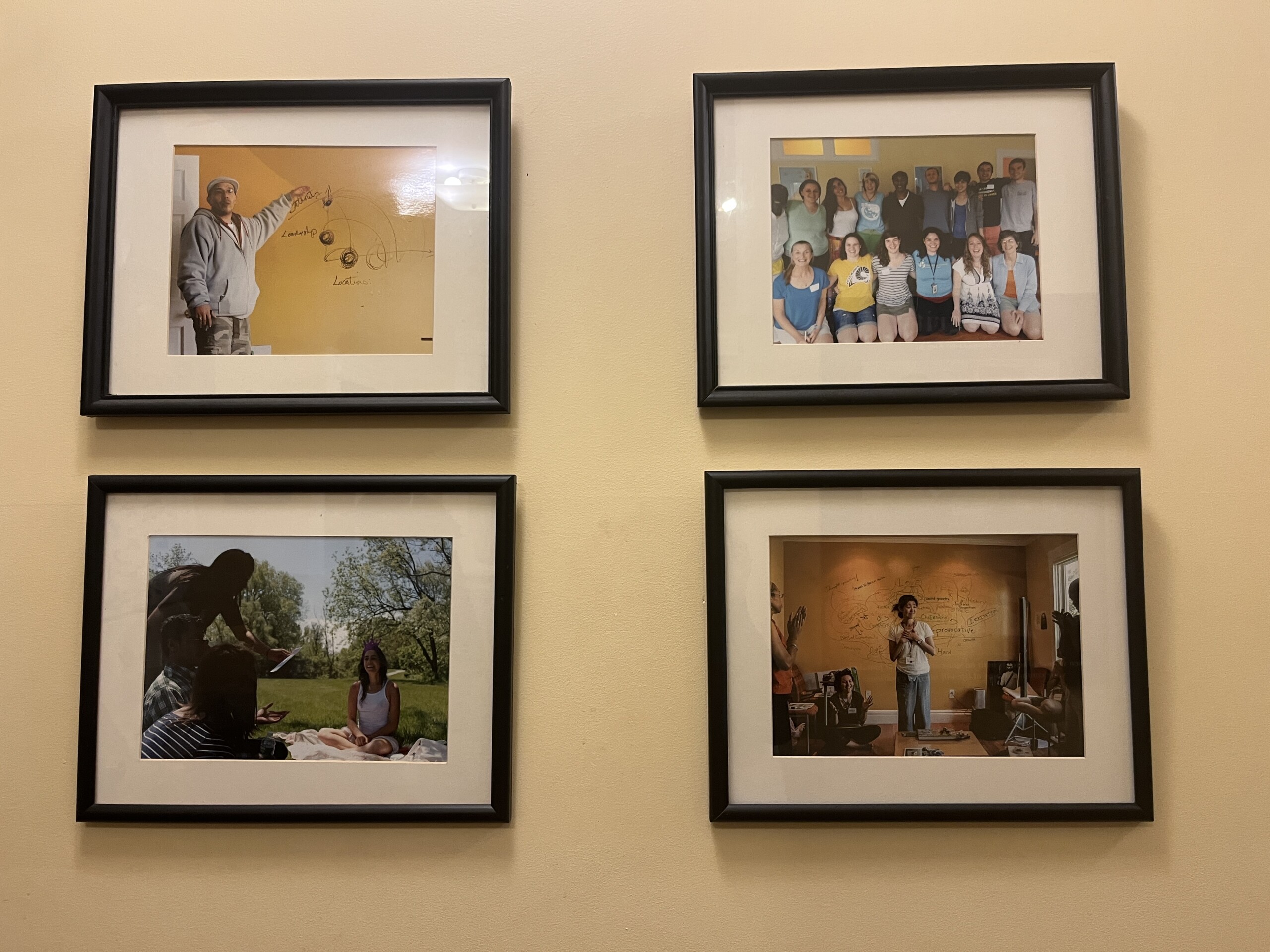
Over the years, the Gandhi Institute has fostered community engagement through volunteering, hosting workshops, and through their community garden.
The Gandhi Institute hopes to also expand their opportunities to spread nonviolence and community engagement through collaborations with UR. Thompson noted that while collaborations have primarily centered around River Campus, there are opportunities to connect with URMC, the Eastman School of Music, and Residence Life, offering structured guidance in soft skills and communication. Michael Jones said, “We’re open to all the ways nonviolence can better the world.” While the Institute has collaborated with UR in the past, events have been contained experiences. Jonathan Jones spoke of the Institute’s hope to build long-term partnerships that go beyond one-off workshops. By creating ongoing programs and more consistent engagement, students can have the opportunity to develop practical skills in nonviolent communication and community building while working with the Institute.
“Gandhi talked about a concept called constructive programming, where you’re establishing systems and ways of connecting with each other in communities that are healthy, that are inclusive, and that displace old, outmoded systems that no longer work,” Thompson said. The Gandhi Institute is grounded in community and nonviolence, nurturing relationships and practices that encourage people to imagine, and build, a more connected Rochester.