If you’ve come across an incident of a bird-window collision on campus, you’re not alone.
It’s estimated that over 1 billion birds die each year in the United States from window collisions: a harrowing statistic, and one that Richard Fadok only learned a year or so ago.
A current RIT professor and 2023–2025 postdoctoral fellow at the Humanities Center studying cultural anthropology, Fadok specializes in the interaction between culture and design: how humans shape our architectural environment and vice versa — as well as the multi-species relationships that form from anthropogenic design. When beginning a broader project covering animals and architecture, the topic of bird-window collisions began to catch his attention and catalyze his research.
“I was meeting ornithologists and other activists and advocates who work on this subject, and I was moved by their stories: by the scale of bird-window collisions, by the kinds of grief that they were experiencing,” Fadok said. “I wanted to do something about it at the University of Rochester, to see what I could do locally.”
Thus, the seed of the “Smash the Crash” initiative was planted. Following his initial research on bird-safe design and conversations with avian advocates, Fadok began a building-monitoring study around the songbird migration period of fall 2024, routinely patrolling 10 sites on River Campus for signs of collisions.
With a small team of student volunteers, including representatives from the Birding Club and Undergraduate Biology Council, the group logged 58 collisions during their 21-day study — approximating around 168 fatalities during fall migration at their tracked buildings alone. The statistics for the other 51 buildings on campus remain unknown, but presumably saw a similar rate of deaths throughout the season.
“I’ve been referring to it as a kind of slow violence,” Fadok said. “[It] can be invisible … we lack ways to represent them and to understand them on an aggregate level.”
Even after the initial research on campus, it was clear that solutions needed to be put into place to prevent the high rate of collisions on campus.To do that, Fadok needed to raise awareness about the problem.
That’s where Mizin Shin, associate professor of Art and Art History at UR, came into the picture. After attending Fadok’s talks on bird-safe design and window collisions, she found the research resonated with her own experience having seen dead birds around the SAGE Art Center. Some of her students had even seen the collisions occur during class through the building’s floor-to-ceiling windows.
Thus, she proposed a collaboration with Fadok and “Smash the Crash,” integrating bird-safe design as the focal point of her Spring 2025 Expanded Print Media course.
“As an artist, I always think ‘If this is a function of purposes, why not include the aesthetic elements?’,” Shin said.
Functionally, the project worked under a few constraints. As birds are at highest risk for collisions with smooth glass surfaces that reflect the natural environment, any deterrent needed to follow the two-by-two rule: grid-like markers must be placed at a maximum of two inches apart on the window’s external layer. Aesthetically, the possibilities were endless, inspiring the creativity of Shin and her students over the semester.
Throughout the course, they experimented with a variety of different mediums: screenprinting directly onto glass, contact paper, and an eventual solution of a perforated film applique. In terms of subject matter, students created designs with an environmental focus of “ecosystems,” once again homing in on the broader subject of conservation.
Now, pending University approval, Shin and “Smash the Crash” are hoping to print the designs on the walls of the SAGE Art Center, serving as both an artistic piece and active deterrent against bird-window collisions on campus.
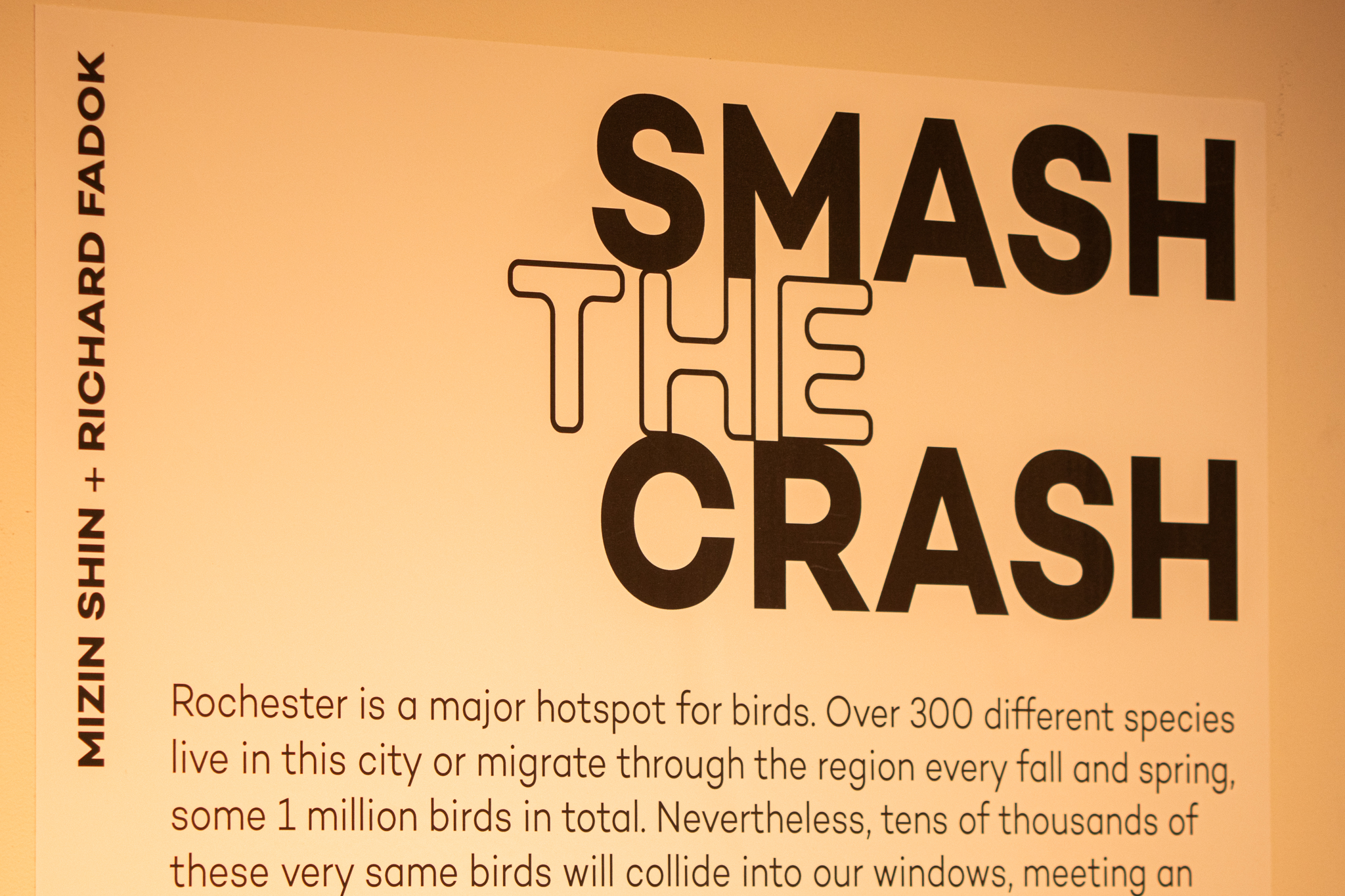
This fall, “Smash the Crash” furthered their outreach through an exhibition at UR’s Frontispace, which opened Oct. 10 and is closing this Thursday. Prints from Shin’s Advanced Printmaking Class line the hallways just outside the tunnels of Rush Rhees Library.
The exhibition, curated by Fadok and Shin, provides space for attendees to reflect on the bird-window collision crisis occurring at a global level, allowing viewers to dive deeper into this highly-experienced yet rarely-discussed topic.
“Whenever I give talks about [‘Smash the Crash’], I ask people to raise their hand and share any experiences that they’ve had with bird-window collisions, and every single time I do it, the room is almost full of hands,” Fadok said, speaking on an inspiration for the gallery’s wider, more interactive format.
The exhibit offers an interactive sticky notewall and a public notebook where attendees can share their own personal experiences with and reflections on bird-window collisions, and the wide range of responses has matched Fadok’s previous outreach.
Taking the conversation from the classroom to the gallery, the open forum allows attendees to cast their stories with a wider net, building a collective understanding of how systemic the fatalities truly are.
Along with these elements, the exhibition features work from a wide range of artists: student-created zines and prints on local species, an artist book depicting photographs of avian victims of window collisions, and an interactive map of bird-window incidents around campus.
“I’ve been using this topic as a way to think about what it means to live in the Anthropocene, to think about what it means to live in an era when animal death is systemic and structural and normalized,” Fadok said. The exhibition hosted at Frontispace provokes that thought even further, opening outreach and involvement to the community at large.
Along with the current exhibition, Smash the Crash is continuing field work at UR, as well as beginning outreach at Rochester Institute of Technology and throughout the City of Rochester. With rising student involvement, the group hopes to expand through additional interdisciplinary work, further building-monitoring studies, and advocacy for creating a bird-safe campus through official University design standards.
Fadok and Shin have come to realize that, much like the strength of a migratory flock of birds, there is power in the collective for their work, especially with the reception that their interdisciplinary outreach has fostered through coursework and the exhibition.
“It makes me realize how important of an issue this is. That it’s not just something that I’m concerned about, but it’s something that we are collectively concerned about.” Fadok said. “I think … that there’s power in that. There’s power in that kind of solidarity.”
The “Smash the Crash” exhibition will be open at the Frontispace Gallery until Thursday with a closing reception from 4–6 p.m. More information on the initiative can be found at their website.