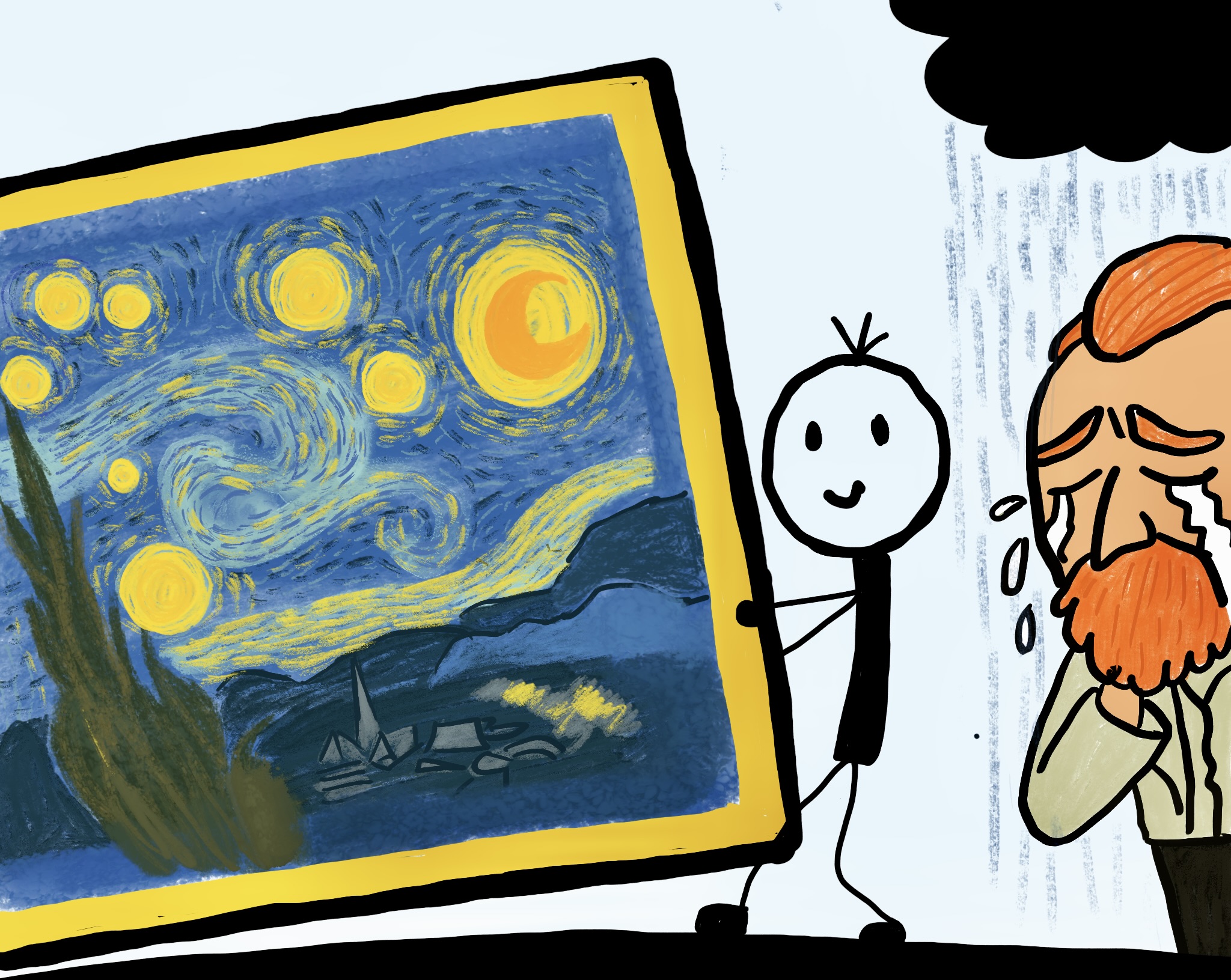
When someone talks about separating the art from the artist, the first image that comes to my mind is a stick figure desperately wrenching “Starry Night” away from a deranged and infuriated Vincent van Gogh. To be specific, this image of Van Gogh. This little daydream, odd though it is, tells us that the struggle to remove the concept of a producer from a product could potentially result in an unexpected wrestling match between you and the image held by the public of your chosen artist.
I want to be really clear before getting into the body of the article: I do not encourage stealing from mentally unwell 19th century painters or laughing at them. Please don’t cancel me or my editors.
Now, open Spotify for me, or Apple Music if you’re one of those oddballs, and play a song. I’ll do it too. There is a big picture of an album cover, in my case, Agora Hills, in bold lettering, and the artist’s name below that — Doja Cat. Similarly, next to each of Van Gogh’s paintings in The National Gallery in London is the name of the piece, and, shocker, attribution to our Dutch, post-impressionist friend. In any official display of a piece of art, the name of the artist clings on like a particularly bad case of Frat Flu. I bet your teachers even made you sign whatever combination of glitter and paint you produced in elementary school, lauded by parents and stuck on the fridge in pride of place.
With the name of any kind of public figure comes whatever famous works and scandals associated with them by the general populace. It’s word association; you can’t avoid it. When someone mentions Danforth Dining, you think of queues that take you back to Hillside, as I experienced today. When someone mentions Rush Rhees, you think of the dark academia Instagram post you can make. When someone mentions D4vd, we now apparently think of a decomposing body in the boot of an impounded Tesla.
This most recent example of a musician being associated with a felony and completely changing their public image forces consumers of D4vd’s music to decide what an appropriate response is. Do they stop listening to his music before charges have even been brought, do they wait to see the situation unfold, or do they buy a privacy screen and block all their friends on Spotify, as some fans of the rapper Ye may have felt tempted to do since the release of his latest album?
And that brings us to the artist formally known as Kanye West — a recently-turned controversial figure with 24 Grammy wins. He is also a self-proclaimed Nazi banned from entering Australia over his song glorifying Adolf Hitler. West’s achievements draw into contention whether institutions should give awards to works by artists who give space to or promote hateful ideas.
My opinion: absolutely not. People like Kanye West ought not to be celebrated and should be pushed to the fringes of society. Awarding the creations of artists who have done unacceptable things gives them notoriety, and thus a platform to influence people in potentially negative ways.
This debate came to the fore in 2020 when Roman Polanski won “Best Director” at the Césars. The director pled guilty to statutory rape in 1977 but fled the U.S. before sentencing and has become a hotly debated figure not only in French cinema, but globally. In being awarded for his work, a man who should have been in prison 50 years ago continues to be celebrated and put on a pedestal as a successful and influential director.
In an unofficial context, away from the world of nominations and awards, anyone has the right to stream, play, and enjoy whatever art they like. But this has two consequences.
By paying for art, you are, no matter how involuntarily, supporting the artist, who profits from your purchase. Even if you wouldn’t touch the person with a 10-foot barge pole, they still benefit from your appreciation for their works. In response, you could illegally download art in order to avoid contributing financially, but in consuming their work, you still bring it into conversation with other people. It gives the artist another potential stream of revenue; another platform on which to be promoted. Unavoidably, product and producer are inextricably linked.
Said 10-foot barge pole would likely be deployed again if a normal person were to come across someone streaming the song that got Ye’s visa rescinded. The second consequence of associating with artists who have a negative public image is a social one: ostracism. Streaming and enjoying Ye’s “Heil Hitler,” is an effort in itself considering the song is banned on Spotify, Apple Music, and YouTube, and is guaranteed to cost you friends and respect. While legal charges cannot be brought against you for consuming media attributable to a morally reprehensible artist, social judgement does not adhere to the same rules.
Engaging critically with art is a different story. In the same way that we study history so that previous mistakes are not made again, we can look at media with the intention to understand what makes it harmful, rather than with the intent to support the artist. This kind of consumption means that awareness can be raised and potentially decrease support for the creator.