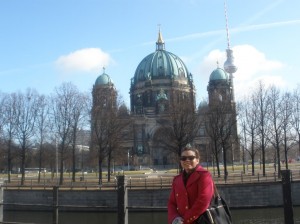
 Berlin is a beautiful city, filled with a vibrant culture, a rich history, and pristine academia. UR Class of 2013 alumni Rachel Bierasinski was lucky enough to spend the spring of her junior year enhancing her learning experience with cultural exposure and a head first immersion into mechanical engineering overseas through the Institute for the International Education of Students (IES) Berlin program.
Living with a host family who helped her with German grammar and vocabulary and introduced her to the instrumental culture of Berlin, Bieransinski became extremely connected to Berlin and found it easy to adapt.
“I remember sitting in the kitchen studying vocabulary with my host mother’s boyfriend, playing board games with my host mother’s children, and having long conversations with my host mother,” Bieransinski said. “I believe that if I didn’t have a host family my study abroad experience would have been completely different.”
By studying at the Technische University Berlin (Technical University in Berlin), she was able to meet and interact with students and people her own age as well.
The IES program aims to accommodate American students in a German environment through small class sizes and accessible libraries, cafeterias, and sports centers, and requires students to have already taken four semesters of German.
“As a mechanical engineering major, it was important to be able to continue my academics while abroad so that I wasn’t behind when I returned,” she said. Bieransinski enrolled in “Elektrische Energiesysteme,” or Electrical Energy Systems, at the Technische University in Berlin. The course, which was instructed entirely in German, required no homework but rather four lab reports, four lab quizzes, and one exam, which, she noted, was “completely different than what we have to go through in a typical course at the University of Rochester.”
Fortunately, Bieransinski was able to expand her education beyond engineering into German language and culture. She earned credits that were transferred directly to her German minor. “It takes some time to adjust and to become more of an independent learner than having to rely on midterms to test your knowledge and where you stand with your understanding of the material,” she said.
While her time in Berlin was far from a vacation, she still managed to take time to explore the city between attending classes and doing homework, exploring multiple museums, operas, and sightseeing destinations such as the Brandenburger Tor and the Reichstag. “With the help of IES Berlin’s optional field trips I was also able to see St. Petersburg, Russia and Hamburg, Germany,” Bieransinski said. Her favorite destination, however, was the Spreepark, an abandoned amusement park that opened in 1969.
In the spring, fall, and summer semesters, the IES Berlin program allows students to integrate among the 3.5 million inhabitants of the socially and economically eclectic city. Bieransinski encourages any student interested in the German language and in exploring their area of study in “the heart of Europe” to apply, in order to benefit from a unique overseas experience.
Kaplan is a member of the class of 2018.