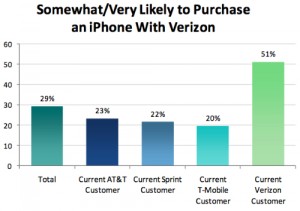
TFTS, a technology-rating website, calculated the likelihood of different providers’ customers switching to the new Verizon iPhone. Courtesy of nexus404.com
The Apple iPhone, in its short lifespan, has become a worldwide phenomenon, status symbol and technological feat. In just four years, Apple has gone from producing its very first phone to becoming the second-largest phone manufacturer in the world. It has sold almost 100 million units, showing no sign of stopping, and it did all of this while being sold on only one network in the U.S. Finally, as of Feb. 10, the iPhone 4 will be available in stores for the Verizon network.

The phone that is being released is essentially the same one that was released half a year ago on AT&T— the software is identical, while the hardware has a few minute changes. First, the antenna is changed from the original iPhone 4. The antenna and chipset of the original phone was designed for AT&T’s CDMA network, while the new phone is optimized for Verizon’s GSM network.
Also, the separations in the antenna band were moved and more insulation was added inside the phone — Apple wanted to make sure that another “Antennagate” scandal wouldn’t occur (when the iPhone 4 was first released, if one completed the circuit on the antenna, the service would drop). As for the other changes, they are mostly superficial: the mute and volume buttons were adjusted slightly, rendering older cases unusable on the new phone and the vibration mechanism was altered slightly to provide a less jarring feel.
The AT&T network, in its tenure with the iPhone, had been constantly chastised for its spotty service and abundance of dropped calls. Many people have not yet jumped on the iPhone bandwagon simply because they were wary of AT&T’s network or were unwilling to break ties with their network due to cancelation fees. Now, the iPhone will be available on “America’s most reliable network” — at least that’s what the commercials claim.
Verizon indisputably has five times more 3G coverage than its competitor. However, in ideal situations, AT&T’s data should be almost twice as fast as Verizon’s. Many reviews of the new Verizon iPhone have claimed that the Verizon bests AT&T with reception (it doesn’t drop calls nearly as much as AT&T). Yet, they have also stated there is a noticeable difference between the 3G data speeds of the two networks — namely that AT&T has a significant advantage. But here at the CT, we didn’t want to take the results at face-value, so we went out and did our own speed tests between the two iPhones.
We tested the phones all over campus and came up with pretty definitive results. We tested in the tunnels, Meliora, Wilson Commons and Sue B. Overall the Verizon iPhone had more bars or equivalent bars in all of the locations. For example, Meliora level two, the AT&T iPhone received no service, while the Verizon iPhone had one or two bars, and could send out text messages.
However, both phones had no service on Meliora one, or the basement level. Using a speed test app, both phones were found to have practically equivalent download speeds everywhere.
However, AT&T did dominate in upload speeds, almost doubling Verizon’s in every testing area. Despite claims that AT&T’s data and download speeds should be faster, no results were found on campus that backed up that claim.
The Verizon iPhone at UR certainly outperformed its AT&T twin — if you had been holding off on buying an iPhone 4 due to network worries, our results should definitely calm your fears. The new phone has all the old technological benefits the AT&T one had, but with better call making abilities and comparable data speeds, at least in Rochester.
Penney is a member of the class of 2012.