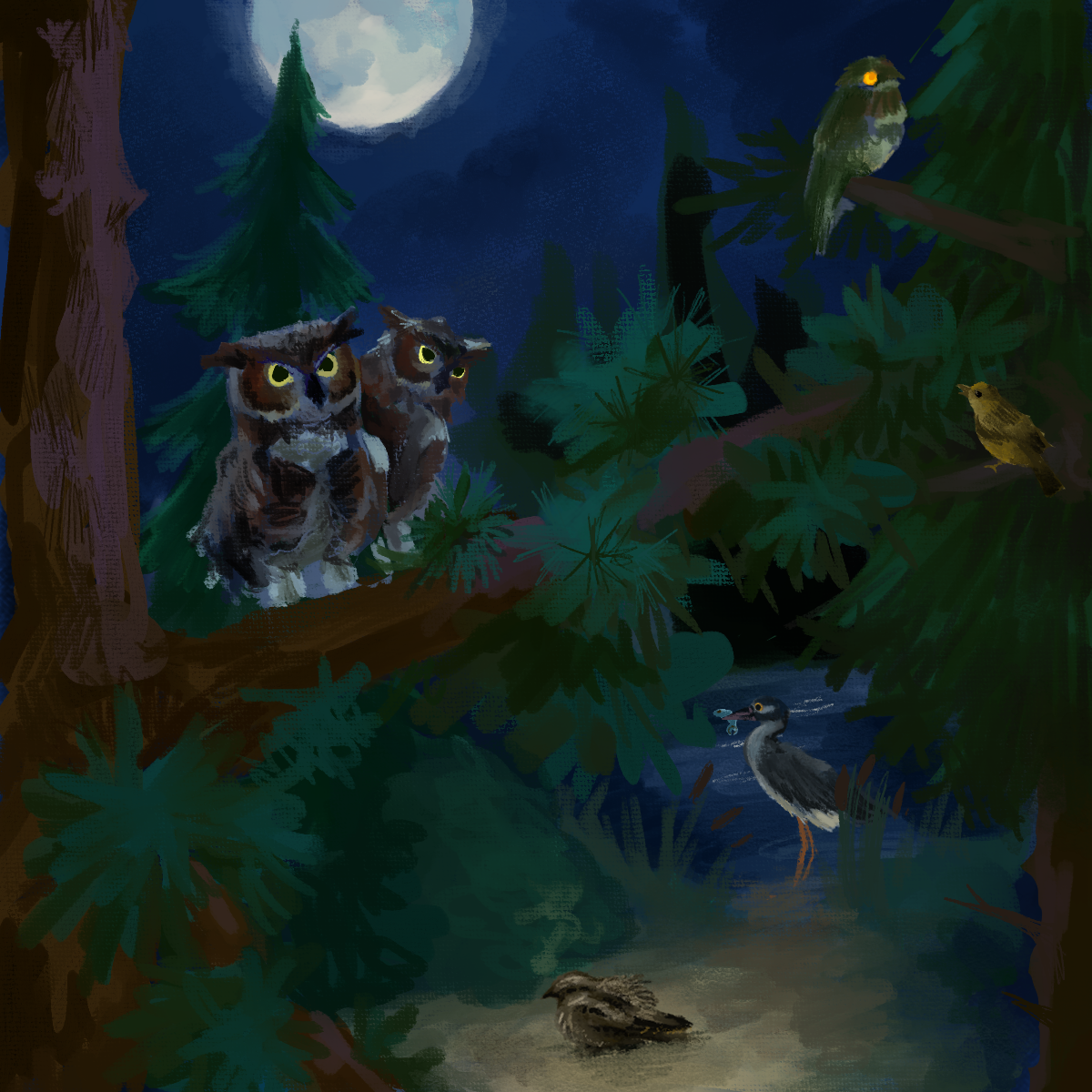
We have all heard the expression, “the early bird catches the worm.” I, as an “early bird” myself, wake up as soon as the sun rises, looking forward to seeing the different birds singing and foraging during the daytime. But the excitement does not stop when the sun sets and the “early birds” return to rest; habitats high and low still teem with birdlife at night.
Once the sun is down and the diurnal birds retire to their roosts for the night, nocturnal birds take their evening shifts, ruling their habitats in the dark and playing important roles from insect catchers to powerful hunters. It might seem that there is not a lot to see when the day is over, but that is far from the case. Nocturnal birds are not as well-understood as their diurnal counterparts — some even have a spookier reputation than what is actually known about them. While I have yet to start venturing out after dark to find nocturnal birds, I can say for sure that they are just as fascinating to learn about as the diurnal birds. With spooky season officially here, this week’s article spotlights the remarkable and various species of nocturnal birds and how they navigate and thrive in the dark.
Nocturnal birds are generally diverse in size, shape, habitat, and behavior, but many species have various features in common. These features include specialized senses to help them navigate the world with little to no light sources, including night vision, acute hearing, and even a sensitive nose. Many of them also have specialized feathers that are soft in texture. The softness of their feathers helps them fly silently as they sneak up on prey. During the day, these nocturnal birds keep a low profile and are able to camouflage themselves with their environments as they roost. With that being said, there are many diverse groups of nocturnal birds, each with their own way of living and navigating their habitats in the dark.
Owls are probably the first nocturnal bird group that comes to mind for most. Owls are skilled hunters, taking on the niches that birds such as hawks, eagles, and falcons perform during the day. Owls catch prey such as small mammals and birds and even insects, amphibians, reptiles, and fish. These powerful predators are known for features such as their large, round faces, wide eyes, sharp night vision, and silent flight, all of which are key to help them hunt. Their facial disk, made from specialized arrangements of stiff feathers, is slightly concave, which helps direct sound to the owl’s ears, located asymmetrically unlike most animals, with one located slightly higher up than the other. This structure of the owl’s facial disk, combined with the asymmetrical ear placements, allows for the owl to accurately pinpoint prey animals in a 3D acoustic environment.
Like many nocturnal birds, owls are often more likely to be heard than seen: their loud, haunting calls can be heard from a distance, to establish territory or to attract mates. The classic hooting call heard in movies originates from the deep call of the great horned owl. Many owl calls have catchy mnemonics or sound like familiar noises. The barred owl’s deep barking call, which can be heard during the day from time to time, sounds like “Who cooks for you?” The screech owl’s call is similar to a horse’s whinny, the aptly named saw-whet owl sounds like the sharpening of a chainsaw, and the barn owl’s call is a harsh, eerie screech that could have possibly come from a mythical creature.
Another large group of nocturnal birds to highlight is nightjars. Similar to owls, these shy, small, and plump birds blend in with the forest floor during the day. These birds are known for their swift, silent flight and have wide, gaping mouths behind their tiny beaks. They belong to the order Caprimulgiformes, which means “goat sucker” in Latin, and actually originates from their nickname “goatsucker” since their wide mouths were often believed to be used for suckling the milk of goats and other livestock. Yet this behavior has never been documented and these birds’ wide mouths are used for other purposes such as catching winged insects on the fly.
Nightjars live worldwide except Antarctica and can live in a variety of habitats. In the tropics, there are nocturnal birds that are distantly related to, resemble and behave like these birds. Mexico, Central America, South America, and the Caribbean are home to potoos. These birds are known for their effortless camouflaging abilities. During the day, they rest themselves against dead trees by positioning themselves vertically with their necks outstretched, causing them to resemble tree limbs. Potoo chicks are as skilled at camouflage as their parents, posing as balls of moss or fungus. They are also known for their bright, bulging eyes, for night vision and warding off predators; when potoos sleep, they can sense predators thanks to small slits in their eyelids.
Frogmouths, native to Southeast Asia and Australia, are so-named due to their wide, gaping beaks and pudgy statures. Like their relatives, they spend their days roosting on trees and are well-camouflaged against their roosts, with their plumages resembling wood.
The oilbirds of northern South America and Trinidad and Tobago live unique lifestyles. These mysterious and secretive birds live in caves, and this way of life sets them apart from other nocturnal birds due to their unique ability to navigate their environments. Oilbirds have been known to navigate via echolocation , similar to bats and dolphins. With each high-frequency call they produce, the sound bounces back from different locations, helping them avoid collisions by detecting nearby objects and estimating the distance of food sources.
Similarly to the oilbirds’ unique echolocation abilities to navigate their worlds, the kiwis of New Zealand are nocturnal birds with uncommon lifestyles and sensory abilities to navigate their habitats in darkness. These flightless birds are about the size of chickens and are related to the extinct moas. During the day, kiwis rest in burrows under the ground and come out at night to forage for food such as worms, insects, and fruits. Their eyes are underdeveloped but their keen sense of smell makes up for it, which is a rare feature in most bird families.
Even within bird groups that are generally active in broad daylight, there are a handful of individual species from these groups that are nocturnal. Australia and New Zealand are home to the respective types of parrot that are active throughout the night: the night parrot in the former and the kākāpō in the latter. These parrots are rarely seen and the former species was once thought to be extinct until a small group was discovered in 2024. The night parrot and kākāpō are currently listed as endangered. The kākāpō is known for its moss-green plumage, deep “booming” calls, and breeding in leks, designated areas used by male birds to dance and compete for females. Both are generally elusive and stand out from other parrot species due to their ground-dwelling lifestyles.
While most water birds prefer to fish in the broad daylight, species such as the aptly named night herons are exceptions. These stocky herons prefer to hunt at dawn, dusk, and night, unlike most herons, and are often seen resting on perches near water during the day. Two notable species, the black-crowned night heron and the yellow-crowned night heron are native to the Americas, and are known for their large, bulging, red eyes, to help them hunt in low-light conditions.
When the sun sets and many birds start to roost for the night, the natural world turns alive with various nocturnal birds. Nocturnal birds such as owls, nightjars, potoos, night parrots, and many more have important roles to play in their habitats, many of which are similar to their diurnal relatives, and each have unique features and sensory abilities to navigate their worlds in the dark. I hope this article has inspired you to get to know your local nighttime birds this spooky season — or any point during the year at the right time and place. Keep a keen ear and eye out for these unique birds and bring a flashlight. Don’t be scared by them — you might discover something fascinating about these powerful, beautiful birds beyond their spookiness.