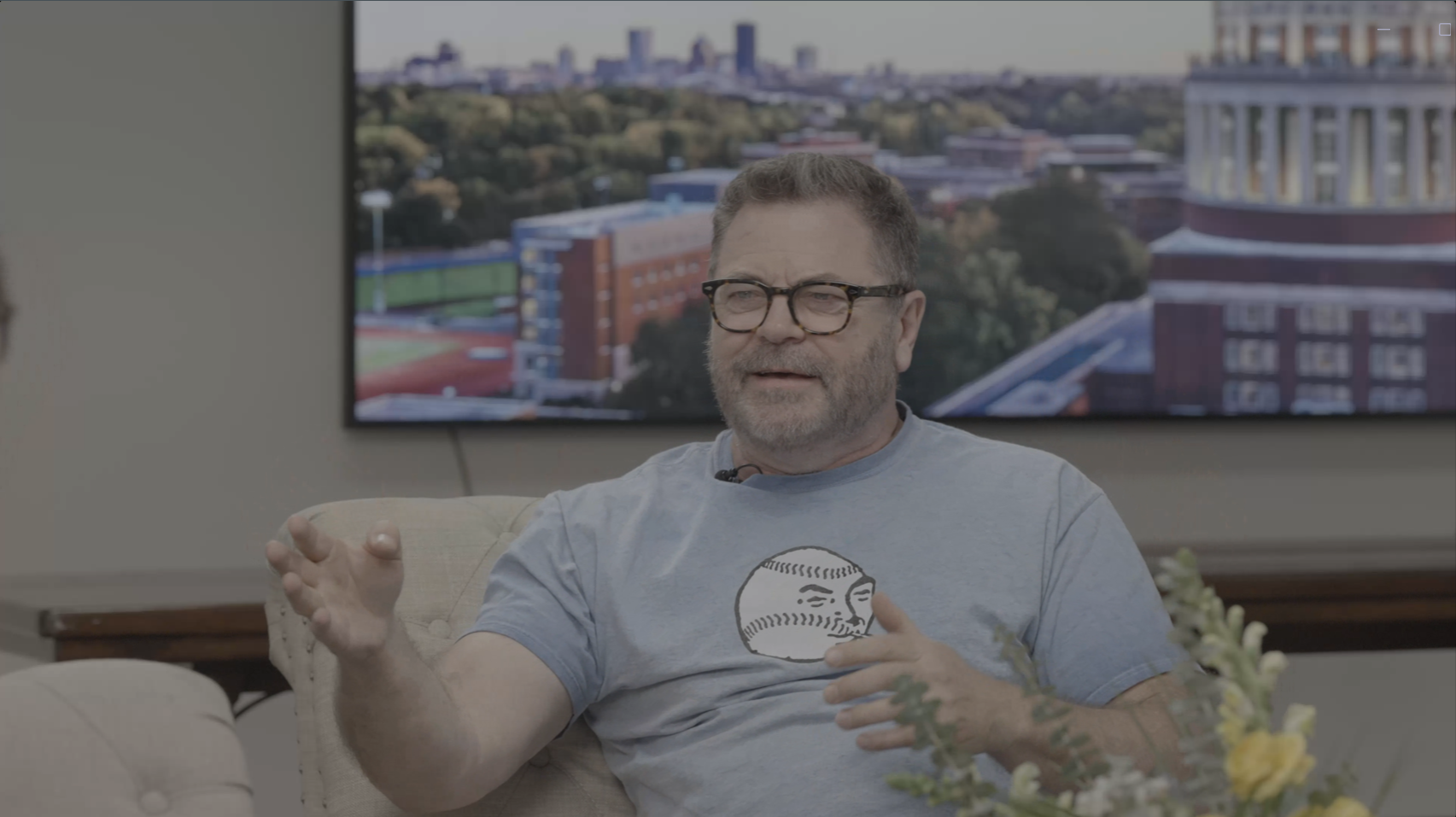
Comedian and actor Nick Offerman was the headliner for this year’s Meliora Weekend. WRUR and CT had the opportunity to sit down and talk with him before his show, where we learned more about Offerman’s creative process and inspirations that help him in front of the camera and in the woodshop.
From the Golden Globe winning and cult favorite show “Parks and Recreation” where he plays the hardy and meat-loving Ron Swanson to the Emmy-nominated “Margo’s Got Money Troubles” where he plays the motorcycle loving father, Offerman portrays tough skinned characters with a deeper emotional layer. When asked what helps him portray emotionally complex characters, he attributed his real-life appearance and personality to the development of his fictional characters. “I just happened to show up in this package,” he said.
From “Parks and Recreation,” Offerman, to his surprise, was drawn into conversations pertaining to masculinity and machismo. Although he appears intimidating and masculine, he described himself as “clumsy, human, and full of emotion, like anybody.” Since the first episode of “Parks and Recreation” aired, Offerman believes the culture surrounding what it means to be masculine has grown toxic, and he hopes to “offer an empathetic, compassionate counterpoint,” and that he thinks people need to “negotiate with hugs and handshakes.”
“It is only a child, … a scared, hurt child, that wants to negotiate with violence,” he asserted. “And so given the celebration of like young, lonely guys celebrating misogyny, celebrating homophobia online, I’m just very glad to be part of the other side of the conversation saying, no, we’re still evolving to where like everyone is a beautiful human being.”
Alongside his views on masculinity and his own personality, Offerman strives to represent this duality of human nature in the work he does, all the while sharing his love of storytelling. He wants to be part of stories that evoke tears and shine on emotional truths. As an example, Offerman referred to his notable role in an episode of Season one of “The Last of Us,” where he is a guarded survivalist who forms a heartwarming romance with someone who falls into one of his traps. “What are we doing all of this for?” Offerman asked. “It’s about taking care of the people we love. And I’m of the opinion that it’s very easy to just expand that circle from your household to your town, to your county.”
For Offerman, college was when his view of the world began to expand beyond the agrarian Illinois landscape where he grew up. As a self-professed “dipshit from a cornfield,” he lauded his classmates at the University of Illinois for introducing him to all kinds of wonders: bagels, They Might Be Giants, and The Cramps. “I showed up at college very ignorant,” he admitted wryly. “So my theater friends immediately just started dumping incredible syrups into my empty head.” He was particularly drawn to Nick Cave and the Bad Seeds, Tom Waits, Neil Young, and Laurie Anderson, which he termed “dramatic, theatrical, romantic stuff.”
His undergraduate journey of artistic discovery was not limited solely to music, however. While Offerman also cites the lyricism of Waits and Anderson as influences on his craft as an actor, he draws much of his inspiration from authors like George Saunders, and of course, fellow actors like Robert de Niro and Phillip Seymour Hoffman. But in an industry where individuality is a precious commodity, he made a firm point of distinguishing between blindly imitating and being inspired by other artists. “It’s not like I want to be like them,” he clarified. “It’s what their original voices give me permission to do.”
In fact, Offerman spent much of his career learning to trust in himself and his work. Despite developing an early knack for being charming and making people laugh, he struggled with self-doubt and fears that his rural background meant he would not be taken seriously as a professional actor. “I would try way too hard to be like someone cooler than me,” he explained, “which, of course, was just stupid.” After spending years trying to craft the perfect identity for the acting world, he realized that Ringo Starr sang it best: “Just act naturally.”
One of Offerman’s other great passions is woodworking, another creative outlet that he aspires to share with others, especially the younger generation. His last book “Little Woodchucks” released October 2025, encourages people to become more self-sufficient. “I want to share that good news with people because our society has taught us to make less and less and to depend on consumer goods more and more. And when we do that, we give away our agency.” Throughout the interview, Offerman emphasized his dedication to authenticity and persistence. “What’s the point of living other than being this clumsy mammal trying to do things and getting them wrong? It’s a huge important part of life to try things and get them wrong. If I ever did anything exquisite or award-winning, it’s because I did a shitty job a bunch of times before that.”
Offerman also feels an intense pride and satisfaction when creating things, whether it be by acting or woodworking. “When you saw [cut] a plank, you will run around the block screaming your head off, asking, ‘Where’s my parade? Did you guys just see what I just did?’ It’s an incredible feeling that is available to all of us for free all the time.”
Offerman reminisced the first time he built a canoe and the feeling of having it float in the river. He realized the memory the canoe held and mentioned feeling connected to his ancestors. He also added, “I can get across the river where there’s a hamburger joint. That feels incredible, because hamburgers are delicious.”
The conversation on appreciation of authenticity inevitably led to AI. “Little Woodchucks” is innately a “screed against AI,” Offerman said. “It’s saying, don’t forget that you can make the whole world around you. Don’t ever hand over your human agency to somebody’s software or algorithm.” Though Offerman acknowledges AI for medicine and research, he replied with a clear thumbs down when asked how he feels about AI creeping into his own acting career. “I’m in the business of people making things to make other people feel things. There’s no need. We don’t need any help.”
He recalled a theater company in Chicago he and his friends started in their 20s, where they created a taxi cab and police car to depict a car chase out of plywood and paint. He cherished this memory as it felt like the audience engaged and participated with the creativity on stage.
“Generative AI culls the work. I’m part of the work that it’s stealing from. It’s so asinine, I think,” Offerman claimed. “People love to just go along with what the money is telling them.”
As someone who has built a career on smaller roles, Offerman also feels strongly about supporting and elevating the vast number of films that go unrecognized by wider audiences. Even at celebrated independent film institutions, like the Sundance Film Festival, which was Offerman’s “bread and butter for a while,” there are simply too many good movies with too few eyes on them. “If there are 100 movies at Sundance, 25 of them are pretty great, and you might hear of three of them,” he said. “And I kind of lament there are so many movies languishing that probably only get seen if people really go down, like, your filmography.”
Many of these thoughtful, hidden gems stud his own resume. There’s “Devs,” a miniseries that follows a woman investigating a suspicious death at a quantum computing firm, where Offerman plays its reserved and mysterious CEO. And “Smashed,” a film about an alcoholic elementary school teacher struggling with sobriety, where he features as a well-meaning coworker. Or “Me, Earl, and The Dying Girl,” where two teenage boys become friends with a girl following her cancer diagnosis, which Offerman called “one of the best things I’ve ever been in.”
In keeping with many of the blunt, taciturn characters he plays, Offerman also has no difficulty being upfront about the reputation he has established for himself. “It’s not like Matt Damon, Brad Pitt, Clooney and me,” he joked. “I’m not getting the scripts, you know what I mean? Only specific writers and filmmakers will want my particular yeast in their dough.”
And while he still occasionally dips his toes into blockbusters, he fosters no regrets about pursuing an acting career that did not follow a more mainstream trajectory. As his career was just getting started, Offerman auditioned to play Wolverine in the X-Men franchise, but appreciates in hindsight that the role went to Hugh Jackman. “I don’t think I would have enjoyed the life in the gym of a career as a Marvel guy would have required,” he said decisively. “I wouldn’t have had my woodshop. I wouldn’t have had all these things in my life that I love.”
Being approached directly by filmmakers also means he has more control over the characters he chooses to play, and a closer relationship with the characters themselves. In his recent Netflix series, “Death By Lightning,” Offerman takes on the role of President Chester Arthur, and did so knowing that the writer, Mike Makowsky, specifically imagined Offerman when he wrote it. These hand-picked performances leave Offerman more confident in the work he does, and he does not find himself wishing for projects that he is not offered, though he once fought valiantly to be considered for the role of Samwise Gamgee in the “Lord of the Rings.”
As an actor and artist, woodworker and writer, Nick Offerman has built a name for himself as a thoughtful, down-to-earth, and genuine man in a career which so easily can blur the lines between fictional characters and real people. While it may be too early to start producing his biopic, rest assured that he has a strong contender for who would play him when the day comes. “There’s a Muppet called Sam Eagle,” he said resolutely. “I would be honored to be portrayed by Sam Eagle.”