Welcome to Part 2 of my incredibly fun journey birding in Southern California. Our second day of birding was spent in areas throughout Orange County, where I came across another variety of birds living in different habitats in each preserve we visited. We first stopped in the San Joaquin Marsh and Wildlife Sanctuary in Irvine. There, I encountered and photographed birds in the freshwater marshes, the shrubland, and in the more residential areas.
We began on the banks of the marshes, where different species of “dabbling ducks,” which feed on or just below the surface of shallow water, and “diving ducks,” who feed by plunging and swimming underwater in deeper waters, were eating, resting, and preening. The common and adaptable gadwall resides in California all year, and it was no surprise that they would be present in San Joaquin. They stand out for their mostly gray plumages in males and brown in females, as most other species of ducks are more colorful. The females look similar to female mallards, except for their thinner, darker bills, and were in the middle of molting as seen in one female’s slightly scraggly, patchy appearance.
The cinnamon teals, a West Coast specialty duck, were feasting on the aquatic plants growing toward the water’s surface before coming back on dry land to preen. Males live up to their name with their ruddy, cinnamon-brown feathers, while females are light brown and have a dark line across their eyes.
Among the dabblers were a pair of ruddy ducks. I spotted those small diving ducks swimming in the open water a few yards away from land. By the end of our stop, one of them finally came to dry land to rest, where I could take some close-up photos. They are noticeable by their blue, scoop-shaped bills, deep reddish-brown bodies, and stiff, spiky tail feathers. Being divers, they usually swim in deeper, more open water. They dive underwater to catch their food, shellfish and other aquatic invertebrates, and come on land briefly to rest.
We journeyed through intricate trails throughout the marsh. As we hiked, we saw a large flock of black skimmers on a small island in the water, calling and flying all over the park and foraging on the wing and dipping their thick bills into the water until they caught a fish. Western and Clark’s grebes were swimming in pairs or small groups and I even spotted a pair of the latter species in a courtship dance, swimming parallel to each other and swiveling their heads and necks side to side.
Before the outing, my birding guide received a “rare bird” alert on eBird, the citizen science program by the Cornell Lab of Ornithology, that a purple gallinule has been making an appearance in San Joaquin. Purple gallinules mainly live in the Gulf Coast of the U.S., Central America, South America, and the Caribbean. The guide theorized that the gallinule may have been a vagrant individual who arrived from western Mexico. Eventually we spotted the gallinule from a distance near a grove of aquatic plants in one of the lakes. It was clear the bird was a juvenile since it was not dressed in its usual bluish-purple plumage as seen in the adults and looked smaller relative to the adults. The bird devoured the aquatic plants surrounding it, alongside another cinnamon teal.
In the bushes surrounding the trail, as well as in those in the gardens and even by the parking lot, I encountered smaller birds such as the common and urban spotted towhee and black phoebe. The pint-sized birds I could not photograph that previous day in LA County made appearances, too. In the garden, an Anna’s hummingbird was sipping nectar from a cluster of flowers. I was finally able to successfully photograph the sprightly orange-crowned warbler hopping through the bushes.
We then drove over to Irvine Regional Park in search of some more chaparral-dwelling birds, including the state bird, the California quail. While we had no success finding quails, we did manage to hear and encounter some different songbirds, such as Western bluebirds, a Cassin’s kingbird, Bell’s vireos, and a Hutton’s vireo. I finally had the chance to photograph an acorn woodpecker in a nearby dead tree, since they are usually seen at greater distances in taller trees. We even spotted cactus wrens, which are much rarer in California compared to states with more of the species’ usual desert habitats.
Lastly, we visited Bolsa Chica Ecological Reserve, the largest saltwater marsh between Monterey Bay and Tijuana River Estuary, which is home to a lot of rare and endangered wildlife. There we encountered many types of water birds, such as herons, egrets, a red-breasted merganser, and lots of shorebirds. Willets stepped through the edges of the marsh. Many yards away from the trail were fenced-in areas which housed different shorebirds, such as endangered snowy plovers, semipalmated plovers, red knots, short-billed dowitchers, and sanderlings.
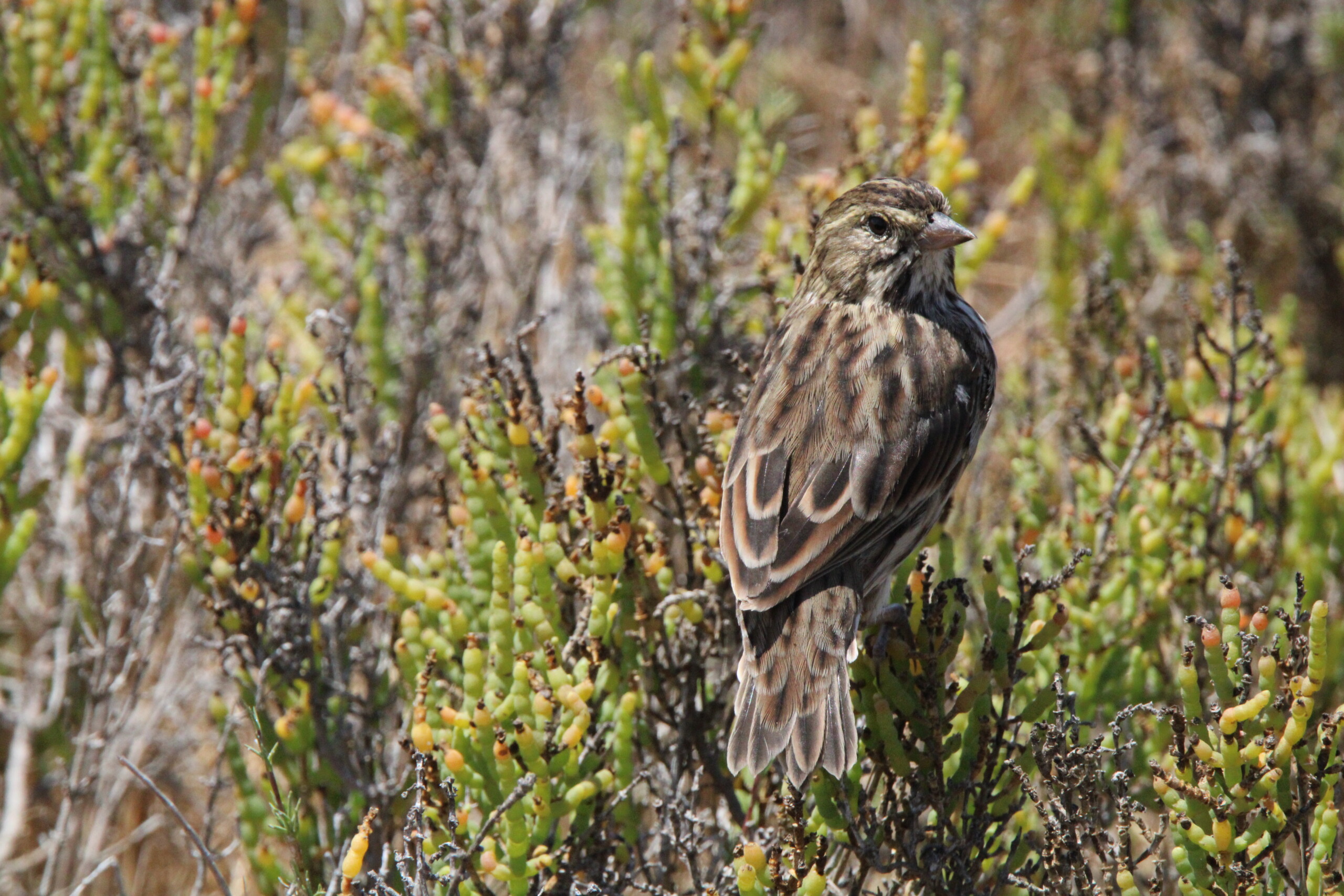
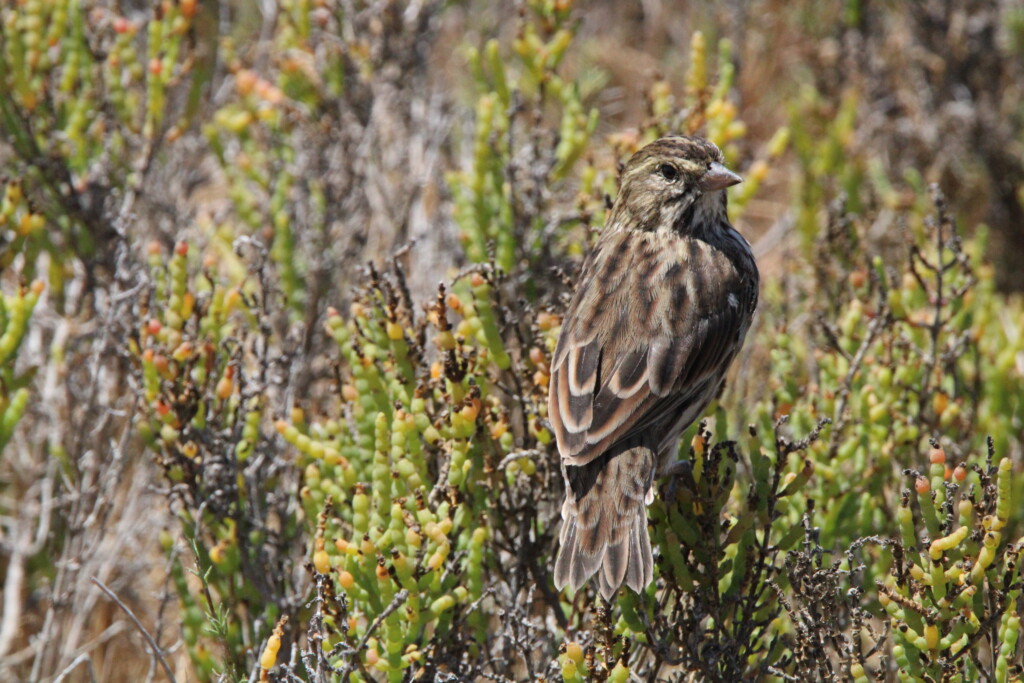
In the reserve’s grassy vegetation just off the path, there were Savannah sparrows, named for the city in Georgia in which they were first discovered as well as their penchant for living in grassy areas. Bolsa Chica was home to a specific and endangered population called Belding’s sparrows, which rely on wetland ecosystems to thrive. They stand out for their darker bill, heavier streaking patterns, and subtler yellow patches above the eyes. A few sparrows even sported slightly larger, chunkier bills and were aptly named “large-billed sparrows.”
On Bolsa Chica’s nearby beach, there were more fenced-off areas for sandpipers and plovers, many of which were at a distance to prevent disturbance from the crowds. Outside of those fenced zones, the beach also hosted large flocks of gulls and terns. I spotted a couple of elegant terns, one of my favorite waterbirds, to close out this journey. Elegant terns look a lot like royal terns, which are related to them and often live or fly in the same groups. However, elegant terns are a little shorter and have thinner, more delicate-looking beaks.
California has been an enchanting and unforgettable place to bird and encounter multiple different species in a wide variety of habitats. For me, Southern California has been a longtime favorite place in the U.S. to visit, and seeing this area’s wide variety of bird species and its diverse natural habitats has been a real treat. I met lots of new species, large and small, in places urban and natural, common and rare, to add to my photo collection and life list. I look forward to visiting California again in the future to immerse myself in the nature this state has to offer.