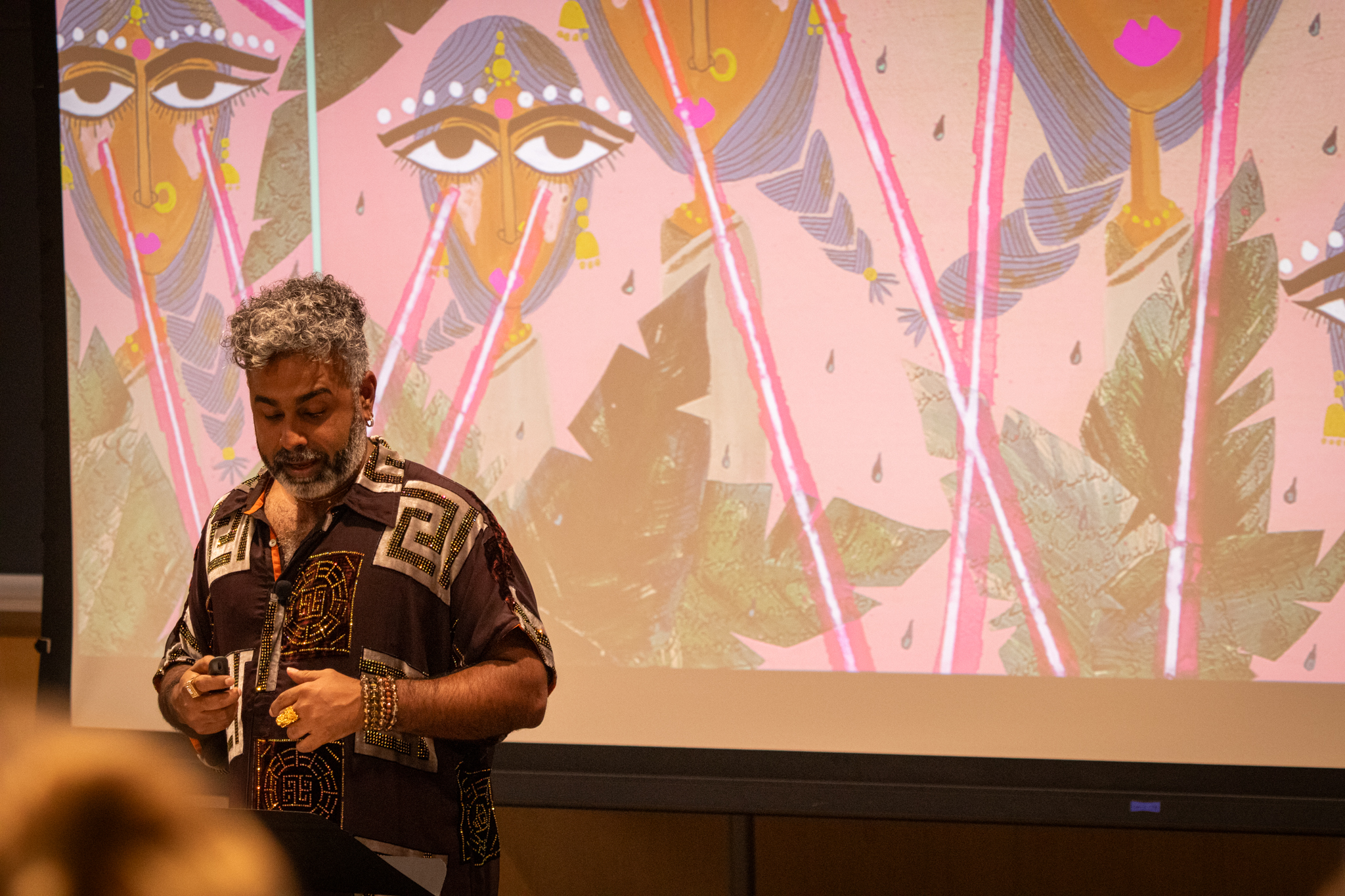
The annual Rainbow Lecture hosted at Dewey Hall by the Susan B. Anthony Institute for Sexuality, Gender, and Women’s studies featured Kareem Khubchandani, an Associate Professor of Theatre, Dance, and Performance Studies at Tufts University and a Visiting Professor at Harvard University. Alongside his educational background, Khubchandani is also a drag queen, who goes by LaWhore Vagistan.
The scenery was already set for the lecture upon entry. Remixes of upbeat Bollywood songs were playing from the speaker. There were desks near the audience that had coloring pages of South Asian Aunties with different patterned sarees and kurtas which we were given markers and color pencils to fill in. There were also sets of bindis, decorative dots worn on the forehead in South Asian cultures, and glittery hand tattoos as well. Another table had books by Khubchandani such as “Ishtyle” and “Lessons in Drag” that were available for sale at the end of the talk.
The lecturer was introduced by Jeffrey McCune, Associate Professor of English and Black Studies at URochester. In his Rainbow Lecture, Khubchandani invited us to examine the South Asian Aunty and who she was in terms of the nuclear family and in fashion. Far from being a mere trope in “backwardness” and an embarrassing relative that “barges in and out,” the Aunty, in Khubchandani’s analysis, are “nodes of structural repair.”
South Asian Aunties are stereotypically gossipers who are very judgmental and project their judgments especially on the youth. These women, who are seemingly along the margins of the nuclear family, are expressive about their traditional values and act as a network where gossip is shared. TikToks were shown throughout the lecture that helped facilitate these points.
They are also known for their extravagant outfits. Central to the lecture was the work of Meera Sethi, a Canadian-Indian artist whose paintings reflect the “Aunty-core” aesthetic. This is defined by color-on-color, pattern-on-pattern, a body enveloped in pattern and every surface embellished. When we shift our attention from the clothes to their faces, we see a weathered body but a confident ease in which the Aunty looks out at the viewer. Khubchandani pointed out that “Aunties floating on the pastel backgrounds don’t have a destination but they do have places to be.” He noticed how Sethi seems to pause time and space for these women and make their bodies available to interpretation by people like us. Khubchandani remarked, “Work shied into their body but they are not shy to show it.”
Why isn’t the Aunty embarrassed from the too muchness of her style? “Perhaps she doesn’t even realize she is too much,” he said. Khubchandani described how the artist Sethi seems to allow these Aunties to enjoy what she’s wearing or rather what she has accumulated. Her clothes are a decades-long accumulation of feeling, endurance, and the weathering body. Her outfits also tell stories of other Aunties. Khubchandani phrased it as “not liberal individualism but accumulation of shared resources,” and through that, “also sharing of feelings… layering everyday labor [with] spectacles of Aunty generosity.”
Khubchandani also included the Aunty’s role in politics, with their first example being NYC mayor Zohran Mamdani (who had a collective audible support from the audience), and his mentioning of the Bangladeshi aunts during his campaign. Khubchandani brought to attention Mamdani’s iconic line: “This is the victory of the Bangladeshi auntie who knocked on door after door until her feet throbbed and her knuckles ached.” The language draws attention to the body of the Aunty, being tired but ever so determined. Aunties sustain this political economic process, from campaigning to movies, which Khubchandani used Mira Nair, film director and Mamadani’s mother as an example for.
Sethi’s work also depicts Dadis, which are South Asian grandmothers, and Khubchandani pointed out the vast difference between the depiction of Dadis among her artwork. For example, Dadi is home, Aunty is outside. Dadi is swaddled, cared for, soft, and comfortable. Dadi functions as Aunty until she becomes domesticated.
“How do Aunties have consequences for queer life?” Khubchandani asked in his lecture. Queer and trans people, according to him, “twist time against norms.” In a similar fashion, Aunties disrupt this linear timeline as well. They resist the post-partum conception of how when you are an Aunty, your work is done, as you have completed your motherly duties to bring children in the world. On the contrary, Aunties still strive to make an impact in their society. They reject the idea that their time is over. Especially in his work as a drag queen and performer, he portrays the Aunty-core and the too-muchness that symbolizes the aesthetic. For Khubchandani, performing Aunty is his way of reconciling with aging and “living with our futures and those who are coming after us.”
The future of the Aunty figure was a notable question that was brought up from the audience. Will these stereotypes still apply to the future Aunties which will be us? “Aunty is not just her style but also her skillset, pleasures, and politics,” Khubchandani remarked. The talk ended on an optimistic note, encouraging us to spend time with Aunties and force us to think more about our relationship with these figures.