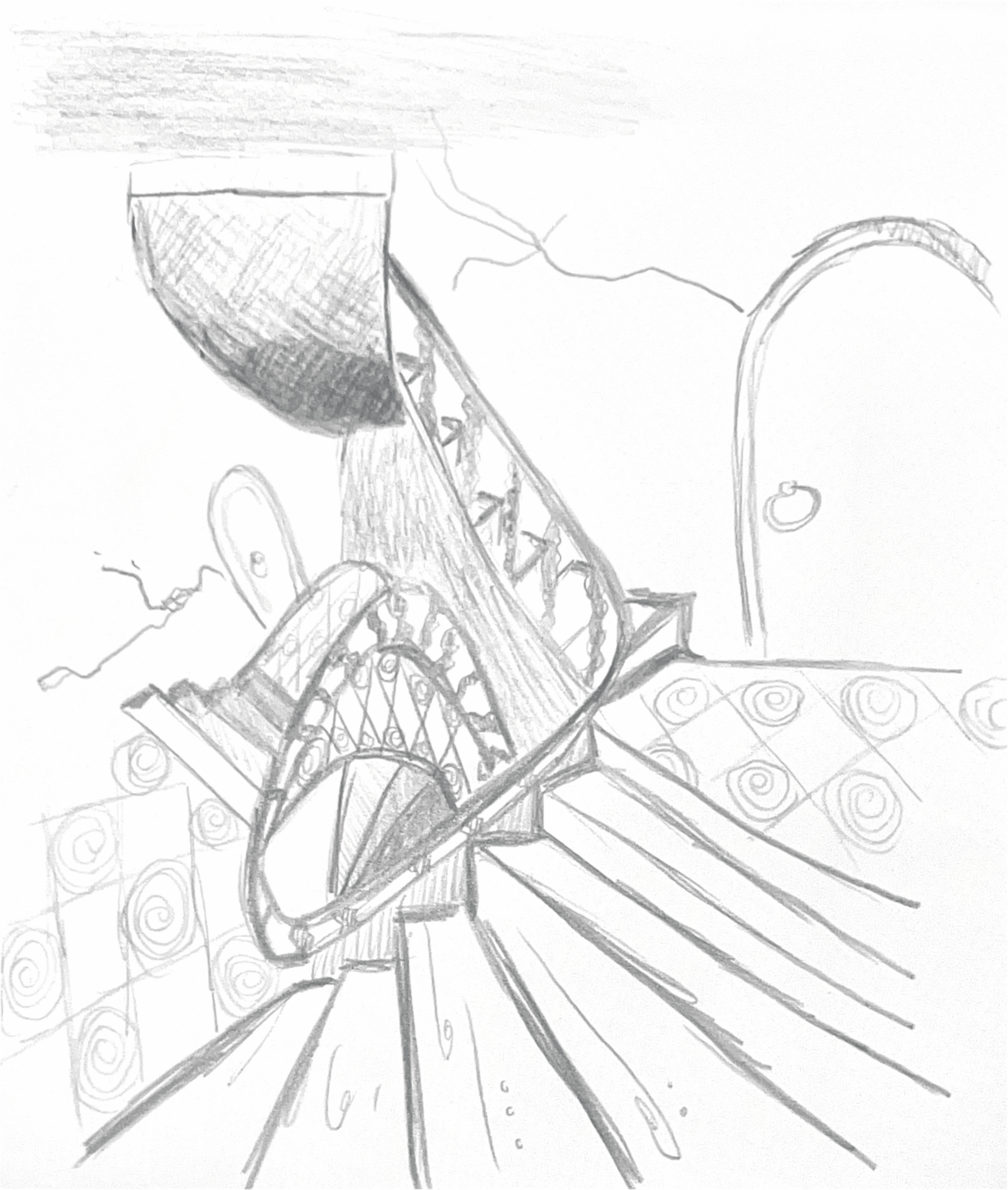
“Katabasis” is the newest novel from author R.F. Kuang, better known for her books “Yellowface,” “The Poppy War” trilogy, and “Babel, or the Necessity of Violence.” “Katabasis” follows the journey of two students of the “arcane arts” — a form of magic reliant on chalk circles — Alice and Peter, as they venture into Hell to save their recently deceased thesis advisor, Professor Grimes. In this universe, Hell is envisioned as a synthesis of many real-life conceptions of the afterlife, drawing on Greek and Chinese mythology, as well as Dante’s “Inferno.” As Alice and Peter arrive in Hell, they chase after their advisor through a series of Hell’s courts, which test their magical knowledge — and their relationship.
Magic in “Katabasis” engages heavily in philosophical and logical questions, with magicians finding power in the contradictions, or knowledge gaps, that exist within these topics. This equips Alice and Peter with magical tools like perpetually refilling water bottles, but also puts them at risk of magical traps that require solving riddles to escape.
As the story unravels, we learn more about both Alice and Peter’s academic histories, with Kuang confronting many issues that are deeply rooted in academia. Readers are asked the question of how far someone is willing to go to secure a job in academia, with both Alice and Peter willing to go to literal Hell and back to get a letter of recommendation from their thesis advisor — a renowned but controversial figure in the magical world.
“Katabasis” isn’t the first book of Kuang’s that Book Club has read. Last fall, members had mixed, but mostly positive, thoughts on “Babel, or the Necessity of Violence” — more thoughts can be found in our Campus Times review from Fall 2025. “Katabasis” follows similar themes of academic corruption and competition in a backdrop of magical realism, which are undoubtedly motivated by Kuang’s personal experience as an academic. She even wrote “Katabasis” while completing her doctoral degree at Yale University. During a November 2023 book promotion tour at the Brattle Theatre near Harvard University, Kuang stated that her book “…started as this cute, silly adventure novel about like, ‘Haha, academia is hell.’ And then I was writing it and I was like, ‘Oh, no, academia is hell.’” — a sentiment that rings true for many of us here at URochester.
Regardless, members of Book Club discussed everything from world-building, themes of chronic illness, political allegories, trauma, and more during our discussion. There are minor spoilers for the book ahead.
The first point of discussion was Kuang’s world-building of Hell and the pacing of Alice and Peter’s story. Some members agreed that Kuang’s depiction of Hell as a college campus (at least at first) could simply represent the main characters’ interpretations, but the “true” landscape of Hell in the alternate universe of “Katabasis” depends on the beholder. One member critiqued the story due to its meandering and disorganized structure, especially during many of the latter chapters, where much of the action occurs. They stated that the “world-building early on in the book fell away as it went along,” and other members agreed, pointing out the uneven distribution of focus on the early courts of Hell compared to the later, more severe courts such as Violence, Cruelty, and Tyranny, which devolved (like the plot, as some members believed) into shapeless dunes of blowing sand.
Another member expressed their disappointment with the progression — “I hate when [a book] becomes too big to handle itself,” while others believed that Kuang was forced to limit her story to a single book when the story could potentially span an entire series. Eventually, we reached a consensus that, though it may not have been due to authorial intention, the plot of “Katabasis” and Alice and Peter’s progression through Hell works with the metaphor that more evil corresponds to more chaos, in both the courts and the storyline.
A second point of discussion centered around the main characters, Alice and Peter, and their development throughout the story. Peter’s character, and the exposition of his life with a serious chronic illness, Crohn’s disease, resonated with a few members, sharing that they also deal with invisible illnesses that affect their lives without existing as a clear physical disability. Additionally, many members found Alice to be a misogynistic, selfish, and boring main character whose potential was squandered and one-dimensional. As one member put it, “She’s insanely smart, but it [wasn’t used] for any reason.” However, it was clear to everyone that Alice’s physical journey through Hell existed as a metaphor for her suicidal ideation and depression — she doesn’t actually want to bring Grimes back from Hell, but she needed an achievement-driven purpose to have a reason to keep living her life, which had thus far been a figurative hell. Alice’s journey and reflections throughout the novel eventually culminate in a denouncement of the toxic academic environment that shaped her into the flawed character we were introduced to.
It was also discussed that Alice’s character reflects a very real, prevalent issue of academic competition and what it takes to break the cycle, including at our university. In her case, constantly striving for perfection and favor over her classmates (or as she sees them, her competitors) led to a downward spiral of burnout and depression, only made worse by a magic pentagram that gave her a perfect memory (every academic’s theoretical dream). Members pointed out that our university motto, “Ever Better,” supports a toxic, competitive academic environment that pits people against each other for grades, achievements, and connections instead of focusing on how these sentiments scaffold academic programs and institutions. One member asked, “Should you be living for a goal, or living for life?” which were seen as the two extremes in the book.
The ending was viewed with skepticism by many members, seen as an underdeveloped deus ex machina — a plot device where an unsolvable, hopeless situation is suddenly and conveniently resolved by an unexpected intervention, such as a divine force or a contrived, last-minute plot twist. Members pointed out that Kuang’s other books lack satisfying endings, and some questioned her ability to successfully wrap up her stories.
Ultimately, as with most books, Book Club’s reviews were mixed. Those who finished the book rated the book on a five-star scale, while those who hadn’t finished shared their likelihood of finishing it. These reviews ranged from one to five stars, but averaged to a rating of four out of five stars.
If you are looking for an excuse to get back into reading or are searching for your next read, join us at Book Club on Thursdays at 6 p.m. Check out our CCC and Instagram (@uofrbookclub) for the most recent updates.