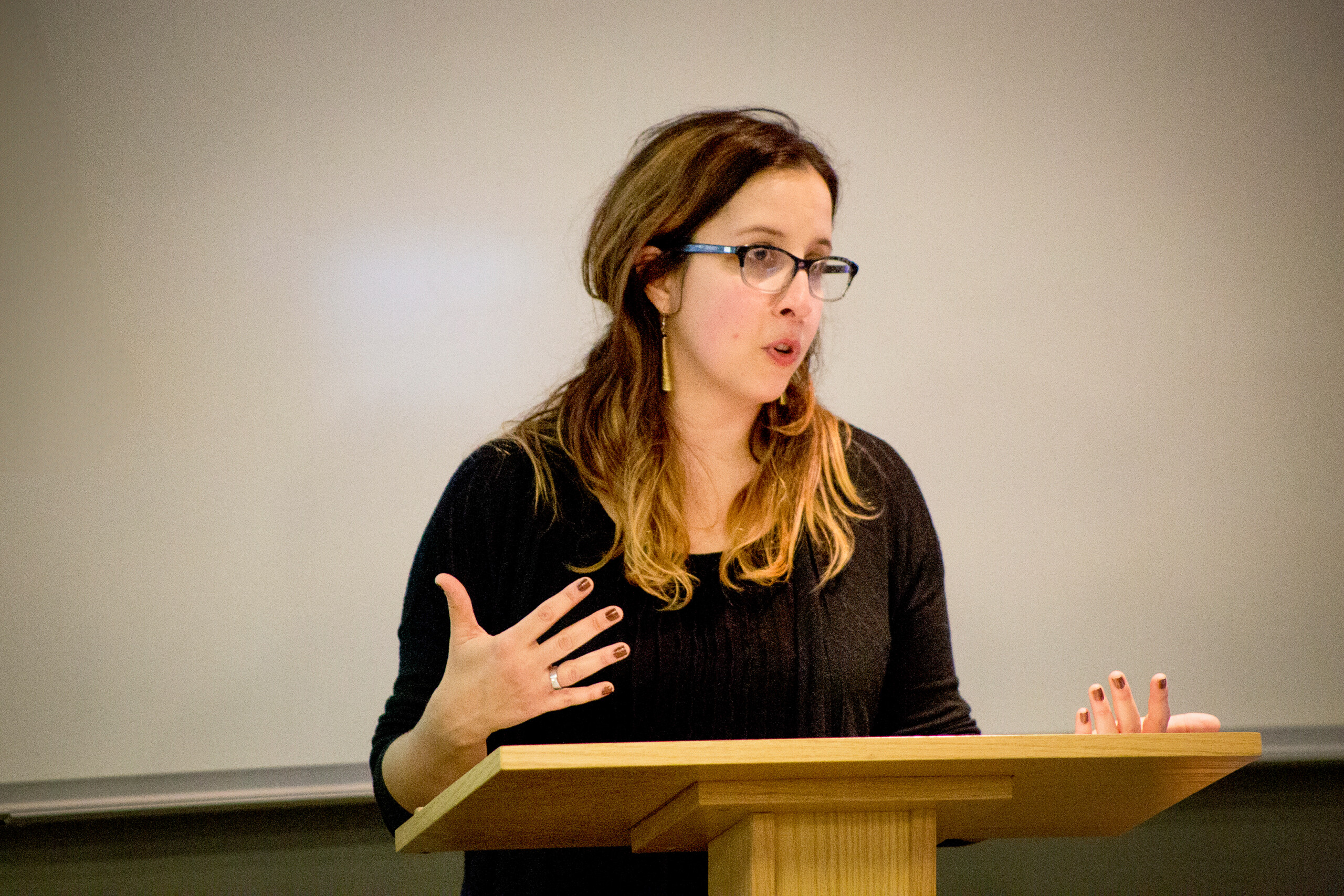
Nora Rubel, Chair of the Department of Religion and Classics and Professor in Jewish Studies, was born in Italy to Holocaust survivors. She is the daughter of an Italian-born father with Polish and German ancestry and an Israeli mother whose family settled in Tel Aviv in the early 20th century.
As a self-proclaimed “military brat,” her childhood encompassed frequent relocation due to her father’s military service to areas where she and her sister would often be the only Jews around. That was until Rubel moved to New Jersey and discovered the, at the time, exotic bagels and lox and American Jewry that existed — “where Jews were allowed to be Jews from the start without a sort of emancipation [like in Europe],” she said.
Despite spending time in Israel as a child, where most of her family resides, Rubel has not visited since 2001 and has no desire to. To her, Israel and Zionism do not intertwine with her Jewish identity. Rubel identifies as neither an anti-Zionist nor a Zionist — words, she believes, are overdetermined and futile, leading to a culture of paradox and division.
“Many Jews support Israel as part of their Judaism, while Palestinians see Zionism as something done to them,” Rubel said. She feels this makes it hard for nuanced conversations beyond social media to take place, which she worked towards breaking through the year-long, six-part series called “Conversations on Israel, Palestine, and the War in Gaza,” sponsored by the Department of Religion and Classics and Center for Jewish Studies.
Omer Bartov, Sa’ed Atshan, and Shaul Magid have completed half of the series thus far. Before he began criticizing what at the moment had the potential to turn into a genocide about six months ago, Bartov was not a controversial person, according to Rubel. Hence, she wanted him to examine the use and weaponization of language — what is meant by words like “apartheid” and “genocide.”
Interpreted by some as an anti-Israel and anti-Zionist series, Rubel emphasized that while the need to support a particular side passionately is understandable, it is crucial to be aware of what you are standing behind by exposing yourself to historical and present knowledge.
Nevertheless, this interpretation of the series caused a petition to circulate last month calling for the Jewish Community Center of Greater Rochester (JCC) to cancel a lecture that Rubel is scheduled to deliver this May regarding Jewish food in America. The petition, which has since been taken down, claimed that Rubel is an “anti-Zionist, self-hating Jew” who promotes terrorism and the mastermind behind the posters.
“It is an outrageous thing to feel like someone within my community thinks I am an enemy from within,” Rubel said in the interview with Campus Times in response to these claims.
Similarly, Rubel’s piece in the Democrat and Chronicle with Professor in Public Policy and Health Mical Raz that defends students’ right to free speech and protests last December brought negative attention to her and her husband’s vegan butcher shop and deli Grass Fed — where Rubel is known as the Butcher’s Wife. The group funding their kosher certification decided to revoke it due to the backlash she faced.
As members of the Task Force for Combating Antisemitism, Rubel and her committee colleagues have found it difficult to agree on a clear and precise definition of antisemitism. “When the petition came up calling me an antisemite, I sent it to the task person, saying this is what happens when our definition is loose.”
Yet, Rubel reiterated that she experiences hope and optimism from students on campus who have, until now, made the effort to engage in constructive dialogue.
“My impression is that you [students] are better than we are,” Rubel said.
Three more speakers will be coming this spring to conclude the series: Laila El-Haddad, a Palestinian author on topics like Gaza and the conjunction between politics and food; and Northwestern University Professor of Political Science Wendy Pearlman, have been confirmed with the third to be determined.