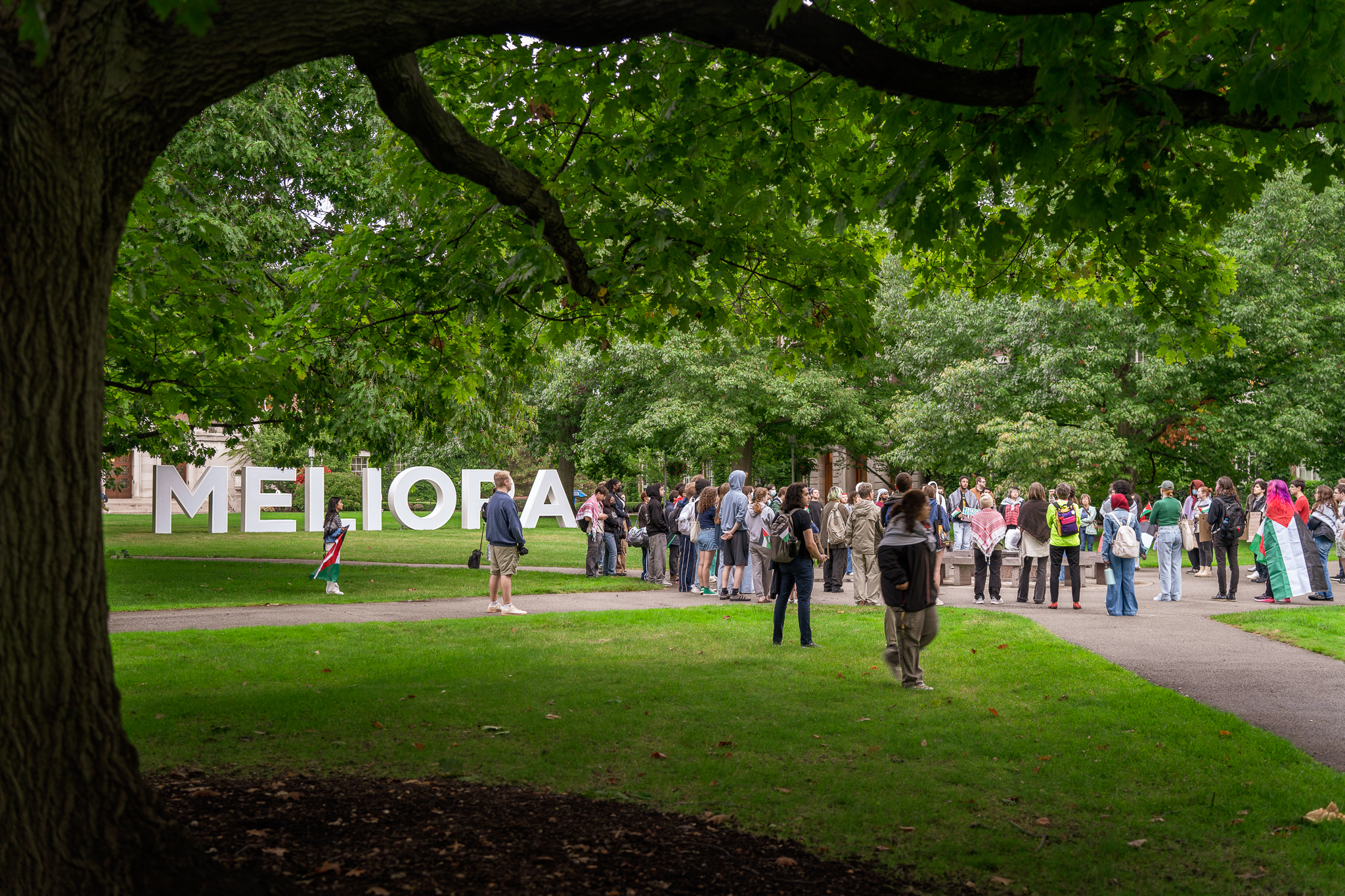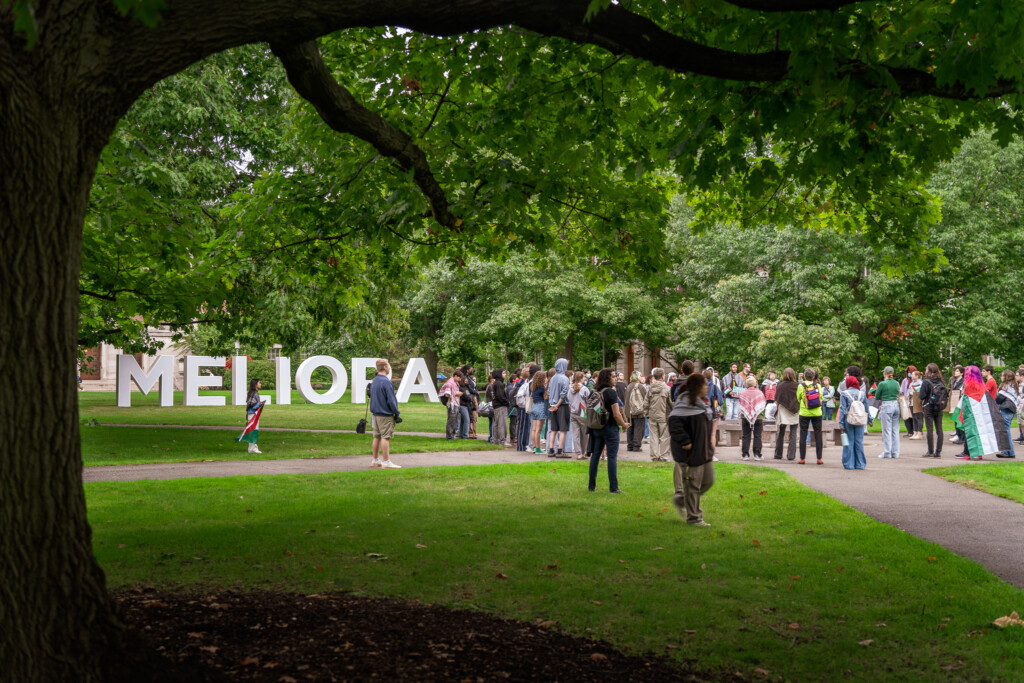
Students gathered at the Meridian on the Eastman Quad on Sept. 24 to protest for Gaza and Lebanon after recent attacks on Hezbollah earlier this week.
The protest’s main speaker, junior Sarah Aljitawi, explained, “The reason that we’re here today is to continue protesting the genocide that’s occurring in Gaza, and specifically, calling out our institution for repressing students’ voices in what we can say and what we can’t say, and also still having academic ties to Israel, and not mentioning or acknowledging the genocide or the loss of Palestinian life, and also to discuss and protest the recent bombings of Lebanon.”
Several students spoke about Lebanon and Gaza, followed by a march around Eastman Quad. Chants of “Israel out of Lebanon. Ethnic cleansing is a crime” and “How do you spell coward? U of R” were heard by students in the walk.
This was the largest protest held on campus since the latest updated protest policies released on Aug. 24. Following updated protest policies, the protest was not registered under an organization but rather under lead organizer, junior Paola Almendarez. Though the event was not sponsored by any student organization, it was promoted by University-affiliated student organizations.
Under the new protest policies, the responsible organizer serves as the main point of contact for University personnel. University spokesperson Sara Miller explained, “This requirement builds mutual understanding about the current event-planning protocols, the parameters of holding an event, and helps prevent any misunderstandings.”
“I want to see if any of the policies change,” Almendarez said. “I want to see how students feel about this sort of, like, registered policy. I think that it will encourage a lot of discussion, and I’m hoping to be a part of those discussions moving forward.”
At one point, Almendarez informed protestors to refrain from using “From New York to Gaza, Globalize the Intifada” in their chanting. She specified, “I was asked by the administration to inform you that ‘From New York to Gaza, Globalize the Intifada’ is something that […] may be making people uncomfortable, and they ask that people stop using it.”
When asked why the protest was called for, Almendarez said, “I requested to hold this event because I felt that it was imperative for us as students to recognize what was happening in Lebanon as an extension of settler colonial violence that we’ve been seeing in Palestine.”
The group plans to hold future educational events throughout the semester to inform the public and raise awareness.
“For them, we have to keep speaking about this,” Aljitawi explained. “For them, we have to keep pushing our institutions to not be complicit in this senseless violence and systematic erasure. And being here is the first step.”