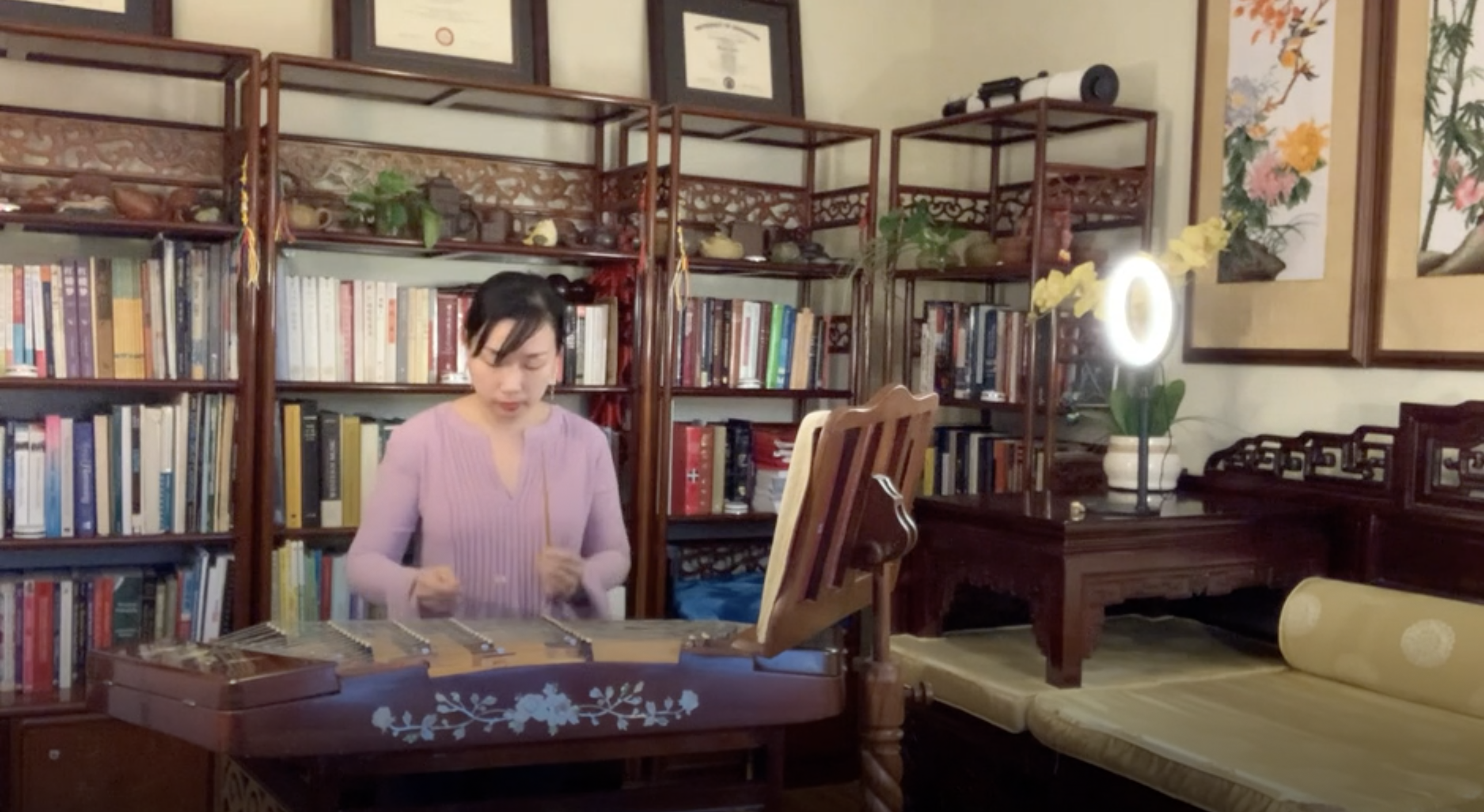
I’d never heard of the yangqin — an 18th century Chinese stringed instrument — until this past Sunday, when I had the pleasure of hearing Eastman graduate and music virtuoso Wenzhuo Zhang ’20E (MA) perform on it in a virtual concert.
Wenzhuo, a Chinese native, began her training on the yangqin at age five. When she was only 13, Wenzhuo was awarded a scholarship to the Arts School of Hebei Province; the highly competitive program only accepted a single yangqin student every two years. After graduation, she placed first in nationwide auditions and was admitted into the National Academy of Chinese Theatre Arts in Beijing, where she was awarded her bachelor’s in yangqin performance in 2005. She obtained her doctorate from Boston University in music education in 2015 and studied ethnomusicology at Eastman from 2017 to 2019. Wenzhuo has performed with countless orchestras and ensembles and won countless awards for her performances.
Before Wenzhuo performed five pieces on her yangqin, she presented a brief historical background of the instrument’s origin, and discussed its continued usage up to the present day. Determined by musicologists to be based off of the similarly-structured English hammered dulcimer, the yangqin was first used in Chinese folk music performance and operas. Later, under Mao Zedong, the yangqin became institutionalized and classicized. Performances began to be sponsored by the state, and yangqin performers were given a path to higher levels of social mobility.
Wenzhuo performed four pieces, three tracing their origins to centuries old Chinese composers, and one from the modern era. Needless to say, Wenzhuo’s performances sounded gorgeous. The yangqin is a unique and beautiful instrument, reminiscent of something between a harpsichord and xylophone, and its sound, coupled with Wenzhuo’s musical ability, allowed the four greatly differing pieces to stand together as a wonderful introduction to the instrument.
It was fascinating to learn about the yangqin and a joy to watch Wenzhuo perform on it from the comfort of my home this past Sunday. If you want to catch similar performances, which happen multiple times for free every week, visit Eastman’s page dedicated to live streamed events!