UR’s tunnel system has a history as long as it stretches across campus and between buildings.
The tunnel connecting the main academic buildings was built in the 1920s when Strong Memorial Hospital was constructed. It has since expanded.
Currently, it connects Rush Rhees Library on one side to Meliora Hall, Bausch & Lomb Hall, Hoyt Auditorium, Dewey Hall, Schlegel Hall, and Gleason Hall. On the other side, the tunnel connects Rush Rhees Library to Morey Hall, Rettner Hall, Lattimore Hall, Wilson Commons, and then to the newly renovated Frederick Douglass Hall.
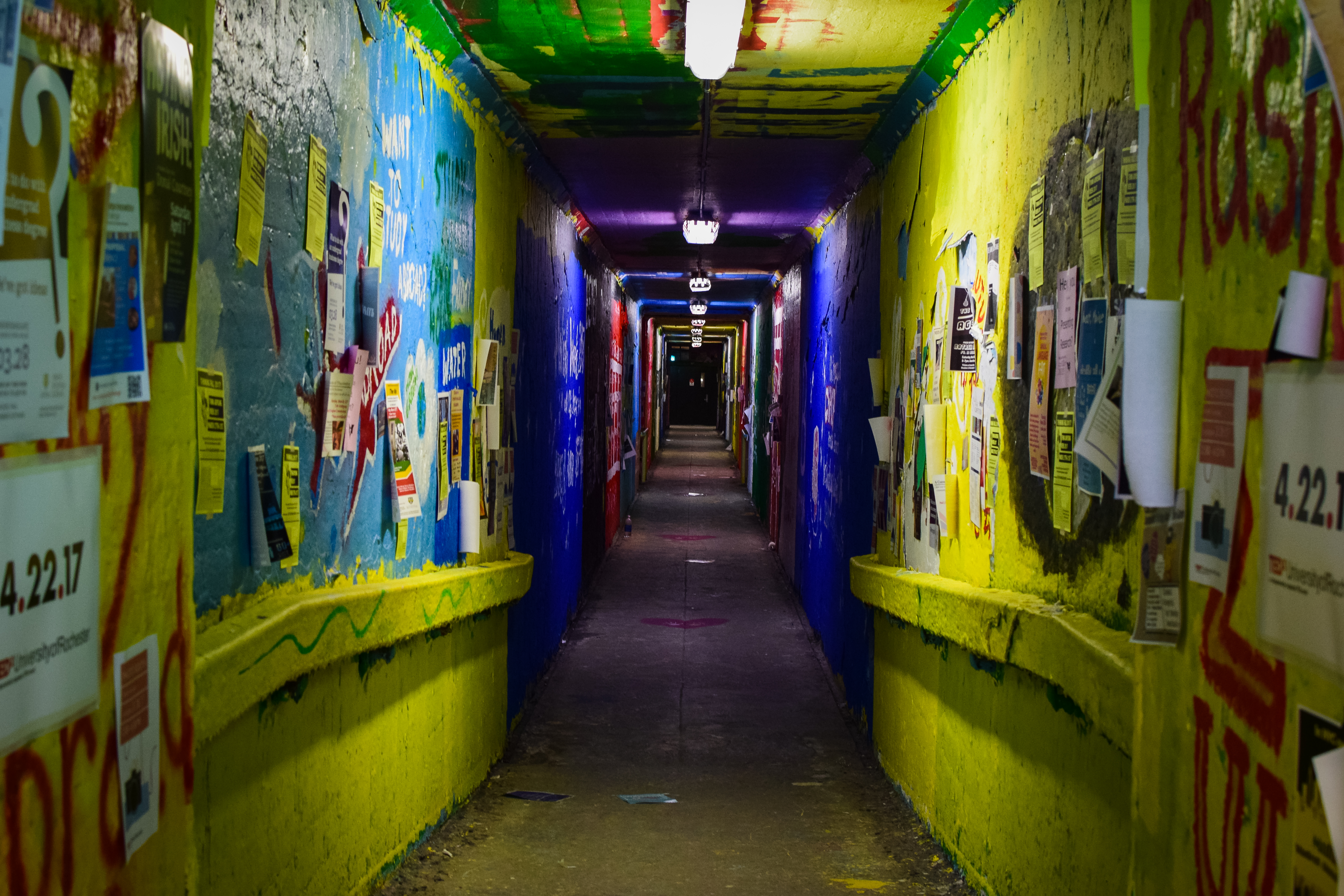
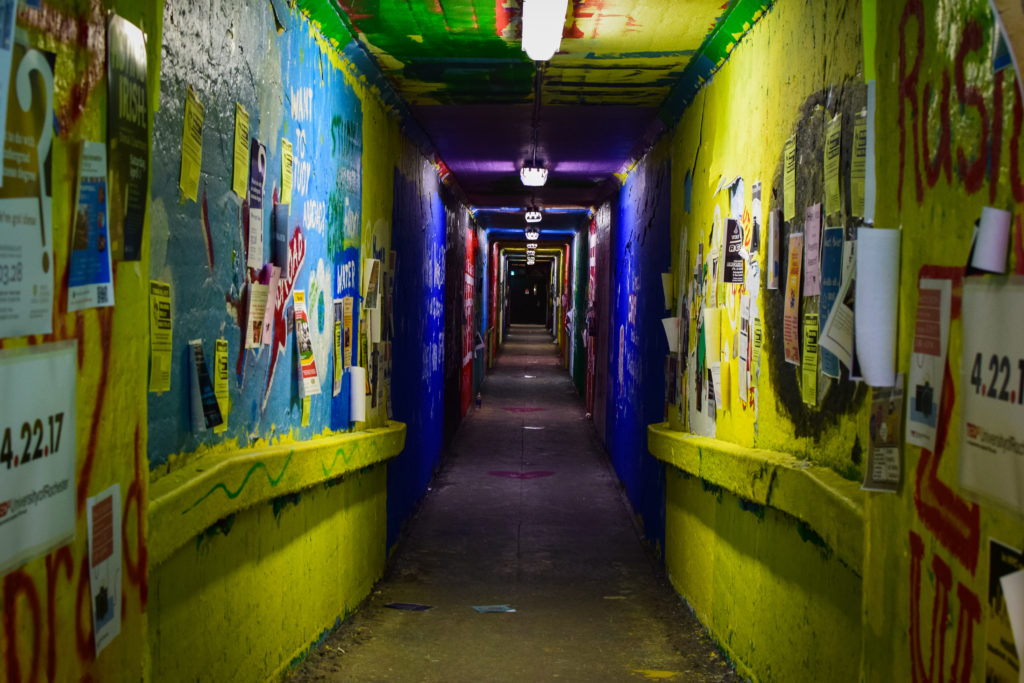
The most famous one among these is the tunnel under the Eastman Quad, which is predominantly painted with messages. The tradition of painting on the tunnel walls started in the 1970s. In recent years it has been a way of advertising upcoming events by student groups.
Two years ago, Rochester-based artist Sarah Rutherford painted the mural titled, “Her Voice Carries” in the tunnel connecting Hoyt Auditorium to Dewey Hall. The mural depicts two images of famed women’s right activist and social reformer Susan B. Anthony.
Along with the central tunnel system spreading all around Eastman Quad there are two smaller tunnels.
Susan B. Anthony Hall was originally the women’s dormitory, and Spurrier Hall was the women’s gym on campus, so constructing the tunnel connecting these buildings made sense. Inside this tunnel, though, there is no heater. There are also holes in the tunnel so you can hear the wind making whooshing noises on certain evenings. Each of the tunnel lamps is colorfully painted, and there are all kinds of graffiti painted on the tunnel walls. Together this gives the underground environment an eery, spooky feeling.
For a long time, there have been rumors circulating about a tunnel connecting the Susan B. Anthony Hall and Rush Rhees Library. According to an article in Campus Times printed in 2001, Facilities and Services at that time confirmed that there were tunnels containing pipes connecting the whole River Campus but said they are not accessible to students. So the only tunnel we can see in Susan B. Anthony Hall is the one connected to Spurrier Hall.
The Sage Art Center, O’Brien, Anderson, and Wilder are connected through a tunnel, too. It is not as old as the Eastman Quadrangle or Susan B. Anthony tunnels. This is just a way for students to visit neighboring residential halls without getting out of the cozy comfort of indoors.
There is no tunnel in the Science and Engineering Quad, but the buildings are interconnected. Carlson Library, Hutchinson Hall, and Hylan Hall share the first floor, while Goergen Hall is connected to Carlson Library by a skybridge. Previously, a tunnel connecting the River Campus to the Medical Center was open to the students, but now only maintenance stuff is allowed in.
Less popular, and far away from the River Campus, is a tunnel that runs under Crittenden Boulevard. It connects the Strong Memorial Hospital to Helenwood Hall, a building in the UR School of Nursing.
Lacking both ornate murals as well as abstract graffiti painted on their white washed walls, the last two tunnels are a stark contrast to their vibrant and colorful River Campus cousins.