Courtesy of Residenial Life
In order to streamline the housing lottery process and accommodate a growing student population, administrators and students are considering a transition to an electronic lottery system.
“We currently have a taskforce of students and staff working on the housing lottery and a piece of that will be online applications and room draw opportunity,” Laurel Contomanolis, director of the Office for Residential Life & Housing Services, said. “We are looking to test it in fall 2012 and use it for room draw in spring of 2013.”
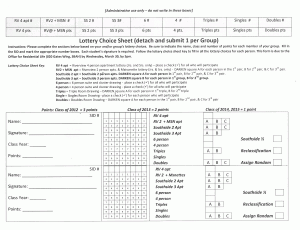
Students currently attend room draw sessions each spring semester to select their housing for the next academic year. Students are required to fill out paperwork promptly, hand it in to the Res Life Office and attend one or more of the room drawing sessions.
“There is a tremendous amount of work that the Residential Life staff prepares manually behind the scenes for each of the eight lotteries,” Contomanolis said.
In addition to the pressure put on the Residential Life staff to sort paperwork and lead the room drawings, the process also puts added strain on students who cannot make it to a lottery session at a particular time.
“I think the electronic lottery system will be a huge step forward,” Students’ Association Res Life Coordinator and junior Shiv Rambarran said. “It will be less time demanding… as [students] will not have to go and wait at Res Life to participate in the lottery. They will be able to make more informed decisions when choosing rooms by having online and instantaneous access to floor and meal plans.”
The Lottery Task Force — consisting of Contomanolis, the chairs of Projects & Services, several SA senators, Director of Dining Services Cameron Schauf, area coordinators and technological staff — meets every other Friday to discuss issues that students currently have with the housing lottery system.
The Lottery Task Force considers confidentiality issues with choosing rooms out loud on the spot, peer pressure issues at room drawings, the seniority point system and the stress related to the process overall.
SA Chair of Projects & Services and sophomore Camila Fernandes called for an entire overhaul of the system, emphasizing the need to make it equitable to all students.
“It is important to understand that our goal is not only to put the lottery process online but also to rethink the entire process itself,” she said,
After a new system is formulated, Contomanolis explained, the necessary programs will be written to make it a reality.
Students have mixed opinions about the future electronic housing process.
“I think it’s fun to go through the whole process with the name calling,” senior Ga-Lim Kim said. “There is an adrenaline rush to the process, and I think the whole cyber process takes the essence of the human life experience [out of the lottery].”
Senior Vladimir Lankevich was not as concerned.
“I personally don’t mind,” he said. “I was pretty lucky with my housing lottery experiences. It would be convenient to have it online, but it’s difficult to say how effective the online system will be.”
Fernandes encouraged more student feedback.
“Students need to realize that administration is willing to help, but they also need feedback in order to make the best decision,” she said. “We want to make sure the lottery process fits students’ expectations.”
Kim is a member of the class of 2013.