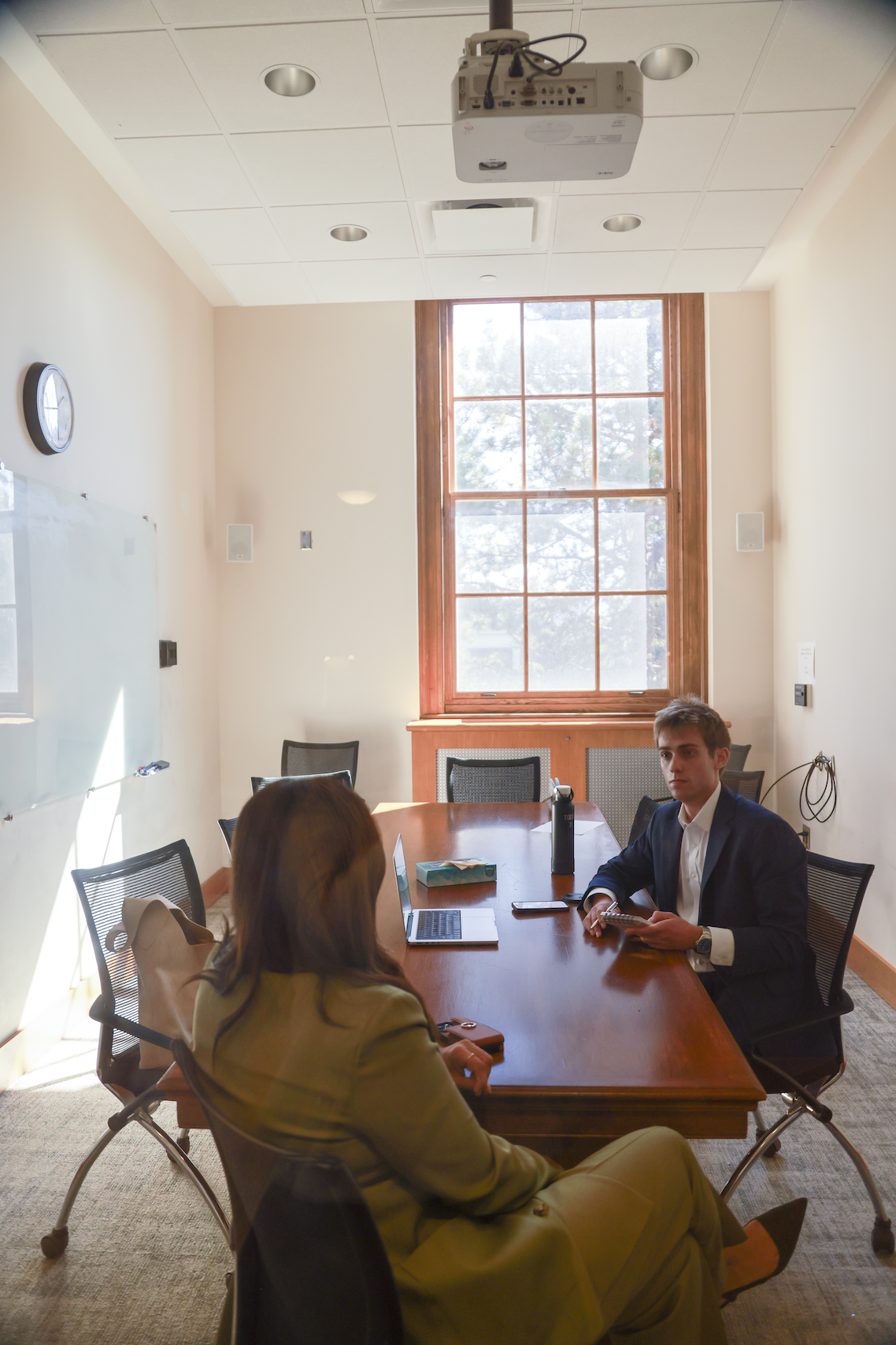
URochester Earth and Environmental Science professor and researcher Dr. Thomas Weber has led multiple, intricate research undertakings on biogeochemical cycles in the world’s oceans. Throughout this academic year in particular, he has collaborated with URochester undergraduate and graduate students to study nutrient cycling in marine environments through multiple research projects.
According to Weber, research on biogeochemical cycles of substances, such as greenhouse gasses, is integral to understanding the sources of gas emissions that cause global warming. Climate change due to human activities, such as emissions from burning fossil fuels, alters the marine carbon cycles as well as the marine environment itself.
“You can think of [marine ecosystems] being an analog to a forest of the surface of the ocean’s plants growing, photosynthesizing, and taking up carbon dioxide from surface ocean water,” Weber explained. “There’s a chain of processes through the ecosystem where the CO2 gets packed into bigger organic matter. Marine ecosystems act as this pump of carbon from the surface to the deep ocean — and that’s climatically relevant because the carbon that gets pumped into the deep ocean no longer exchanges with the atmosphere.”
On one of the two projects Weber is currently overseeing, Weber and the graduate students investigated the sources of iron. They discovered that iron, a mineral usually abundant in rocks, generally arrives into the ocean from dust particles in the atmosphere. Understanding the sources of iron is important to understanding marine life, since many organisms depend on iron to survive, and animals such as whales disperse iron across regions of the ocean.
Another notable project he has overseen was centered on understanding the marine carbon cycle. It specifically investigated how marine life produces and consumes carbon as a result of excess carbon dioxide emissions.
Senior Kylin Roberts, who studies Environmental Science and Chemistry, collaborated with Weber on her senior thesis project about marine carbon cycles. After taking his Physical Oceanography course and gaining research experience at the Bigelow Laboratory for Ocean Sciences in Maine, she decided to pursue further research in biogeochemical cycles and center her senior thesis around marine carbon cycles. Her work often focuses on algae since it is involved in both biogeochemical and marine cycles.
“[Algae] consumes and produces carbon,” Roberts said. “With all the carbon being in the ocean from pollution, the research project was determining if [algae has] enough carbon available that they don’t have to consume carbon anymore, or [if we should] take it out of the atmosphere because it’s all available around them.”
Research for her thesis involved placing a carbon-measuring instrument into the ocean as well as measuring the rates of carbon uptake in algae. Roberts will continue organizing and analyzing her data and plans to publish her thesis toward the end of the semester, which may potentially be published as part of Weber’s work.