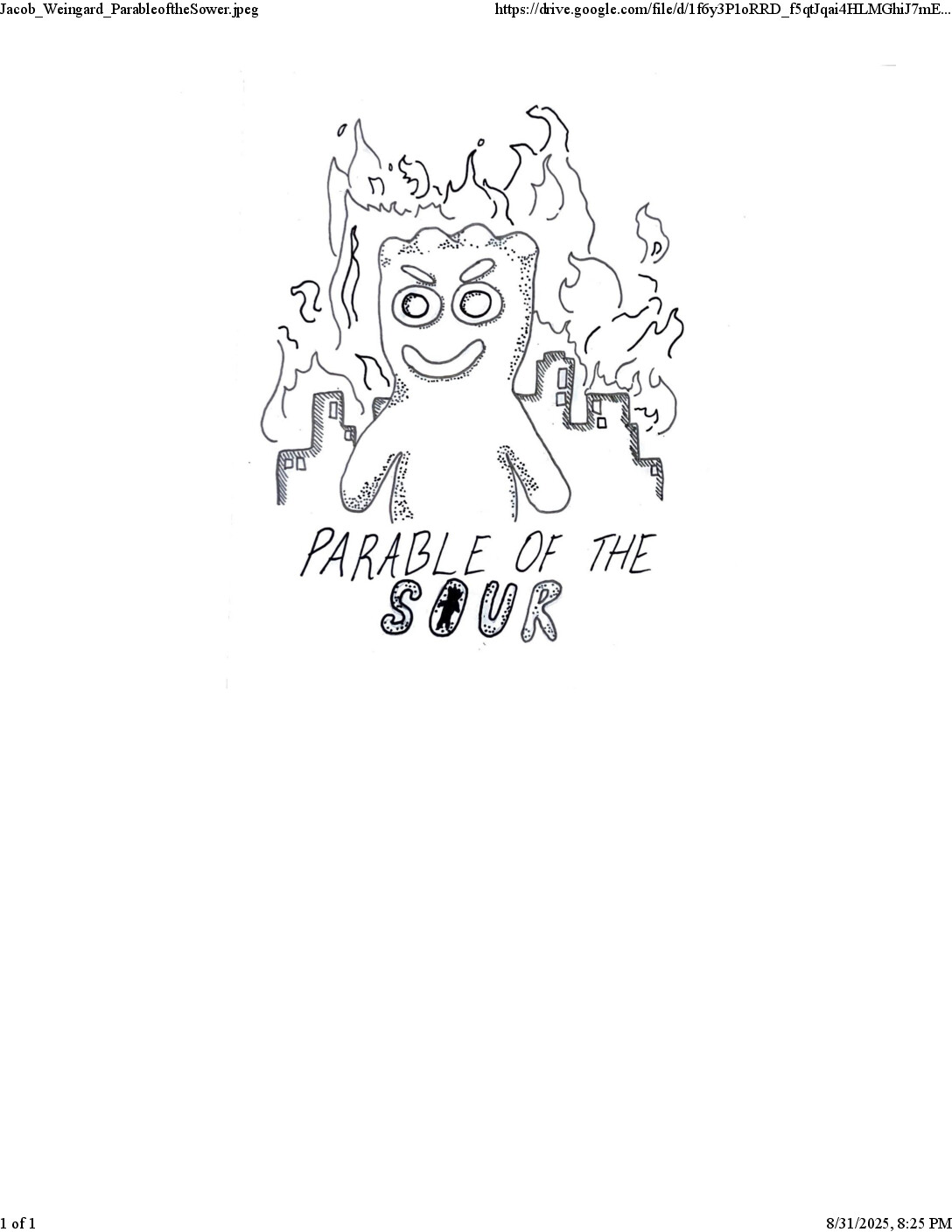
Book Club’s first read of the spring semester, “Parable of the Sower” by Octavia E. Butler, follows Lauren Olamina, a preacher’s daughter living in a walled neighborhood outside of Los Angeles in a dystopian 2024. Lauren’s world has descended into madness and anarchy due to the climate catastrophe that has occurred in the 31 years since the book was published. Due to her mother’s recreational drug use during pregnancy, Lauren has a condition called hyperempathy, making her debilitatingly sensitive to the physical and emotional pain of others. When her neighborhood is destroyed by a fire set by outsiders, Lauren’s family is killed and she is forced to journey north in a dangerous world tormented by scavengers, cannibals, resource scarcity, and “pyro,” a recreational drug that gives its users a euphoric feeling when observing fire. Along the way, she meets a variety of new characters and develops her own belief system, Earthseed, with the main teaching of “God is Change.”
Book Club’s opinions on the novel’s world-building and religious motifs were pretty mixed. Readers don’t get too much background on how the world has gotten to this point, which some felt left something to be desired. However, others suggested that the ambiguity connected us more to Lauren because she has a similar blindness to the former world. She has grown up in the confines of her neighborhood and knows nothing of life before communities like hers were necessary.
The novel’s plot also gathered a lack of consensus among members. Some found Lauren’s hyperempathy to be inconsistent and the logic behind it flimsy, while others found it necessary as a humanizing factor in such a cruel world. One member found it compelling, stating that “every shot she takes she means it, she’s not doing things carelessly like other characters in the book.” Another agreed, saying, “The author needed a connected tissue to make this character care about the people around her.”
Reading the novel in the time of its setting was also a great discussion point given the relevance of themes such as environmental disaster, corruption of law enforcement, and religion. Our members appreciated the chance to compare and contrast Butler’s dystopia with the one we are (or aren’t) living now. In addition, some felt that the journeys of Lauren and her contemporaries were relatively unrealistic given the state of the world. For example, Lauren and the two surviving members of their neighborhood trust a group of travellers they meet relatively readily and never really face consequences. They are never stolen from and don’t run out of money in a world supposedly crawling with scavengers, thieves, and a severe dearth of resources.
Other major topics of discussion were the themes of religion and trust. Our members found the novel to be an interesting commentary on why people turn to religion and how it can evolve in times of need, with Lauren crafting her own religion and preaching to her found family. One member felt that “The purpose of religion for her was […] finding agency,” commenting on the functional purpose of religion in Lauren’s life. Another felt that “the power of belief almost creates hope […] it almost makes life so much more bearable.” Although there was agreement on the thought-provoking nature of the role of religion in the story, the actual tenets of Earthseed raised some eyebrows. While some members appreciated the fluidity of Lauren’s teachings, others felt that it was too vague to be a realistic or useful belief system.
“Parable of the Sower” was followed by “This is How You Lose the Time War” by Amal El-Mohtar and Max Gladstone in the Book Club lineup, which also garnered mixed opinions from our members. If you are looking for an excuse to get back into reading or are searching for your next read, join us for a new semester of Book Club this Thursday, Sept. 4 at 6 p.m. We will be in Douglass 401 with introductions, activities, and an overview of our voting nomination process. Make sure to stop by and join us on CCC.