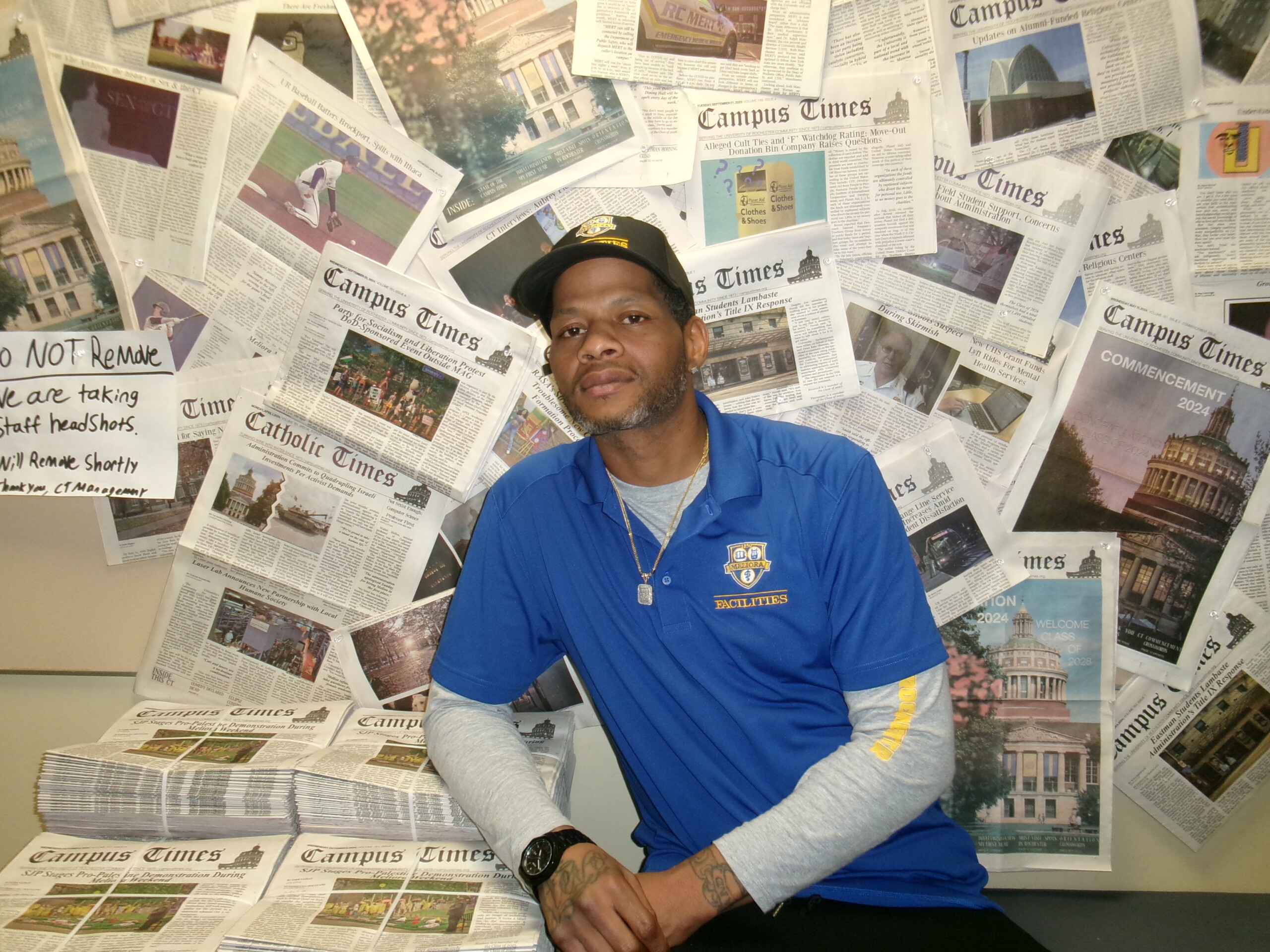
As the campus bustles with students and staff, Corey Arnold quietly goes about his work, ensuring that UR remains a welcoming and clean environment. With one and a half years of experience under his belt, Arnold has become a familiar face in the University community.
Arnold works in Environmental Services from 1:30 p.m. to 10 p.m., primarily covering the first and second floors of Wilson Commons. “If someone’s not here, I do the whole building,” he explained.
Originally from Rochester, Arnold knows the area well. Before joining UR, he worked as an electrician alongside his brother and through temp agencies.
“I got stuck here because I loved it,” he shared. “Because, it’s like, you doing my work and a lot of times y’all help me to make my day go through by communicating with me. It makes the school go better when you communicate. Lack of communication, you really don’t get nowhere.”
He recognizes that many students may be shy or preoccupied with their own groups, but he encourages them to engage.
“I guess they don’t expect us to conversate with them people a lot. There’s a lot of times they stay … to themselves. I’m a more people person. I want to learn from people so they can learn [from] me instead of who I really am and see that I have a good heart. Some people try to probably judge me sometimes. I’ll be overexcited so they don’t know how to take me, but I’m a good person. They just really get to try to know me.”
One thing Arnold learned from working in Environmental Services is that helping means a lot to him and goes a long way. Not only does he appreciate the help that students and other staff offer when he’s on his shift, he’s also willing to help people.
“If anybody comes to me, I’m willing to help them after I get done with my job. Or even if it’s in the middle of my job and it’s right there while I’m doing my job, I’ll still help too.”
He sees himself as more than just a custodian. He wants to be a supportive figure for students.
“I want you all to get far in life,” he said, positioning himself as a “parent away from parents.” He explained, “Because, it’s like, some of y’all far away from y’all parents. So y’all need to talk to them, like, on the phone or on y’all tablet or, you know what I mean? And, it’s like, sometimes y’all need an older person in conversation to help y’all go through what y’all going through here too.”
He knows how important it is to have a mentor when away from parents because he has five sons himself and three grandchildren.
“If my kids not around me and they around older people, I would want them to feel comfortable by having a parent kind of parent to parent them.”
Reflecting on his interactions with students, Arnold fondly remembers a particular exchange with a student who offered to buy him lunch, which he found both touching and bittersweet.
“It was sad that the way they see me work, I really don’t sit down and eat but a salad. So it’s just like when she did that for me, it was just amazing. And she didn’t have to do it.”
Ever since he started working here, he became friends with Elijah Bader-Gregory, Student Association president. “He speaks to me with joy. Like, he really sit there and conversate. And I love his conversation, you know?”
“Everything positive. Everybody knows me. Everybody’s cool with me,” he noted, emphasizing the uplifting connections he makes daily.
Last semester, Arnold was out for six months for hip surgery, and many people thought he was fired. But when he came back, students and staff were really happy that he was back.
Regarding other staff in Environmental Services, Arnold said, “We all hang together … Some of us eat lunch together, you know. And we ain’t got no bad vibes with each other.”
He also appreciates his bosses who also sometimes help around during his shifts, and Miss Jen from the library who has always spoken up for him
For students looking to make Arnold’s job easier, he stresses the importance of communication and consideration.
“Communicate with us,” Arnold said. “Show us that we here. I mean, because a lot of time, because we’re like the bottom of the bunch. […] When you go to the bathroom, when you wash your hands with the napkins, like, pick them up and put them in the garbage. That’d be more helpful for us too. So we gotta keep going through the same stuff all the time.” But he understands that students are always in a rush, trying to get to classes.
A little acknowledgment can also go a long way in bridging the gap between custodial staff and students. “We often feel like we’re at the bottom of the bunch,” he admitted. A small act like properly disposing of trash can make a significant difference in his day.
One of Arnold’s favorite eating spots is a Mexican restaurant called Three Brothers in Geneva. He also loves seafood and the outdoors. He’d rather be outdoors than be in the city because it’s more relaxed and not too busy.
He went to New York City before and thought “people were robots, because [he’d] be like ‘Hey, how you doing?’ and they’d just be walking past you like they don’t know who you are.”
For his future, he wants to buy a tiny house, similar to a mobile home, and travel everywhere.