During London’s Industrial Revolution, the trees turned black. Soot from the numerous factories, churning out material goods at an inhuman rate, drifted through the air and rained down from the sky, covering the surrounding forests in a thin layer of ash. The white peppered moths that lived in the forest were suddenly at a disadvantage. The white trees that they used as camouflage from birds were no longer white. So, they adapted in a process biologists call a “directional color shift,” as new generations assumed the color that was more advantageous in their environment. Within a few decades, the majority of peppered moths were black.
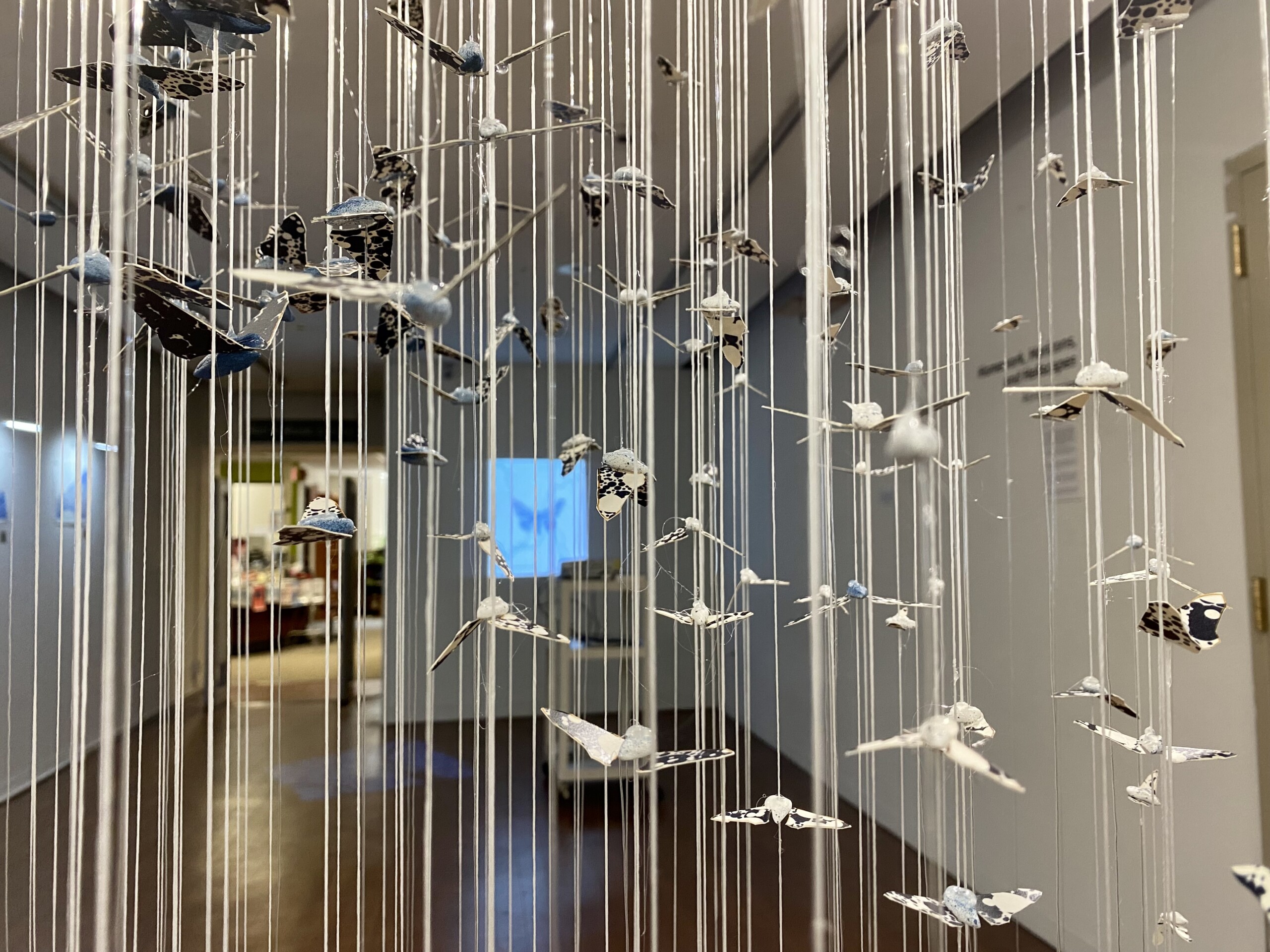
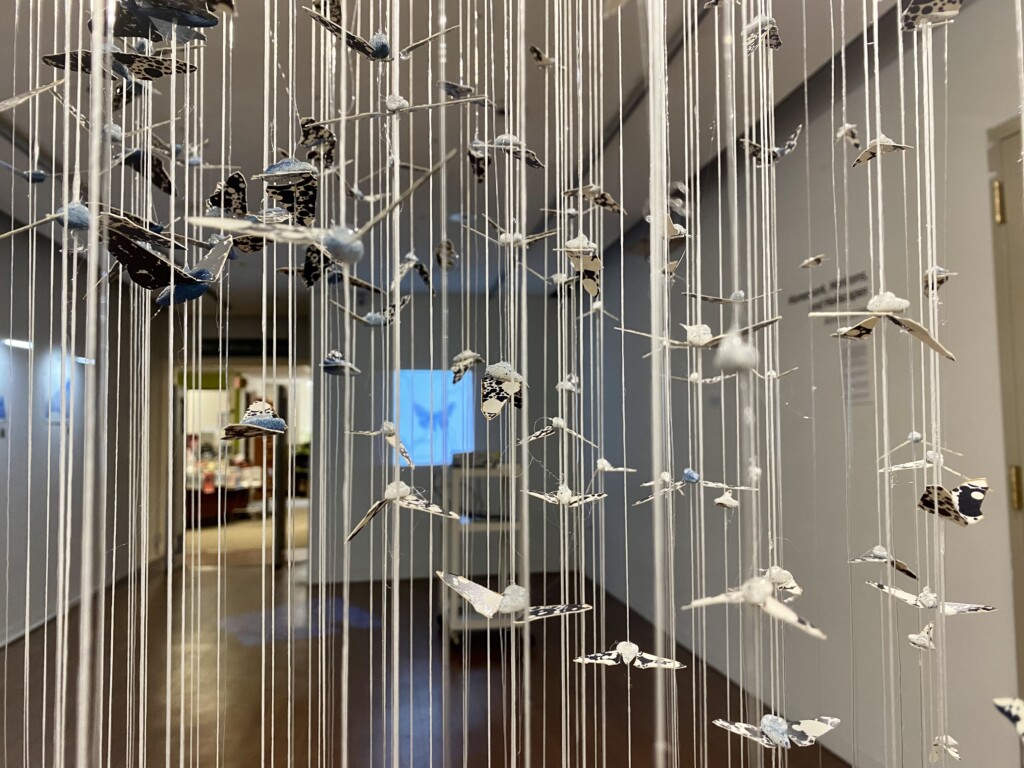
Such deeply visual evidence of humanity’s impact on the world is rare or at least not often flaunted, but it is this trend that senior Anna Lusier hopes to bring to the forefront in her senior art exhibit, “Homework, Hellscapes, and Horizons.” Her piece, “Moth Magnification,” stands in the window of the Frontispace Gallery, showing tiny sculptures of peppered moths changing from white to black. The three-dimensionality of the little Lepidoptera, hand-crafted and strung in a gallery, represents natural selection artificially and blatantly. How natural is natural selection when spurred by strictly anthropogenic means?
Lussier’s artwork aims to interweave environmental facts, environmental fictions, and environmental futures at the cost of our small comforts. She wants her artwork to be aggressive, assistive, and accountable. And her pieces in the Frontispace Gallery are nothing if not thought-provoking.
Her portfolio of artistic skills is diverse, and in this exhibit alone, her vision takes form in video projections, drawings, and sculptures. Along a side wall are a series of pen and highlighter drawings on graph paper. Each drawing seems to lie within the confines of an arbitrarily graphed line. But underneath each piece is a QR code that, when scanned, takes viewers to the graph that inspired the artwork. Her pieces address the shrinking of the Aral Sea, the increase in food waste in landfills since the 1960s, soybean production, health of fish stocks, and emissions and expected warming by 2100. Some of these graphs speak to more obvious environmental issues. Others force you to pause. What happened to the Aral Sea? What do soybeans have to do with anything?
The answer to both questions is key to the theme of the exhibit. The Aral Sea was drained for unsustainable cotton cultivation, resulting in toxic salt plains where there used to be flourishing fishing communities. Demand in the soybean industry is rising, causing widespread deforestation, lowering water quality, and displacing indigenous peoples. These are deeply human realities often reduced to statistics. We can read about how many trees are cut down each year to make room for industrial farming, but what does that number truly mean? A trendline on a graph may be two-dimensional, but the effects exist in a multi-dimensional world. Underneath the graphs, hidden behind rational squares and plotted timelines, are thousands of unnamed voices, crying out from between x and y.
Lussier’s exhibit urges visitors to understand the effects that we supposedly will never experience, attempting to create a space where facts and empathy can coexist. “Between the rigid grids and blank horizons there is still time,” Lussier’s artist statement urges. “We can create space. We can reconsider our connections to the future, and to one another.”