On Monday, SA deliberated over a resolution supporting the creation of a Latin American Studies department and major at UR, a measure that was drafted in response to a petition created by senior and president of the Spanish and Latino Students’ Association (SALSA) Elvis Vasquez that has garnered over 370 signatures on the SA petitions website.
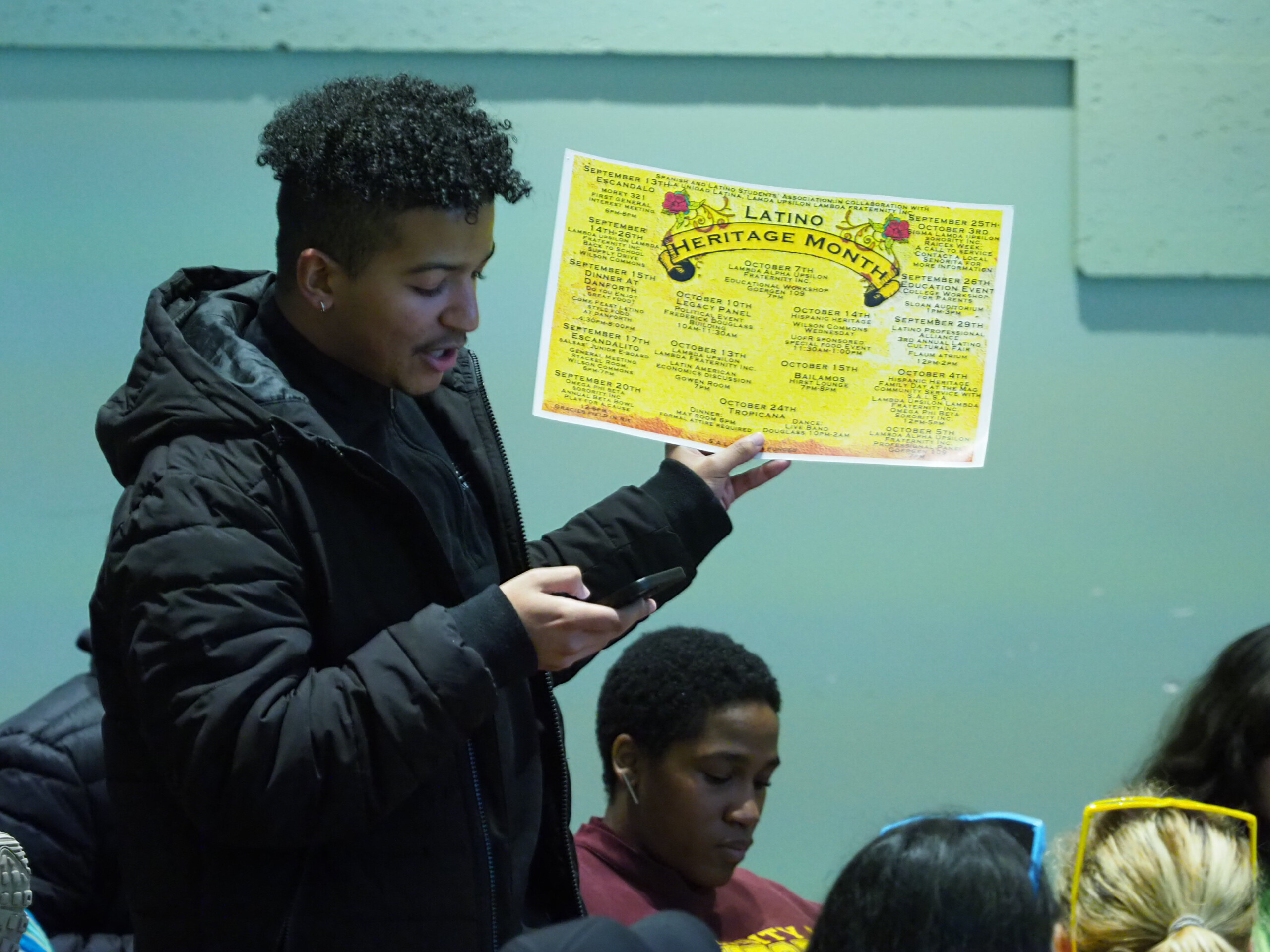
The resolution passed by a unanimous 13-0 vote after Vasquez and six fellow students gave speeches supporting the statement. Holding a colorful promotional poster for a full month’s worth of SALSA events, Vasquez spoke first.
“This is a poster from the fall of 2011 of what [SALSA] did for Hispanic Heritage Month,” Vasquez said. “They tried to create an event for almost every day of the month just to make a statement, just to make it known that we exist on this campus. […] And for anyone who has experienced planning big events on this campus, then you know that this process is exhausting. But it was necessary because, before 2013, two years after this Hispanic Heritage Month demonstration, there weren’t any courses that effectively centered Latin America despite the effort of students. In 2007, an undergraduate student tried to create this major, but it was shut down by the school. This cannot happen again.”
Senior Diego Encinas also spoke. He went through the Interdepartmental Studies program to create a Latin American Studies major, and he had nothing positive to say about the process.
“I can only say that it was overly complicated and very stressful. There are several times I would go weeks, sometimes months — and I’m not saying that to be dramatic — that I wouldn’t hear back from my department advisors. […] Nothing about the process incentivizes students to partake in it.”
Alongside calling for the department’s establishment, the students critiqued the treatment of topics relating to Latin America, particularly in classes outside the History Department. Junior Andrés Arocho, the president of the Student Organization for Caribbean Awareness (SOCA), said these classes usually discuss Latin America through the lens of the United States.
“This excludes the essential local perspectives on things,” he said. “We learn about colonization through the eyes of the colonizer but don’t actually get a holistic representation of the Latin American story.”
Arocho also said the establishment of the department would provide all students with a space to discuss Latin America while helping Latin American students “reconnect” with their identities and histories, echoing a call made in an earlier speech by first-year Paola Almendarez.
“Latin American Studies as a major is necessary within a diverse and culturally-aware institution like the [UR],” Almendarez said. “Though I’ve not been here for long, I’ve learned that many first year Latino students, including myself, have noted a lack of representation with the curriculum. This representation is necessary to not only connect Latino students with their histories, which have been historically suppressed, but to further educate other members of the [UR] community.”
While the resolution passed, it is only a statement of support. The major will have to be proposed to and approved by the College Curriculum Committee and pass checks by the New York State Education Department, and the department’s creation will have to be approved and facilitated by administration with the School of Arts and Sciences. This end of the advocacy is being spearheaded by History Lecturer Molly Ball, who is the coordinator of the Latin American Studies minor.