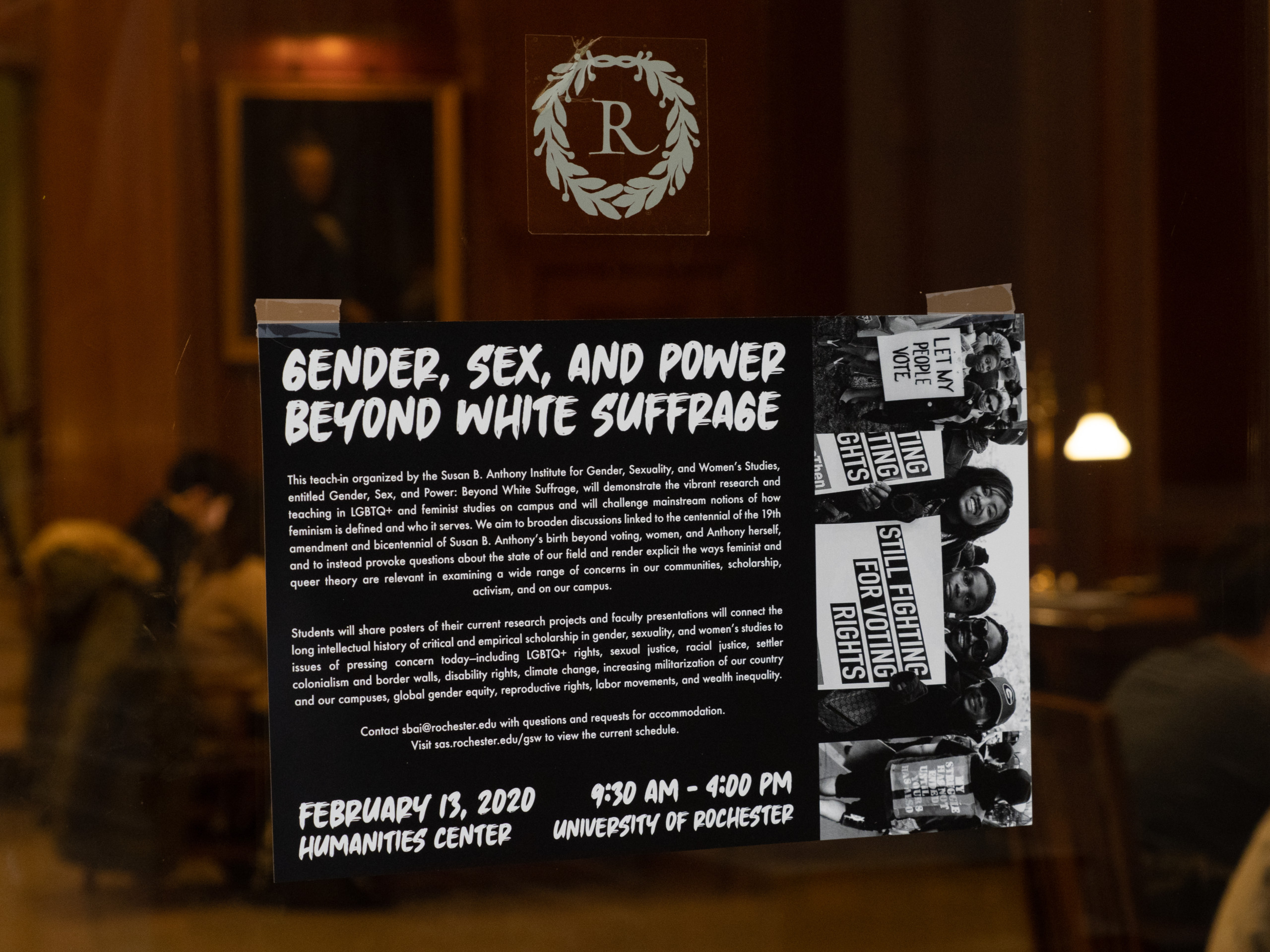
Executive director of Bitch Magazine and UR adjunct professor KaeLyn Rich opened “Gender, Sex, and Power: Beyond White Suffrage,” a series of presentations that boasted a number of talks intended to aimed to expand the audience’s understanding of feminism’s intentions and applications.
Her talk specifically surrounded the idea of “power and control,” or the rigid hierarchy of the modern workforce.
Rich opened her presentation on Thursday with a description of Facebook COO Sheryl Sandberg’s book, “Lean In.”
This book, she said, was intended as a guide for women looking to empower themselves in the workforce. She quoted a criticism from journalist Susan Faludi: “It’s a corporate-backed campaign that encourages women to promote themselves as marketable, common objects for professional advancement, while dismissing solidarity and downplaying the effects of systemic gender bias.”
“When I think about feminist leadership and what I’m here to talk about today, I’m not really here to talk about ‘Lean In,’” Rich said. Rather, she discussed ways to improve working conditions for employees within the confines of a capitalist system.
Rich introduced the concept of a panopticon, created as an organizational structure for prisons, but later expanded to other institutions, including the capitalist workforce. A panopticon is a building with rows of cells blanketing the walls on all sides, with a guard tower in the center. The guard cannot see every cell at once, but the prisoners can never be certain whether the guard is looking into their cell, so they’re always on their best behavior. The creator of the panopticon, according to Rich, also foresaw its usage in “asylums, schools, and hospitals.”
“And then during the industrial revolution,” Rich said, “it became a really popular way of organizing factories.”
Rich continued, saying the panopticon was part of a trend toward constant observance of the worker under capitalism, as well as an example of power and control in the workplace. “What else are power and control issues?” she asked. “Sexual assault, interpersonal violence, the police — it’s a power and control sort of dynamic.”
She related the concept of the panopticon to modern uses of the internet, asking, as she gestured to the camera recording her, “What are some of the effects of living in a world where we are, truly, in a state of surveillance, always possibly being watched and not being watched, as we livestream to Facebook?”
She also related it to her aims of improving the lives of her employees while surviving in a capitalist system. “You trust your staff so that you’re not always watching them — you’re trusting that the work is getting done,” she said, though she cautioned against “putting your emotions on people, because regardless of what everyone thinks, you’re still a boss.”
“You want to be careful. You want to be vulnerable and open, but you don’t want to be abusing your power,” she said.
Rich also discussed organizational structures without any hierarchy as alternatives to top-down leadership, but abandoned this concept as too difficult to put into practice.
“The movement Occupy Wall Street was a very flat and leaderless group of people,” she said. “And then eventually it dissipated because nobody was leading it.”
Concerned both by the nature of capitalism and by the unsustainability of flat leadership models, Rich said that while she’s looking for ways to dissipate the culture of overwork at Bitch Magazine, there are still some unknowns.
“I think the biggest challenge, honestly, for nonprofits, and for leaders and managers, even in the most progressive spaces, is capitalism,” she said. “It’s that we still live in a world where we need to pay the paychecks.”