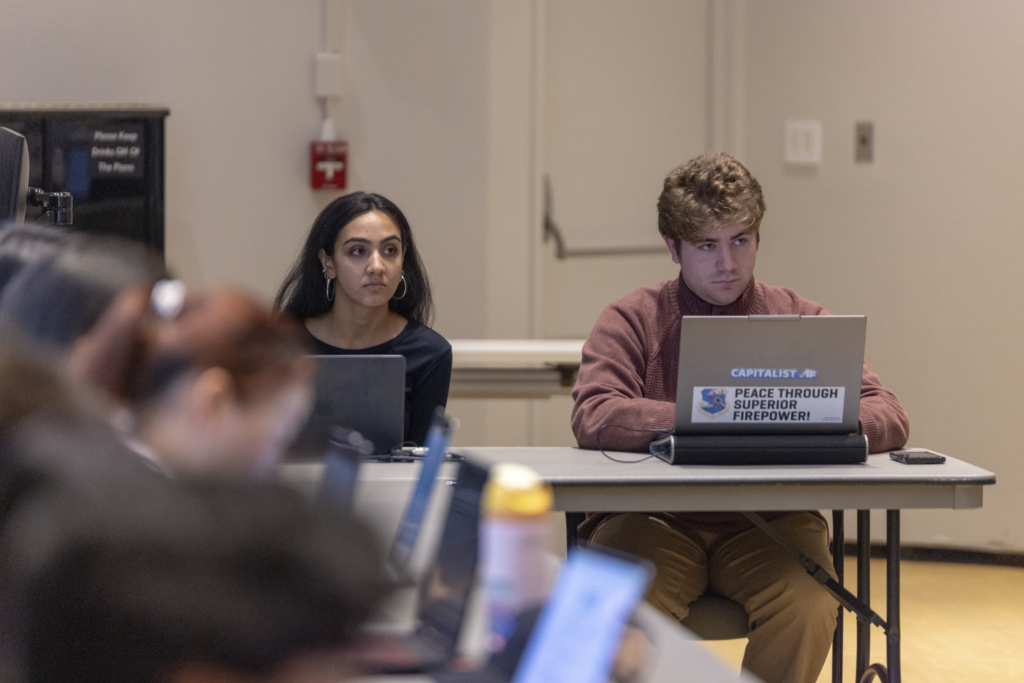
Now is more important than ever to exercise your rights, sophomore Justin Delinois told the assembled students, an audience that included members of the Douglass Leadership House (DLH) and a bevy of visitors.
Delinois was referring to DLH’s “Lounge Lesson” for the month of February: “Black Activism: Know Your Rights.”
Delinois, who led the event, explained that the evening would address the topic of black activism in a broad sense, with a focus on the legal rights of protesters and other activists.
He introduced Iman Abid, a representative from the New York branch of the American Civil Liberties Union (ACLU), who spoke for the better part of an hour on the legal rights and restrictions activists might face when attending rallies and marches.
“You can speak to anything [on public land] as long as it doesn’t condone any violence,” she told the audience.
She noted that the protection of free speech extends to the distribution of leaflets and literature as well, with the same caveats.
The summer of 2016 saw some of the largest #BlackLivesMatter rallies ever organized in Rochester, Abid noted, but those rallies also saw the arrests of 74 people.
So what rights does one have when encountering police?
Abid explained that the ACLU endorses civil disobedience, and that it’s better to walk away unharmed from an interaction and take legal action later.
With that said, Abid explained how to exercise one’s Fifth Amendment right to remain silent (by announcing it), and that citizens may legally refuse to comply with a search of their belongings—although the officer may legally (or not) search you regardless. It’s also legal to calmly leave, if you aren’t actually under arrest.
Abid urged activists to have the name of an attorney at hand when protesting, and to consult the ACLU’s online pamphlets on encounters with FBI agents, immigration officers, and law enforcement personnel.
Activists should also take care to remember that their rights on private property—which includes campus and other private universities such as RIT—may differ from those on public property.
Abid explained, in response to a student question, that the Department of Public Safety officers wouldn’t need a warrant to enter and search a dorm room or a car.
After speaking and answering questions for the better part of an hour, Abid turned the floor back over to Delinois, who wrapped up the event with a discussion of activism in general, covering topics such as criminal justice, LGBT rights, racial equality, and animal rights, among numerous others.
He gave a brief lecture on a number of black activists, including Mary McLeod Bethune, a 20th-century educator who sought to improve education for African-Americans; Wangari Maathai, one of Kenya’s first environmental activists; Marvelyn Brown, an actress and AIDS activist; and Jimmie Briggs, an investigative journalist whose focus is on human rights