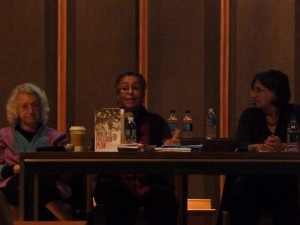
Alysha Alani, Contributing Photographer
Ordinary people can make an extraordinary difference in the world. This was the message of three women who spoke to a large crowd of students, workers and community members on Thursday, Oct. 18. Judy Richardson, Betty Garman and Dorothy “Dottie” Zellner came to the Interfaith Chapel to tell stories from their book, “Hands on the Freedom Plow,” and to share lessons learned from lives devoted to activism.
Richardson, Garman and Zellner were all members of the Student Nonviolent Coordinating Committee (SNCC) during the Civil Rights Movement of the 1960s. Inspired by the famous Greensboro sit-ins of 1960, SNCC was instrumental in freedom rides and voter registration drives that helped to end segregation in the American South.
The three women were college-aged when they moved from the Northeast to Alabama to join the organization. It was not bravery or uniqueness that brought these women to the front lines of the fight for equality, but a sense of responsibility to fight for justice.
“I consider myself the average, everyday, ordinary coward,” Zellner said.
Each of the women had been exposed to intolerance and discrimination. Zellner had seen the liberation of the concentration camps; Richardson, the mistreatment of workers; Garman, the racial prejudices of her family. These experiences, in combination with the injustice occurring on the national level, prompted the women to action.
“I had to ask myself what kind of country I wanted,” Garman said.
Once in Alabama, the women helped with clerical tasks such as typing and operating phones for SNCC. Life wasn’t easy.
“However bad you think it was, it was worse,” Zellner said.
The women faced local hatred, police brutality and the constant fear of being arrested or killed. Nonetheless, each gained a great deal from her involvement with the group. SNCC forged their friendship and developed the women’s desires, ideals and goals.
“SNCC changed who I was, changed who I became … it gave me new eyes,” Richardson said.
Richardson, Garman and Zellner remained with SNCC throughout the civil rights movement and continued with social activism in the years that followed. They returned to their days of SNCC when they co-wrote their book. Working with three other SNCC women in what became a 15-year project, Richardson, Garman and Zellner created a master narrative of the experiences of 52 women involved in SNCC.
“We hope young people will see themselves in these stories and see that they can do something about what’s wrong today,” Richardson said.
This hope for student action was echoed among all three of the women. They pointed to issues in the U.S. that seemed to parallel the problems they had fought against: disenfranchisement, inequality and discrimination.
The women urged the audience to learn from history that movements can begin with a single action — students need not, and should not, wait to get involved with a cause about which they are passionate.
“It is time for each one of us to think about how our voice is going to be heard,” Garman said.
Hansler is a member of the class of 2015.