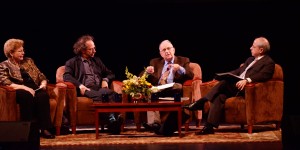
Sam Bearzi, Contributing Photographer
The subject of the humanities’ role in today’s world brought over a hundred UR alumni and a handful of students to the sixth annual Presidential Symposium entitled “The Humanities, Artistic Expression and the Digital Age” on Saturday, Oct. 13 in Strong Auditorium as part of Meliora Weekend.
Stanley Fish, a professor of law at Florida International University, exchanged discussion with fellow panelists Katherine Hayles ’77, director of graduate studies at Duke University and Tod Machover, a music and media professor at Massachusetts Institute of Technology, during the event’s heated 90 minutes.
Dean for Humanities and Interdisciplinary Studies Thomas DiPiero — who stood in at the last moment for moderator Hugo Sonnenschein ’61 — asked Fish how relevant the digital humanities are to present academia.
Fish, a self-proclaimed “print scholar,” said digitizing the humanities is an attempt to become “more like the sciences,” and will lead to nothing but “perhaps more funding.”
Criticizing Fish’s analysis as “partial and, in places, incorrect,” Hayles argued that it reflected the dated views of someone averse to change.
Machover added that technology’s ubiquity is reason alone to not remain neutral about the digital age.
“Technology holds a great deal of power if you take advantage of it,” he said. “If you don’t, you become a slave.”
Fish clarified that he had “only admiration” for the other panelists and “no quarrel with the creativeness of technology.” He also acknowledged that choosing not to enter the digital revolution is “the hermeneutic of screwing around.”
After the moderated discussion concluded, DiPiero opened the floor for audience members to ask questions.
One alumnus questioned whether digitizing the humanities, “while used as an instrument to enhance the world,” replaces their fundamental humanity, producing murmurs and nods of agreement throughout the room.
Hayles replied that though humanity is, by its name, essential to the humanities, it cannot be considered an intrinsic, immutable idea.
“It’s neither historical nor transcendent, but requires constant interrogation,” she said.
After a few more queries, UR President Joel Seligman chimed in. Admitting that “it’s not an easy question,” he asked the panelists what lay in store for the humanities.
“They have no discernible product, no public appeal,” Fish responded, citing the unique predicament of the humanities.
“Though we will never be able to justify their existence, we must make sure that the humanities are supported, no matter what anyone else says.”
Hayles quipped that she, for once, agreed with Fish, provoking a round of applause.
“You can’t design a future by looking in the rearview mirror,” she said. “Digital literacy skills are central for students in the 21st century.”
Fish expressed his pleasure that he and Hayles had finally found common ground, while Machover initiated a three-way handshake of sorts.
DiPiero had the final say, encouraging the crowd to take the “evaluative thinking” the humanities have traditionally fostered and continue to apply it toward bettering the future.
Audience members praised the panelists for a lively dialogue and reacted positively to the event overall. Harold Mansfeld ’62 described the symposium’s topic as “eye-opening.”
“Having attended UR when the liberal arts were at the core of its curriculum, I am fascinated by the ways in which the humanities have evolved,” he said.
Senior Nathan Travis shared Manfeld’s positive outlook.
“The panelists all gave a captivating glimpse at how the humanities and liberal arts can mesh with today’s digital age and help it further advance,” he said.
Gould is a member of the class of 2014.

