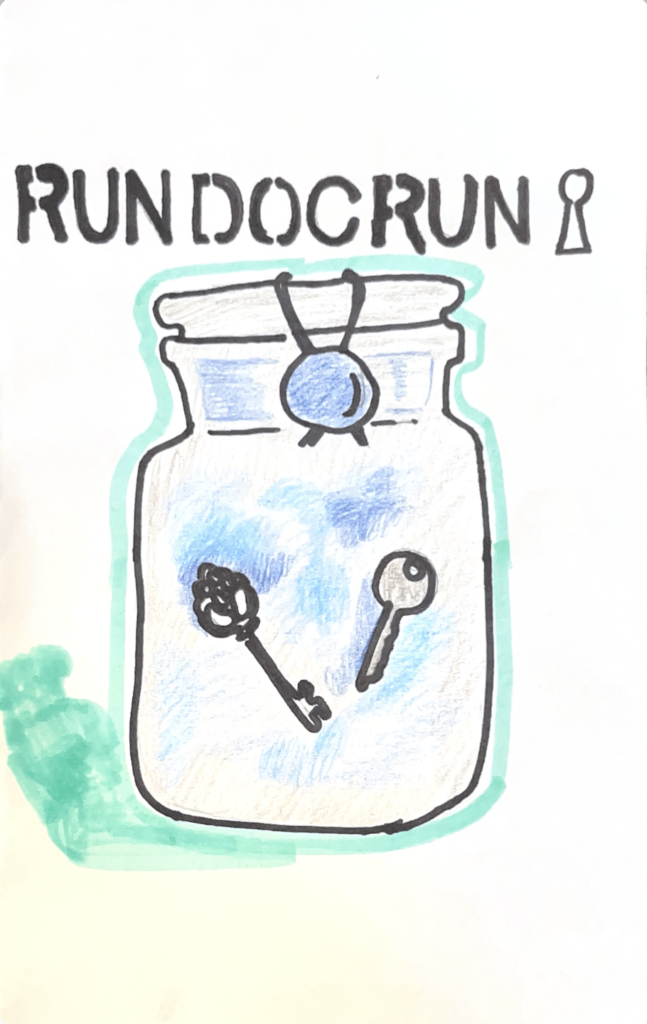
There are certain life skills and experiences that are formative in one’s perception of the world and the impact they desire to have on society. “What do I have to offer? What can I do to make the world better?” are questions that many children consider, and from a young age Shirish Patel knew that medicine was his calling. Through a childhood that focused on the depletion of wildlife, the desire to be a flight medic/doctor, and the overwhelming feeling of community while hiking, Patel knew that there was something to be admired about the way humans connect with each other. Whatever he did, he wanted to bring connection and accessibility to the world. His recent book, “Run, Doc, Run,” takes a literary step inside the world that forms a doctor through experiences and training.
Though his endpoint was psychiatry, Dr. Patel didn’t always want to be a psychiatrist. While going through med school, residency, and key rotations, Dr. Patel’s thoughts around mental health echoed the general sentiment of the ’80s: that psychiatry was taboo and a relatively unimportant form of medicine. Harmful phrases like “loony bin” and “shrink” kept the public’s negative opinion on psychiatry in a constant positive feedback loop.
Though his textbook understanding of psychiatry was rather limited, his move to the United Kingdom forced him to reevaluate this skepticism. Sudden unemployment in the UK left Dr. Patel with little choice but to give a psychiatry career a chance. With a half-open mind and no clue what to expect, he was thrown straight into a rotation of psychiatric hospitals that were fed patients with ailments that no other medical hospital could find a cause for.
Psychiatric hospitals present a different perspective on illness than that of a standard medical hospital. A medical doctor has quantitative evidence that points to a disease and a potential cure. Psychiatry isn’t as simple: a lot of the symptoms come straight from the patient rather than the tests, and they aren’t always visible or obvious. And, more often than not, psychiatry prevents more of a physical danger to the doctors in the field than in most other professions.
Dr. Patel had to grapple with this fact during the beginning of his career. He knew that medical school would restrict his view of patients to just a list of symptoms, and didn’t want to lose his empathy for the whole person. He saw patients that struggled with conditions defined in psychiatric research such as obsessive compulsive disorder (OCD), schizophrenia, and dissociative identity disorder (DID), as well as patients who struggle with suicide ideation and self harm. All of these patients, in some way, had a formative impact on the doctor he would become. They taught him the importance of listening, a gentle touch, and of being the doctor willing to explore other options.
Though Dr. Patel physically settled into this field eventually, the acknowledgement of the stigma surrounding psychology and the field is something he had never thought much about. As much as psychiatry wasn’t seen as a real medical field, psychiatrists weren’t always seen as being real and knowledgeable doctors. Dr. Patel thought this way himself at the beginning of his career. He confesses to once believing that psychiatry, as a profession, was below him and his standard medical training. As he progressed within his career, this impression ceased. He began to see his fellow psychiatrists’ cooperation as more of a virtue than a constraint.
Hiking is an important activity for Dr. Patel. The sense of community and kindness he finds while on hikes represents that of his experiences in the psychiatric field. From the people who helped carry his brother on a hike at the beginning of the book to the people he helped while hiking towards the end of the book, his career carried on much like this. Dr. Patel went from student to teacher as much as he went from the helped to the helper. It is a full-circle moment best represented by his restorations to a Veterans Integrated Services Network (VISN), specifically his hospital, VISN 2, in upstate New York. He embraced the idea of meditation in his practice, concluding that not every patient needed to rely on drugs, though he did not eliminate their use if deemed necessary.
Dr. Patel is a prime example of a change of character throughout life. Lessons of humility by learning and practicing the field in which he looked down upon, meditation practices, and a mindset against judgement are all skills he learned that didn’t come out of his medical textbooks. They’re skills learned from real life experience, something that is changed by the extremely taxing occupation of being a psychiatrist, and a doctor in general. “Run, Doc, Run” explores the means behind these themes and the slow but honest progression of a doctor who is still just the child longing for a positive change on a human life.
As someone who has prospects in the medical field, this memoir provides examples of the good and the bad of the profession. While I cannot say that his experiences will be mine, it is refreshing to see something not sugarcoating medical school, jobs, and switching specialties. That being said, I found Dr. Patel’s writing to be a bit confusing as a storyline. With the ideas and themes of his life that he intended to convey, a clearer story or timeline would have been greatly appreciated. I found him mentioning events that happened ahead of the time in which a chapter was heavily focused on. This skewed my perception of the story as well as the order of events.