It’s the middle of April. The weather is getting warmer every day (despite the seemingly never-ending cold snaps), the school year is coming to a close, and the days are nice and long. Whenever I need a break from studying for my finals that are inching closer and closer, I’ve been making sure to carve out time to go birding. After walking around campus, as well as other areas such as parks in Northwestern New York, spotting birds has become more commonplace. The resident bird species are singing, foraging, and preparing to nest while many migratory birds are starting to arrive.
The red-winged blackbirds that reside around the Genesee Riverway Trail near the First-Year Quad, the Interfaith Chapel, and the Engineering Quad have been going about their business, singing from their perches off the trail and foraging on the ground for insects. Yet one peculiar thing I’ve noticed is that the females have become more active in tandem with the males. Males are known for their all-black plumage with bright red and scarlet patches on their upper wings, called “epaulets,” while females are speckled brown with lighter-colored streaks, making them resemble large sparrows. Most times when I observe red-winged blackbirds in the wild, it’s usually the males that are out and about, singing to defend their territories or looking for food. But recently, I saw the females (which usually stay hidden to protect their nests and their young) appearing on the small trees off the trail, foraging on the ground among the males, and vocalizing.
The resident goldfinches have also become much more active and conspicuous. Their golden-yellow plumages are turning brighter and brighter yellow as the days go on. I could easily spot them on the treetops from the trail and hear their whistles and trills, which sound like “Po-ta-to-chip!”
The woodpeckers that appear throughout campus have been making more frequent appearances. Downy woodpeckers, the most common, as well as the smallest woodpecker in North America, were seen throughout the Genesee Trail. I could hear their calls, which sound like a high-pitched, staccato whinny, and I could hear them drumming on trees, which they use to attract mates, defend their territories, and, if they are tapping in a more irregular pattern, for hunting wood-boring insects in the trees or building their cavity nests.
I spotted a flicker foraging on the ground for ants just off the trail. Flickers are unique woodpeckers; they often hunt on the ground for insects while most other woodpeckers prefer to drill on large trees for insects. I also caught my third sighting overall of the largest woodpecker in North America, the pileated woodpecker. This powerful bird is hard to miss with its pointed red crest on its head, with males’ crests covering the entirety of its head, from the back of its head to its forehead, and females’ crests spanning from the back of its head to the middle. I heard its loud, trilling call, which sounds like something between human laughter and chickens squawking, and its deep, resonant pecking before I spotted it. The bird was hunting wood-boring insects on a dead log right off the trail and gathering them with his long tongue.
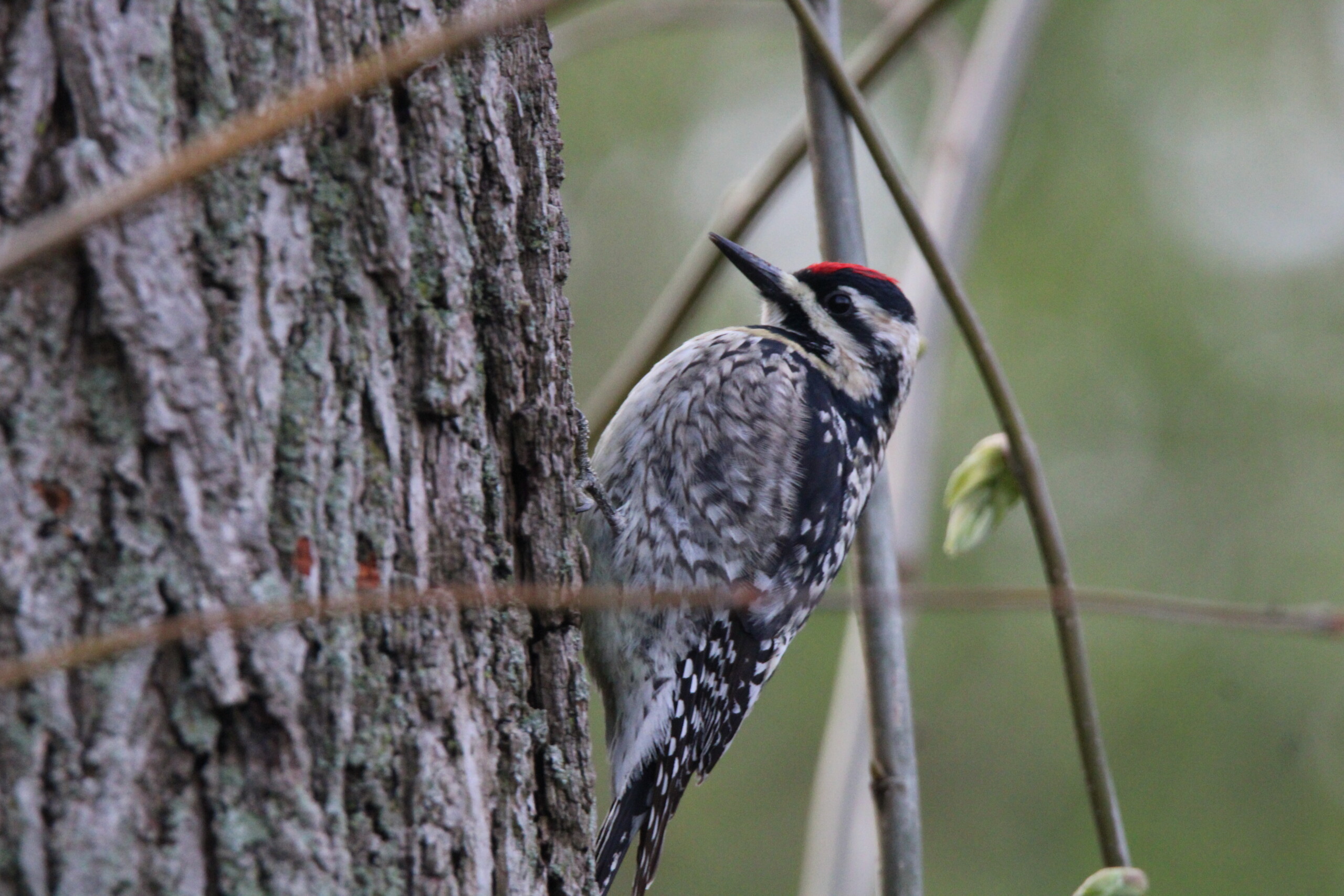
Another woodpecker I want to highlight is the yellow-bellied sapsucker. Yellow-bellied sapsuckers, unlike other North American species, are the only woodpeckers that migrate. I had known before that yellow-bellied sapsuckers live and nest in different areas of campus, and I also remember spotting a juvenile on the large tree by Crosby. Throughout many of the large trees on the Genesee Trail, as well as next to the Chapel, and even near buildings such as the First-Year Quad dorms and Schlegel Hall, I spotted sapsuckers scurrying through the branches and looking for food. I saw a male sapsucker, distinguished by his red throat patch, on the trees outside the Chapel, and a female, whose throat patch is white, on a tree above the stone wall off the trail, drinking tree sap from the small, shallow holes she drilled, called sapwells.
The yellow-bellied sapsuckers were not the only migratory birds I got to spot and photograph while birding. A Northern house wren, widespread across the continental U.S. for breeding but more often heard than seen, was singing from a perch in the trees by the Chapel and then foraging for food on the ground.
Sparrows were seen throughout different areas of campus as they were making their way farther North to nest. Chipping sparrows, with their characteristic rusty red caps, were foraging for food on the ground among song sparrows, and they were seen in the bushes along with the more urban areas of campus. On Eastman Quad and in the bushes by the Chapel, I saw aptly-named white-throated sparrows. White-throated sparrows are unique in the way that they have four sexes; these birds come in two variants with either white or tan stripes on their heads. White-striped individuals of one sex will only mate with tan-striped individuals of the other sex. White and tan-striped sparrows were in search of seeds while scratching at the ground to uncover them. Before I spotted them, I could hear their distinctive song, which sounded like “Poor-Sam-Peabody-Peabody-Peabody!” Other sparrows I managed to spot on campus, as well as in Canandaigua recently, include dark-eyed juncos, with a pink bill and (if native to the Eastern U.S.) slate-gray plumages with white bellies, and field sparrows, searching for seeds on the ground and eating from the feeders. A swamp sparrow, that looks strikingly similar to the more widespread and common song sparrow except for its rusty cap, was hopping along the ground near the Genesee River cove.
Other birds I spotted in those bushes near the Chapel include the brown thrasher, a relative of the mockingbird with a slightly curved bill, rusty brown back, and white belly with brown streaks. The tiny and energetic ruby-crowned kinglet flitted through the bushes in search of insects that have started to come out for spring. These birds have been one of the most challenging to photograph due to their small size and quick movements, and I finally managed to get a shot of them after visiting that site and waiting patiently for a few minutes.
In the short pathway by the cove of the river was another shy bird I successfully photographed, the hermit thrush. True to its name, and like many thrushes, hermit thrushes tend to keep a low profile, avoiding contact with all other creatures by blending in with the forest floor with its rusty brown plumage and reddish tail feathers. I made sure to keep my movements slow and my voice soft as I watched it from afar and took some photos.
While overlooking the river on the footbridge, I could spot a flock of barn swallows gliding around the river and preparing to nest. These birds flew at high speeds, catching insects and sipping water from the river mid-flight. I could spot them landing in the perches underneath the footbridge and could spot nests made from soil and parts of leaves.
I also want to mention an exciting highlight of my recent birding outings: a palm warbler. Warblers are one of my favorite songbird groups and species such as palm warblers, yellow-rumped warblers, and pine warblers, tend to arrive up North the earliest. Seeing that palm warbler in that small tree between the cove and the larger Genesee River made me look forward to spotting more incoming warblers on campus as migration goes forward.
As spring goes on, my sightings of the various types of birds around Rochester have been clear reminders of the changing, warmer seasons. Birdlife on and off of campus has diversified as more and more migratory birds are arriving or passing through this area to breed. I can only hope for more exciting species to appear as spring migration progresses.