Season 2 of HBO’s “The Pitt” began streaming in January after winning Best Drama Series and four more awards at the 2025 Primetime Emmy awards for its first season. Both seasons follow a full shift at the Emergency Department (ED) of the fictional Pittsburgh Trauma Medical Center (PTMC), and each episode follows an hour of the main characters’ shift.
At the heart of the show’s riveting patient cases, plot twists, and cliffhangers that make you sit on the edge of your seat is the medical accuracy of scenes. Writers and directors achieve this by working closely with medical advisors to ensure the medical terminology, procedures, and character details reflect real-life emergency medicine. Their guidance helps ground the drama in authenticity, both immersing viewers into the true-to-life intensity of each episode and providing meaningful representation for healthcare workers.
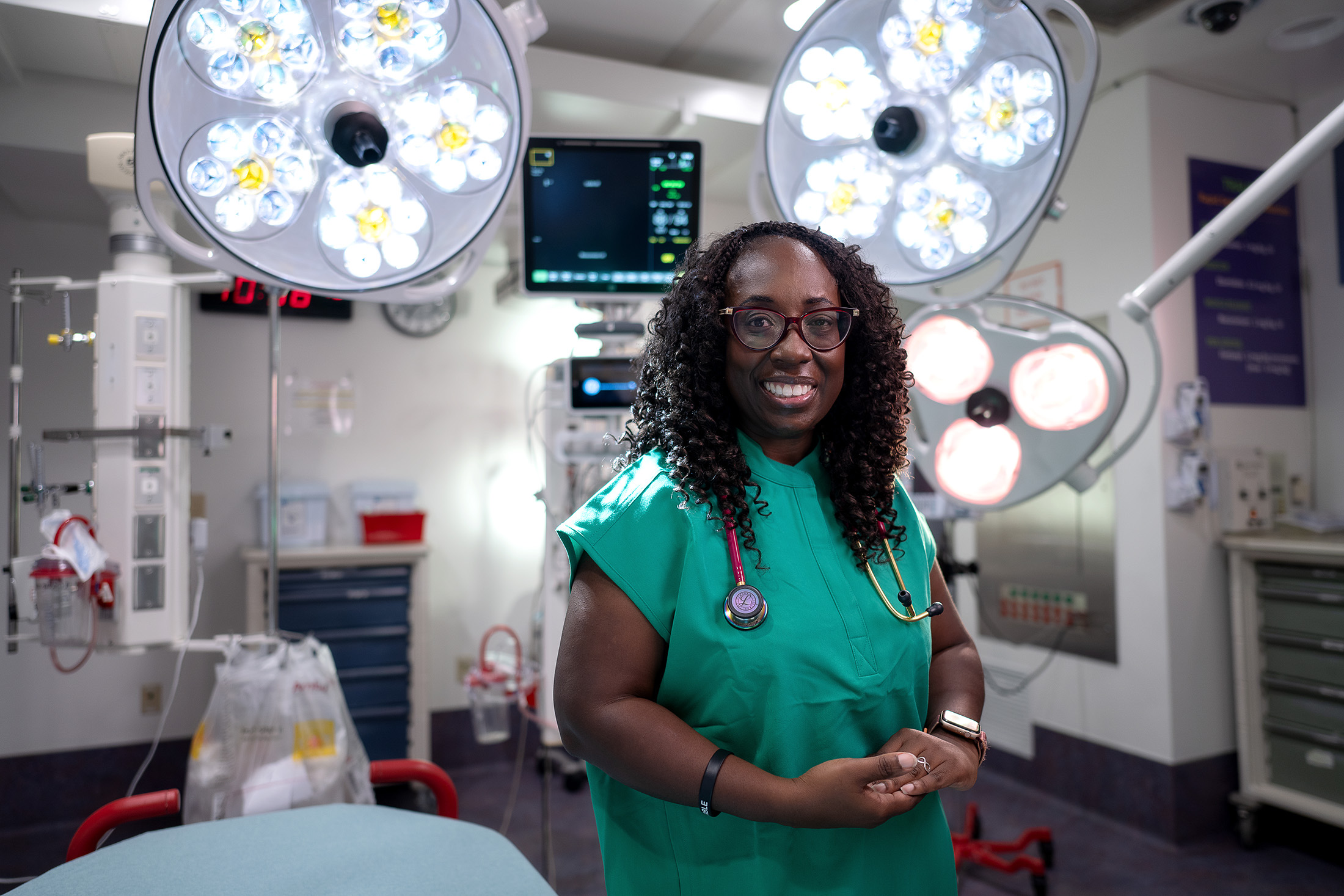
Medical Director of Prehospital and Emergency Medical Services (EMS) at the Children’s Hospital of Pittsburgh and University alumna Dr. Sylvia Owusu-Ansah ’00 played a pivotal role improving the accuracy of the show and creating memorable storylines. She connected with ED physician, producer, and television writer of “The Pitt” (and the early 2000s series “ER”) Joe Sachs in March of 2024 to advise for Season 1. This opportunity arose through Hollywood, Health & Society, a University of Southern California program created to guide the entertainment industry in forming accurate narratives with the latest information on health and safety.
“What they asked me basically was ‘What has not been shown on medical dramas that you think is important — what storylines?’” she recalled. “I shared with them things such as [being] tired of sickle-cell [anemia] patients being considered pain seekers.” She also referenced how she “talked about how we [healthcare workers] do a moment of silence [after deaths of patients], the demographics of Pittsburgh” and “being troubled by the increasing ingestion of THC in kids and how that affects kids and how parents aren’t very aware.”
These concepts manifested themselves throughout the show’s first season, such as in a storyline involving the treatment of a Nepali-speaking woman whom the residents and nurses had difficulty interpreting, as well as a four-year-old who ate his father’s weed gummy.
“[I] spoke about my experience as the only Black physician in my emergency department. Only 5% of all active physicians identify as Black, only 2.3% of them are Black women. So hence Dr. Collins.” The character Owusu-Ansah refers to is a Black woman and senior resident in Season 1 of “The Pitt” and is her favorite on the show.
Owusu-Ansah also added, “If you’re going to talk about healthcare in Pittsburgh, you have to talk about Freedom House Ambulance.” One of the patients in Season 1, 81-year-old Willie, was revealed to be a former medic for the Freedom House Ambulance, the United States’ first ambulance company to train first-responders beyond basic first-aid. The 25 Black men in the program’s inaugural class of 1967 became the nation’s first paramedics. The plot line shed light on Pittsburgh’s lesser-known revolutionizing legacy of these pioneers who broke racial barriers in healthcare at the time and set the precedent for EMS in the U.S. With the popularity of “The Pitt,” the public now seems more aware of Freedom House, according to Owusu-Ansah.
“I’m seeing all the social media posts are talking about Freedom House the past two years when I’ve never seen anybody talk about Freedom House,” Owusu-Ansah said.
This shift has also driven bipartisan support for introducing a federal bill to award the Freedom House Ambulance with the Congressional Gold Medal, a goal Owusu-Ansah has pushed for.
As of publication, “The Pitt” is currently the number one series streaming on HBO Max. When asked what makes the show stand out from other medical dramas, the URochester alumna gave credit to its medical accuracy. “Medical accuracy streamed with real character stories of both patients and the physicians,” she added, “making the physicians seem human by showing their vulnerabilities, right? And showing that they too are not perfect. You have [Dr.] Langdon with his struggle in drug use and going to rehab. You have Dr. Robby and [his] PTSD from COVID. You have Whitaker and his so-called ‘homelessness’ and the list goes on and on and on.” Dr. Michael “Robby” Robinavitch played by “ER” actor Noah Wyle is the attending of the PTMC Emergency Medicine team and oversees the department including Dr. Langdon, Whitaker, and half a dozen more.
The authenticity of each individual patient case was also important in contributing to the show’s acclaim. One notable storyline, which is one of many Owusu-Ansah helped create, was that of Joyce St. Clair, a Black woman in Season 1 who has sickle cell disease. Sickle cell anemia is marked by an abnormality in the shape of red blood cells which leads to the cells’ destruction and blocking of blood vessels, characterized by painful episodes, called “pain crises,” that can last for hours. The disease disproportionately affects Black populations. The patient case was taken straight from one of her own patients who was also initially mistaken for an addict.
“[Joyce was based on] a 17-year-old female, probably 90 pounds soaking wet, who was brought in in restraints, and we were told that she was known to be aggressive,” Owusu-Ansah described. “She was spitting. She was biting. But her chief complaint was pain crisis. I heard a lot of screaming commotion in the hallway. So I came into the room. It wasn’t my patient originally. I came in and she was in four point restraints. And then the security guard even had his hand around her neck … I yelled and screamed, told them to get off of her and kneeled down next to her, whispered in her ear and said, ‘Just try to relax. I’m here for you. I’m your advocate.’ Again, I’m the only Black person in the hospital in the ED.” In the show, Dr. Samira Mohan took Owusu-Ansah’s place as the advocate of the sickle cell patient.
For Season 2, Owusu-Ansah helped in building the story of a one-month-old infant, nicknamed “Baby Jane Doe,” who was abandoned in the bathroom. She said she sent the writers information on “Safe Haven” babies and the legal acts in the state of Pennsylvania surrounding legal protection of babies, such as how leaving a baby older than 28 days in the hospital is considered a crime.
Owusu-Ansah has also directed her own short film, “In Good Hands,” a 12-minute HBO film-finalist that speaks to her experience as a Black physician in academia. It was screened from New York City to Los Angeles through the American Black Film Festival and will be released this spring or summer.
Navigating the film industry as a full-time physician has been a refreshing opportunity to take a break from the ED but also appreciate her profession more, said Owusu-Ansah.
“Having the media aspects has helped me enjoy my job more and create a balance, you know, because in healthcare it’s a broken system, especially in the emergency department. It’s fast paced, high acuity,” she pointed out. “And I work with children. I call time of death on children. I mean, last summer I had three shifts, three weeks in a row where I called time of death on babies, three babies. And so it is a nice break from that … Over the span of a lifetime of my profession, I may touch hundreds, maybe thousands of lives individually. But through media, you touch millions of people all at once.”
Originally from Boston, Owusu-Ansah attended the University for a bachelor’s degree in Biochemistry. Her undergraduate experience solidified her lifelong dream of becoming a physician. While attending the University, she conducted HIV research and took advanced biochemistry classes where she enjoyed learning about calcium channels, receptors, and proteins.
“I did my final paper on the papain enzyme from papaya … which I always wanted to use in the world of cosmetics to help folks like myself in our hair texture to have natural ways of straightening hair instead of using chemicals such as lye,” she said, which can lead to scalp irritation and burns.
Owusu-Ansah also started a program at the University called “Kids for College” which brought inner-city youth from underserved communities, such as the public housing that used to be where College Town is. The program aimed to expose these students to higher education where they would be paired up with mentors and attend classes in STEM and liberal arts. She was also very involved in the Interfaith Chapel and spent many Sundays there attending and helping out with services. Her favorite study spots were Carlson, her dorm room, and the Pittsford Wegmans which her friend would often drive to.
In college, Owusu-Ansah overcame challenges stemming from being the only Black student in group settings and emphasized the role that religion had in her determination. “I was told [by a classmate] that if I were to go into medical school, it was because of affirmative action … Other people didn’t think I was going to make the cut. And so I prayed about it. I prayed and fasted in the end at the Interfaith Chapel there.”
She recalled only applying to four medical schools due to a lack of confidence. Despite these obstacles, Owusu-Ansah not only graduated from the University of Chicago Pritzker School of Medicine in 2005 but also obtained her Masters in Public Health (MPH) in Health Policy from Johns Hopkins. With her background in health policy-writing, Owusu-Ansah has spent over a decade on Capitol Hill pushing for legislation on pediatric healthcare.
Amidst the hectic shifts that unfold in “The Pitt,” Owusu-Ansah thought back to her own most-hectic ED shift. “You know, there’s so many. There’s so many I can’t even recollect. Usually right after the holidays are pretty busy … people hold out during the holidays.” Season 2 of “The Pitt” notably takes place on a holiday: the Fourth of July. “Also Mondays in the ED are infamously busy. People tend to stay home on weekends, depending on the level of sports activity in the city, too.” Since October, Owusu-Ansah has taken a break from the ED as she is officially a cancer survivor and finished her last chemotherapy treatment Feb. 10.
The intersection between community and healthcare is a central theme reverberating throughout Owusu-Ansah’s work, from her research and extracurriculars at URochester and her EMS leadership in Pittsburgh to her policy work at the Capitol and her medical advocacy on “The Pitt.” Her expertise has helped shape the series into an overnight fan-favorite that simultaneously reflects her deep care for marginalized communities and the history, resilience, and dedication of frontline healthcare workers across the nation.