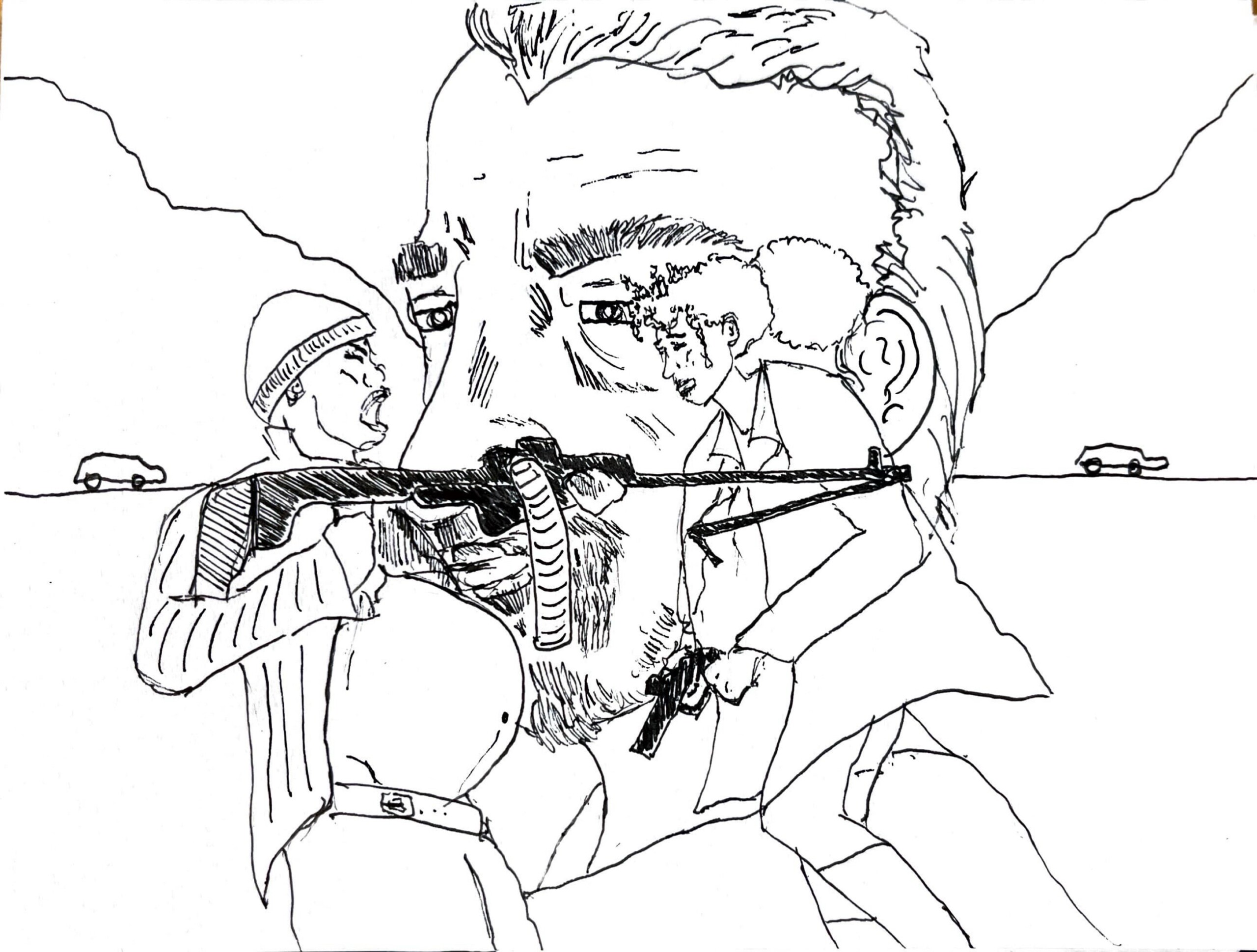
“One Battle After Another,” a film directed by Paul Thomas Anderson, combines current American politics, comedy, lust, and family dysfunction better than any movie I have ever seen. It not only offers a unique take on incredibly relevant themes such as immigration, racism, military corruption, activism, and rebellion, but does it all in such a hilariously absurd way that the movie will leave you dying of laughter.
The film stars Leonardo DiCaprio as Bob, an on-the-run former revolutionary who must rescue his daughter Willa (Chase Infiniti) when she is captured by the same obsessed, purely evil officer (Sean Penn) who chased down Bob and his wife 16 years earlier. Living in a society with a purist government who retaliates against anyone who helps any sort of minority, the odds are especially stacked against Bob and Willa who must find and rely on their very few allies to escape.
Along with DiCaprio, Penn, and Infiniti, the stacked cast also includes Teyana Taylor, Benicio del Toro, Regina Hall, and Tony Goldwyn. While everyone’s performance is spot on, I have not stopped thinking about Sean Penn as Steven J. Lockjaw since I left that theater. Penn somehow makes one of the dumbest, creepiest, and most ridiculously written villains also one of the most hateable, disgusting, and malicious characters I have ever seen. His grunts, his posture, his walk, the combing of his hair, and his in-your-face dialogue make him so comedically brilliant while not disrupting his threatening, unsettling presence.
Needless to say, DiCaprio also puts on an Oscar-worthy performance, blending guilt, clumsiness, absurdity, stupidity, and gentle care into a brilliantly-written character.
The biggest surprise of the film was Chase Infiniti, who made her feature film acting debut and brought life, innocence, strength, and fury into a character that could have easily just become a damsel in distress.
In the end, however, what brought everything in “One Battle After Another” together is the magic man working behind the camera: Paul Thomas Anderson. On paper, this film sounds like a simple cat-and-mouse chase, and while it is largely that, Anderson adds many layers to the story that make the chase feel much more thrilling. The movie can be categorized as a thriller, action, comedy, political commentary, dysfunctional family flick, and so much more, because it hits on all those notes wonderfully.
Additionally, the strong, panic-inducing use of piano and violin in the score (composed by Radiohead guitarist Jonny Greenwood) is brilliant. The vintage soundtrack is full of gems, the cinematography is simple but effective, and the overall scale and atmosphere of the film feels so grandiose, yet so intimate and intense, in the best ways possible.
My only potential gripe is that because of how over-the-top the comedy is, sometimes the emotional or political moments may not be as effective due to a lack of clarity in the film’s tone. However, this barely impacted my experience, because I will never take for granted movies that keep me on the edge of my seat from start to finish and still have me dying laughing constantly.
I initially gave the film 4.5 stars, but I would not be surprised at all if it moves up to 5 stars on rewatch. Expect this movie to be in every single Oscars predictions list you see, especially for Best Picture, as well as Best Director and Best Actor. Go see this film in theaters before it’s too late, and, “¡viva la revolución!”