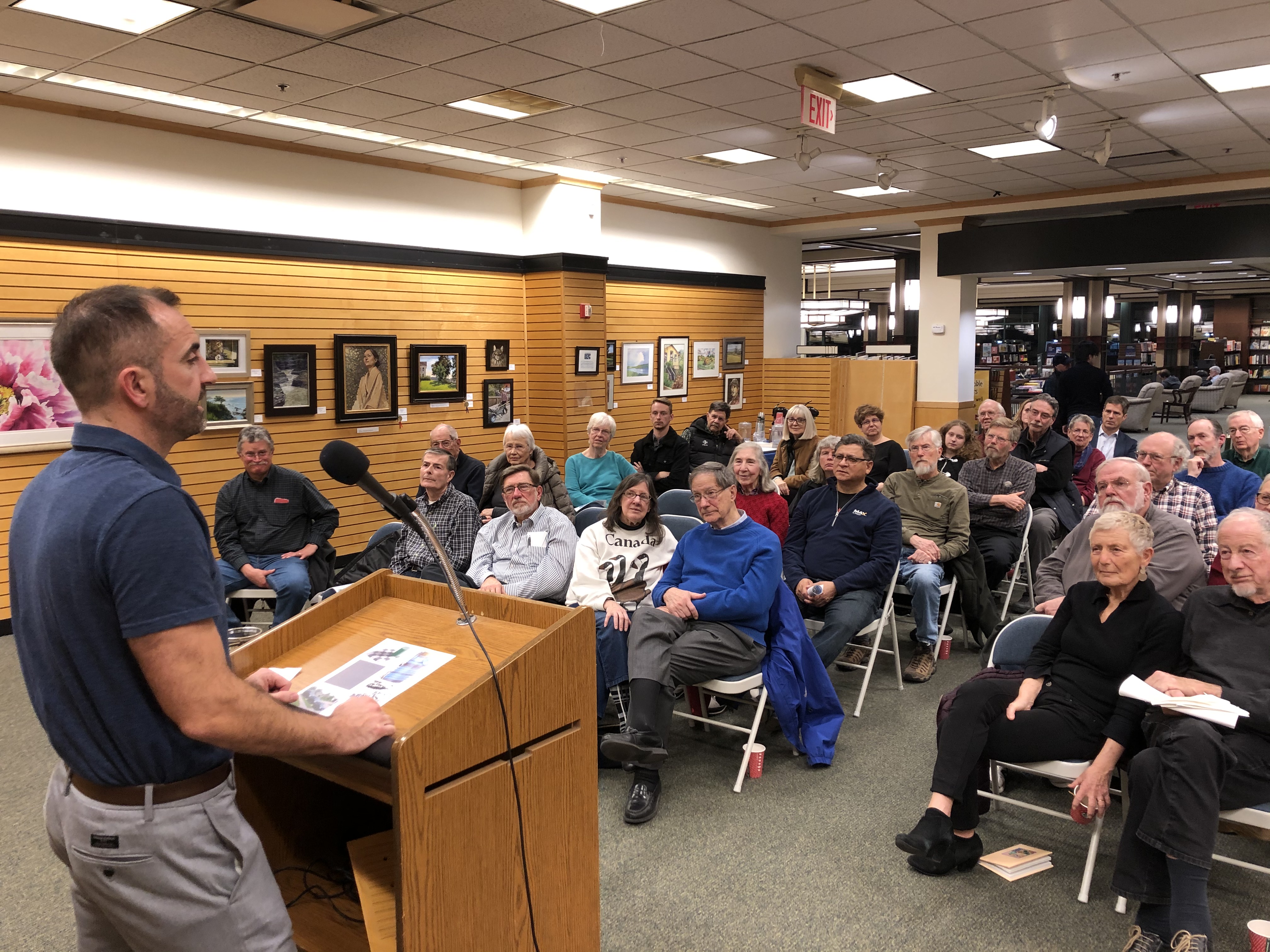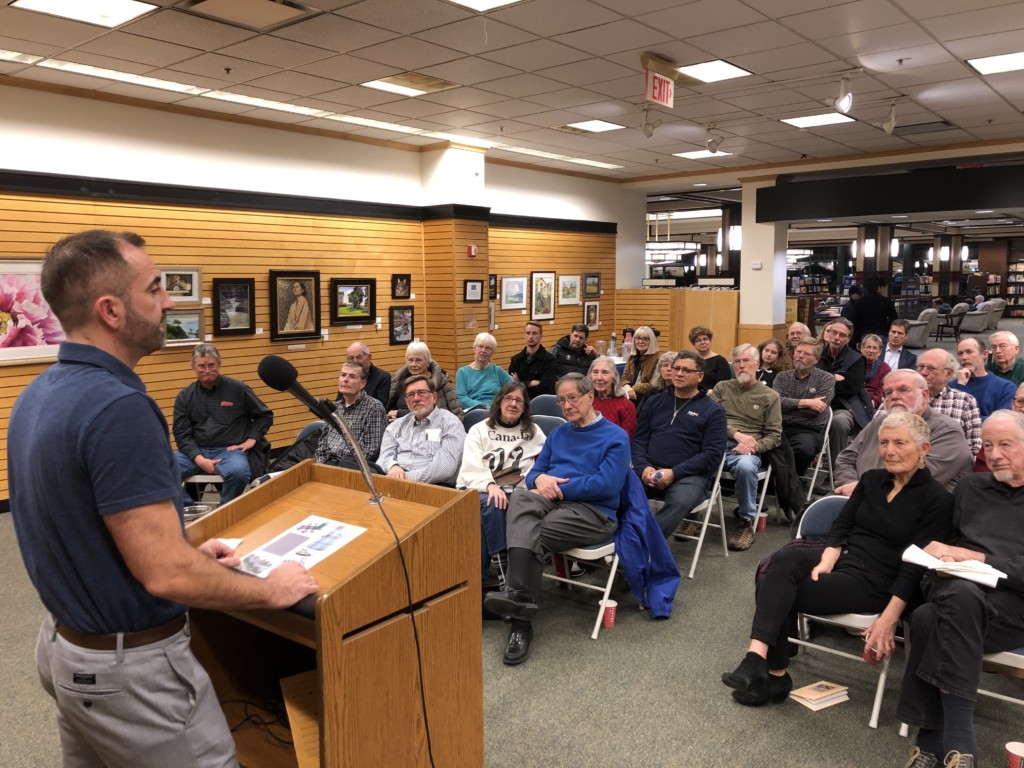
In an otherwise quiet Barnes & Noble, Pittsford Plaza on a Tuesday night, dozens of people packed into a modest room to listen to a scientist speak on bottom-up and top-down perception.
This is Rochester Science Cafe (RSC), held the fourth Tuesday of nearly every month during the school year. “The idea of a science cafe is to engage the community of non-specialists,” said UR biology professor David Goldfarb, who is one of the two co-organizers of the RSC, said after this month’s cafe on November 26.
“It’s an old concept, a ‘science cafe” he continued. “Tonight, you observed an expert talking to non-specialists — more like a conversation.”
RSC is often held at coffee shops with about 10 to 12 people. This one was unusually large with about 50 people.
“If it gets too large, then it will become a lecture, and most people in the room will not have the opportunity to tell their own story,” Goldfarb said.
Every available month, a professor from UR or RIT is invited to the cafe at Barnes & Noble to give a talk.
They are not allowed to bring in slides, as that would break the flow of the conversation and turn it into a lecture.
“You don’t have time to get into technical details or a blackboard to write on, so you want a coherent story,” said UR professor Edmund Lalor, this month’s presenter. “My only prep was to try to make a small number of bullet points of the main topics that I wanted to hit, and then go through that sequentially and keep the audience with me as I go.”
RSC’s objective is to engage the public in more sophisticated fields of science at a level they can find fascinating in relation to their own lives. For instance, in January the cafe will host a talk on artificial intelligence, delivered by UR computer science professor George Ferguson.
“He’s talking about artificial intelligence — everybody is talking about how artificial intelligence is taking over the world and our jobs, but then few really understand what artificial intelligence is,” Goldfarb said.
The cafe’s beginnings go back to 2008.
“Josh Faber, another professor at RIT, had the same idea as I did at the same time,” he said. “So the Rochester Science Cafe is a collaboration between UR and RIT. [Faber] would handle the spring series, and I do the fall one.”
This was over a decade ago. Originally, the cafe received a small grant from the National Science Foundation for cookies, coffee, and the traveling fee for speakers. But at some point the grant lapsed, and UR’s Department of Biology now covers all these expenses.
Goldfarb, reflecting on Lalor’s talk on how our minds work, said that he appreciated the impact of scientific engagement on the public. “These people today can go home on Thanksgiving and talk about human perceptions.”