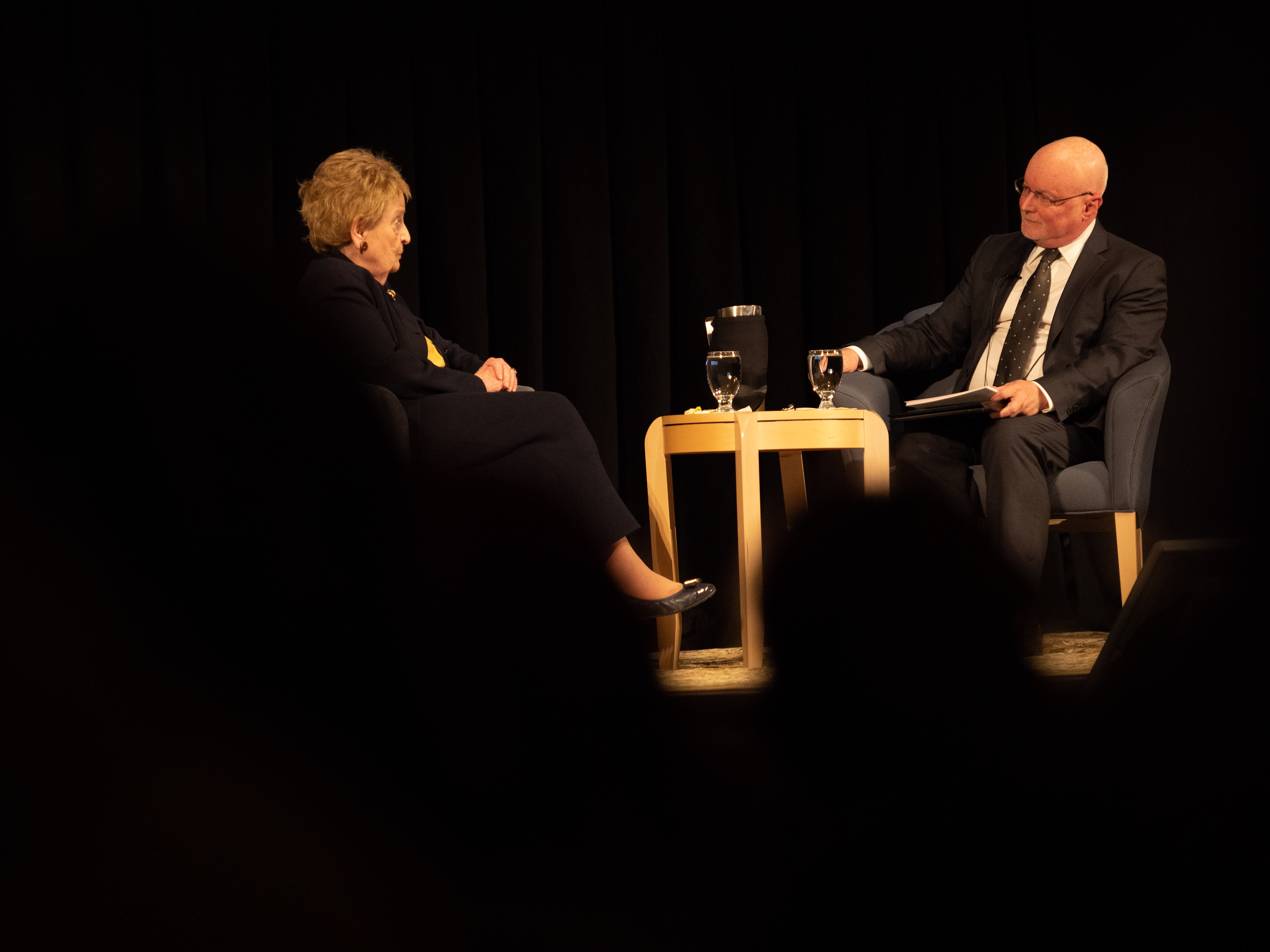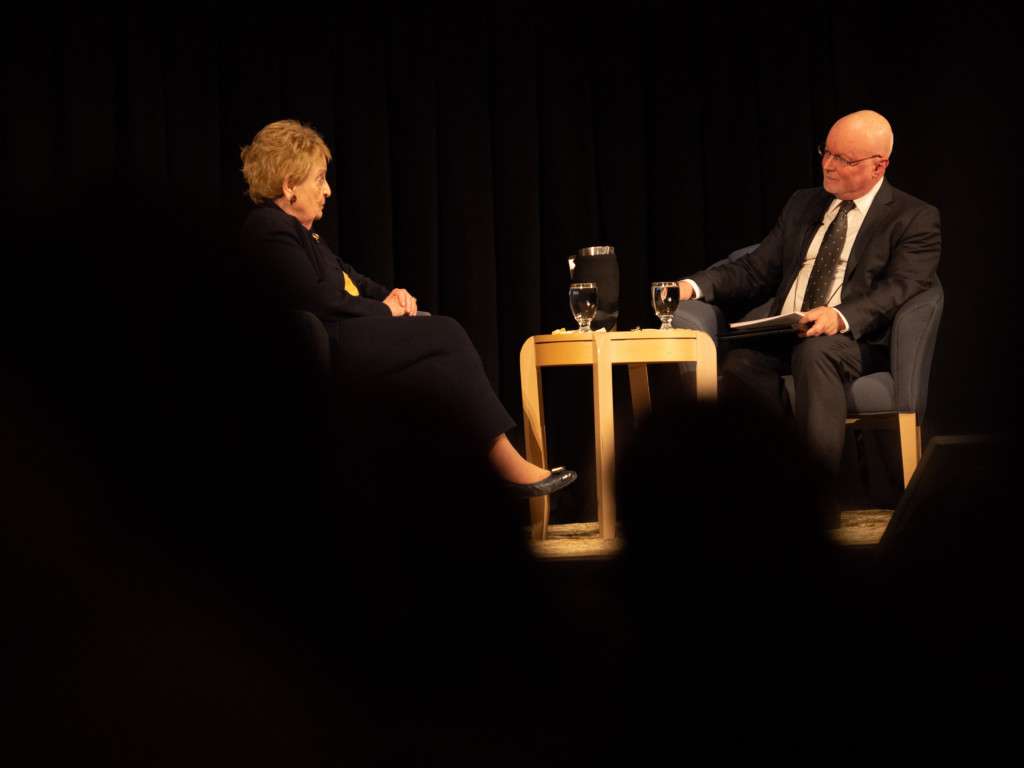
Former Secretary of State Madeleine Albright described herself as an “optimist that worries a lot.” She discussed the contradiction through the lens of technology, foreign affairs, and political dialogue last Thursday during her keynote speech in Strong auditorium.
Albright and her family escaped Czechoslovakia and received political asylum in the U.S. in 1948. In her early career she served as a National Security Council’s congressional liaison, before being appointed as the U.S. Ambassador to the United Nations in 1993. In 1997, she was appointed Secretary of State.
Albright praised the advancements of technology and the benefits of globalization, yet worries that it is a double-edged sword. She said people feel threatened by technology and will make their fears known by protesting and embracing nationalism, and made mention of how people see technology as a faceless entity encroaching on their established lifestyles, which causes them to cling to their identity out of a sense of fear and possessiveness.
This, in turn, has catalyzed many global issues, such as the rise of right-wing leaders that resemble the fascist leaders who ravaged the world at the beginning of the 20th century. She includes Donald Trump in this category, and uses the perception of technology as a threat as an explanation for his isolationist stance.
She feels that stifled dialogue and a fear of multilateralism has created a world plagued by gross nationalism and aggression, and suggests that we need to “engage in difficult conversations” with productive dialogue about our differences.
“Foreign policy affects real people,” Albright said. “There is no way to be totally isolated. We need to understand how much of our lives are dependent […] on other parts of the world.”
She continued, pointing to the importance of America’s presence worldwide. “This is the indispensable nation […] where we can, we should lead and are better off and safer when we do [lead].” She said that if we send the message to the world that “the U.S. is AWOL,” it makes it a lot easier for other countries to fill the vacuum that we have left behind.
In her opinion, we are going “AWOL” by allowing leaders from Russia, China, and Syria to further destabilize the Middle East.
But not everyone agrees with her. “As the former Secretary of State, she is looking at this issue through the lens of ‘how do I ensure world peace?’” said senior Anthony Pericolo, president of UR College Republicans. “Even though we are bringing stability and security to the Kurds, how does it look to the Middle East if we’re always involved?”
Albright also championed respectful discourse, expressing a belief that a significant cause of social and political division is a lack of civil dialogue.
“If you spend the time having respectful conversations with people [understanding] why they think how they do […] [that] is what it is to live in a civilized society,” she said.
UR President Sarah Mangelsdorf said she thought highly of the event.
“I thought tonight she articulated a lot about the values of our country,” Mangelsdorf said. “She’s an immigrant who’s had tremendous success, and she talked about our basic values of respecting human rights. I just thought she was inspirational.”