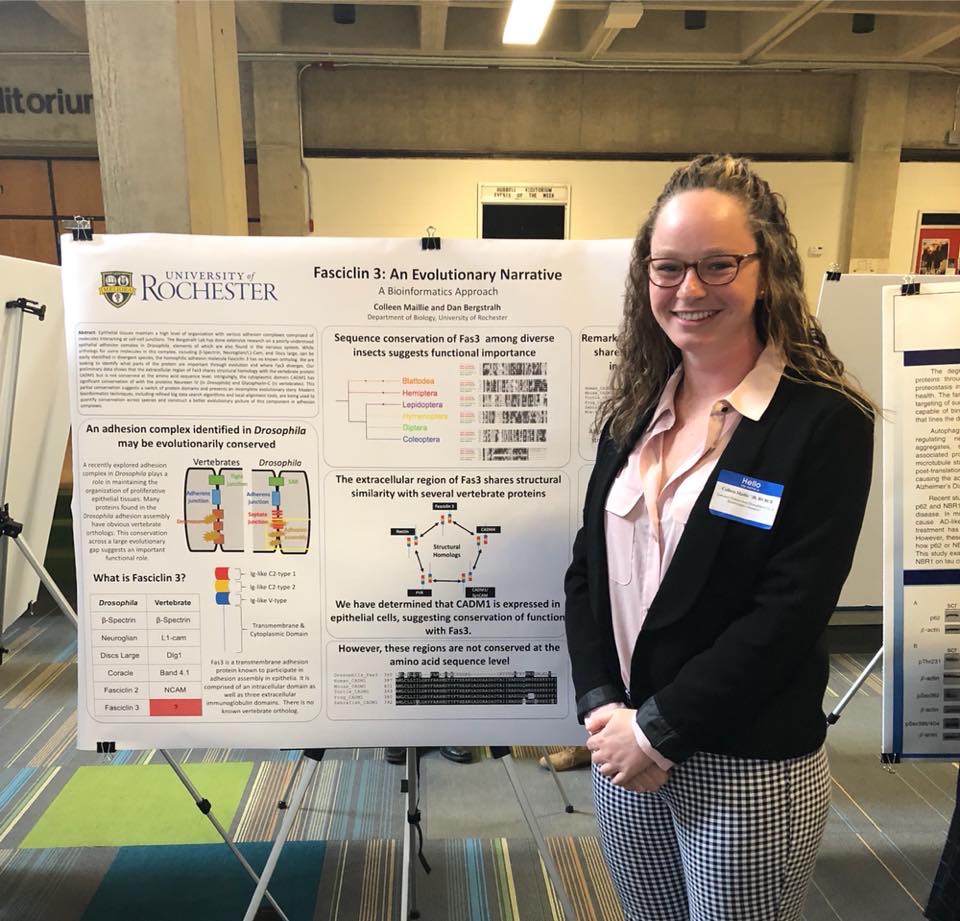
Junior Colleen Maillie walks the delicate balance as field hockey captain, undergraduate student, and computational biology researcher.
“I’ve learned to be adaptable and lean into the different surges […] each area brings, whether that’s a series of back-to-back presentations for lab or a run in NCAA tournament for field hockey,” Maillie said.
For Maillie, who was first recruited for field hockey, self-discipline and planning are valuable skills when managing a busy schedule, and there are many lessons learned from both the field and the research lab.
“I think taking ownership and having drive is […] a transferable skill I’ve learned in field hockey,” she said. “You have to be willing to push the boundaries in both.”
When she began as a nursing student, Maillie thought that “the only way into healthcare was [as] a doctor or [having a] professional medical degree.” In her sophomore year, however, she began investigating the computational biology field.
Maillie began her independent research project after she worked in Dr. Dan Bergstralh’s lab, cloning and genetically engineering Drosophila (fruit) flies. She found that she was indeed more interested in computational biology research, working with computer models and programs, when compared with wet lab research, which uses chemicals and/or biological materials in a traditional laboratory setting.
Undergraduate research usually involves undergrads working with graduate students, but it can later lead to something greater. Mallie indicates that her project in the computational biology department is unique: “Dan and I have been the primary people working on this. Research (between a PI and an undergrad) is kind of unusual and not what I expected to happen.”
With Bergstralh, she investigates proteins involved in cell adhesion. One such set of proteins facilitate Drosophila ovary cell tissue growth, which Maillie says functions like a zipper. Scaffolding and adhesion proteins “hook” the cell layers together until the growth of the bottom layer requires the top layer to “unzip” and separate from the surface of a Drosophila ovary.
In many organisms, these adhesion proteins are genetically similar, and evolutionary relationships between seemingly distant organisms can be deduced. Using gene sequencing programs, Maillie analyzes sequence alignments to create evolutionary trees based on genetic similarities.
Maillie also analyzes insects such as termites, stink bugs, and bumblebees. She has found that the Fasciclin 3 adhesion protein is conserved between most invertebrates, but not with spiders. When she discussed this with a postgrad who studies vertebrates, Maillie suggested that specific amino acid residues in the proteins may have mutated to yield an entirely different adhesion protein.
“It’s really exciting to be able to go into a lab meeting and talk about something that everyone doesn’t know,” Maillie said.
