This fall’s student government elections brought a new group of senators into office, while also highlighting broader questions about student participation in campus politics.
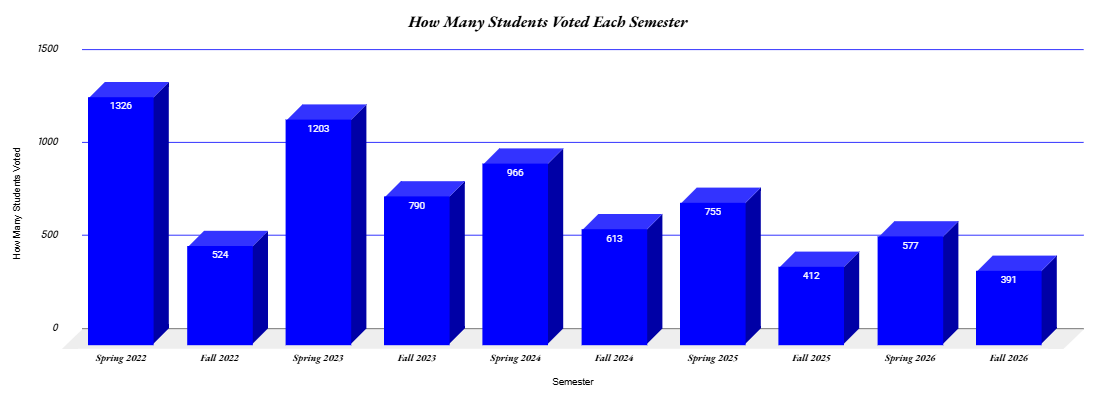
A total of 391 students voted in this round of elections, marking both a decrease from the 412 votes last fall and a record low in a fall election since at least 2022, according to election data provided by Fall Elections Coordinator and junior Angelo Romero.
The results follow a broader decline in participation across recent Students’ Association Government (SA) elections. While 790 students voted in Fall 2023, that number fell continuously each year, reaching 391 this semester. Spring elections have experienced a similar trend, falling from 1,326 voters in Spring 2022 to 577 in Spring 2026.
This fall’s election was also largely driven by first-year students. Of the 391 students who voted, 327 (83.6%) were members of the Class of 2030. Comparatively, 29 (7.4%) were members of the Class of 2029, 15 (3.8%) were members of the Class of 2028, and 20 (5.1%) were members of the Class of 2027.
According to Romero, at URochester, fall elections focus primarily on first-year Class Council and Senate seats. While first-years vote for their own Class Council representatives, students of any class year can vote for any Senate candidate. Candidates who do not secure one of the four Senate seats designated for their class are then considered for at-large seats based on the same election results.
| Simple Explanation:
1. Each Class Year Elects The 4 Candidates With The Most Votes (plurality, not majority) 2. All The Candidates Who Weren’t Elected Move Into The “At-Large Section” And Go Against Eachother. Top Candidates With Most Votes Are Elected In At-Large (There Is No New Election; We Look Back and Check To See Who Has The Most Votes, In The Same Election.) 3. No Matter What Class Year You Are, You Can Vote For Any Candidate. |
“I want people to know that elections are happening,” Romero said in regards to low student participation. “I want candidates to have time to be able to campaign. I want more people to run for campaigns.”
Part of the challenge, according to Romero, goes beyond getting students to the ballot box. “Some people didn’t know voting was happening. Some people don’t care about elections. Some people don’t know what the Students’ Association is,” Romero said. He also noted that some students confuse SA with Class Council, while others may not realize that they can vote for Senate candidates outside of their own class year.
Additionally, the depression in voting may have come from students not seeing a representative from their own class on the ballot, or feeling removed from SA altogether. Romero emphasized, however, that the decisions made through campus elections still have the ability to affect students.
He hopes for all members of this community, regardless of citizenship status or nationality, to learn that “no matter where you’re from … every election matters.”
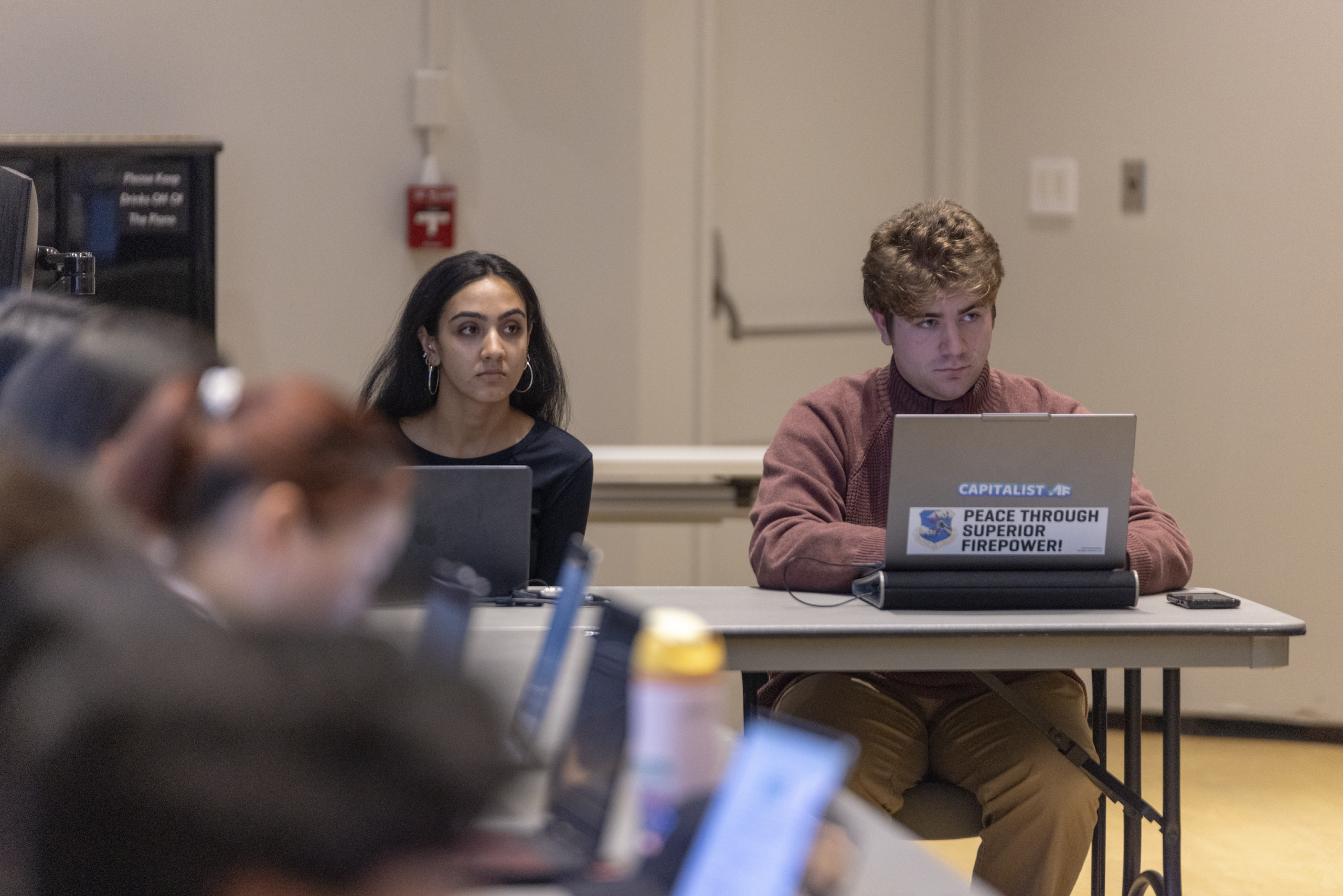
(Teddy Almond / News Editor)
For Romero, that makes increasing awareness of SA just as important as increasing the number of students who vote. His statement also echoes concerns raised by newly elected senators about communication between students and the institutions meant to serve them.
“One of the things I noticed upon coming to [U]Rochester was the amount of confusion students, including myself, seemed to have when they first arrived on campus,” expressed first-year Joanna Lee, a newly elected senator.
When asked about what kinds of issues on campus she hopes to improve, she voiced her concern about the accessibility of URochester information and resources to students. “While [U]Rochester resources are great, they could be updated to be more easily accessible for students, and allow them to not feel as lost or confused.” Part of addressing that disconnect, she explained, means increasing awareness of resources that are already available to students.
“I want to make sure that [U]Rochester can be made more easily accessible, updated, and organized for all so that the students’ lives can be made easier.”
Senator and First-year Jack Catten conveyed similar concerns, saying that during the recent elections week the “miscommunication between our school’s institutions and the student body couldn’t be more prevalent.”
He hopes to address these issues through his position and protect the passions he’s observed within students during his first few weeks. He sees the Senate as a “mechanism to bring some of those passions to light and start making real change on behalf of [his] community.”
In the future, Romero hopes to increase advertising, put up more flyers around campus, and hold events where students can meet candidates before voting.
Whether through running for office, learning who represents them, or simply casting a ballot, he hopes more students will see themselves as having a place in that process.
“I want to see students engaged,” Romero said. “That’s the goal.”