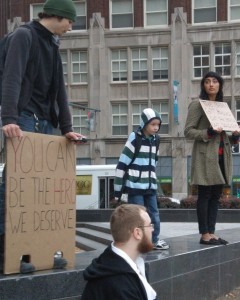
Occupy Rochester protestors displayed signs at a rally on Wednesday, Oct. 12 at the Liberty Pole in downtown Rochester. UR senior Melanie Prasad, right, holds a sign that reads "The banks got bailed out, the people got sold out."
The 99 percent of Rochester have found their voice — not on the steps of the New York Stock Exchange, but on home turf, beneath Rochester’s Liberty Pole.
Occupy Rochester, as the burgeoning group calls itself, is an extension of the rapidly growing Occupy Wall Street movement that began protesting social inequalities in New York City’s financial district on Sept. 17. Despite a slew of arrests and initially scant mainstream media attention, Occupy Wall Street is gaining clout across diverse segments of the population, and has spread to more than 100 different cities nationwide and 1,500 worldwide.
Occupy Wall Street defines itself as a movement against corporate greed and the “1 percent,” which refers to the “haves” — the richest echelons of society, the banks, the mortgage industry and the insurance industry. It is, according the movement’s website, a “leaderless resistance movement with people of many colors, genders and political persuasions” who constitute the “have-nots” and the 99 percent.
On average, about 40 people have been attending the daily rallies in front of the Liberty Pole in downtown Rochester, according to protester and ad hoc leader Emily Good, who described Occupy Rochester as an “autonomously organized movement.”
The rallies occur Monday through Friday from 4 to 6 p.m., with Wednesday being the “march” day, in which protestors take to the streets with signs bearing anti-greed slogans. Organizational and planning events take place on Sunday from 1 to 3 p.m. at the Flying Squirrel Community Space, according to the group’s website, where forums have been started to organize an active group of protesters.
Good, a Rochester resident who attended the first four days of the Occupy Wall Street protests in New York City, said she hopes Occupy Rochester will “add to the national call for the absolute renewal of the financial world and the economy.”
However, at the rally on Wednesday, Oct. 12, Good noted that Occupy Rochester’s goals are more specific to the city’s particular economic and societal issues. She said that the movement’s primary concerns will be the alarming number of housing foreclosures in Western New York and issues relating to student life at local schools and colleges.
“The police profit off of fear,” she said. “They refuse to invest in people, in health care, in students.”
UR senior Melanie Prasad, who marched in four days of Occupy Wall Street protests this past weekend with fellow UR senior Sarah Litten, attended her first Occupy Rochester rally on Wednesday. She said she has plans to organize a coalition of UR students to attend the protests in Rochester on a daily basis, and hopes to spread aware of the movement to the student body.
“There are so many people who are generally dissatisfied and it’s so good to see us finally mobilizing,” Prasad said. “Everyone in our age group has grown up so apathetic.”
Prasad said she sees high property taxes and high unemployment as particularly pressing issues, and that the currently raging debate over hydrofracking is particularly relevant for the city of Rochester due to the fact that a significant portion of land in the Finger Lakes region has already been leased to natural gas companies.
Still, like the majority of Occupy Wall Street protestors, she thinks the absence of a concrete agenda is not a detriment to the movement.
“It shows that there isn’t one single fix and that everyone has a lot of their own issues,” she said.
UR graduate student Bill Finan, who said he has attended eight out of 10 rallies held in Rochester so far, supported this view.
“It’s not about any single issue,” he said Wednesday. “It’s about representation for the 99 percent.”
Finan said he is optimistic about Occupy Rochester after “hundreds of protestors” turned up for the rally on Monday, Oct. 10, and that he hopes to galvanize enough support to emulate Occupy Wall Street by physically occupying Rochester. Due to the impending inclement weather, he suggested using a parking garage as the locus of the protests.
“Just like the one in [New York City], we’re trying to show the world what’s going on, but we’re also a place for people to discuss politics and issues,” he said. “We’re all united in the 99 percent and we’re not afraid to take to the streets for what we believe in.”
Buletti is a member of the class of 2013.