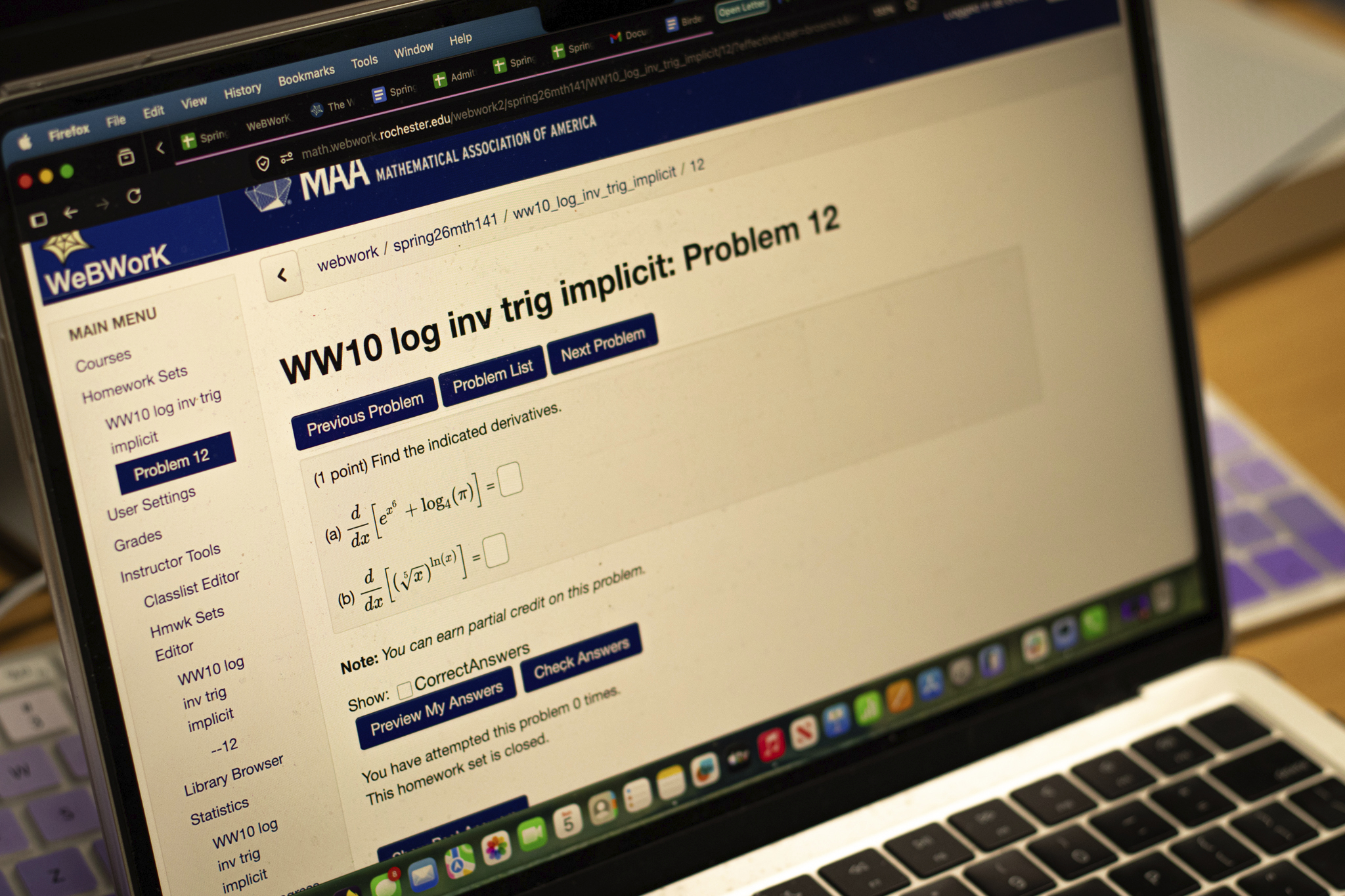
If you’ve ever taken a STEM course at URochester, you’ve probably completed your fair share of WeBWorK sets. Though WeBWorK problems are probably best known as a part of calculus courses, trying to make that last problem shine green at 11:55 p.m. has to be one of the wider-reaching shared experiences in the school; courses from physics to computer science to business incorporate the platform.

For those who haven’t experienced the hit of dopamine we now associate with the particular magnificent shade of green WeBWorK will flash across the screen in response to a correct answer, WeBWorK is a web-based homework system designed to provide instant feedback on a variety of problems.
“It’s not just multiple choice or fill-in-the-blank. It can recognize very complicated mathematical expressions and test for accuracy,” said Mark Herman, URochester math professor and WeBWorK co-administrator. “The foundations on which it’s built allow for just many different types of questions that can be asked.”
Co-administrator Herman, with fellow administrator and Math Professor Mary Cook, keep the site running, mainly by working to create new course sites and dealing with bugs in homework questions.
These homework problems come from decades of professors’ contributions. Over 35,000 problems have been contributed to the Open Problem Library that comes with WeBWorK at last count, according to WeBWorK’s Wiki. Moreover, instructors have access to a large collection of macro files to assist with creating new problems, something they can do because the website is open source.
“What that means is it’s free,” said Herman. “And anybody that wants the bare-bones code of every little detail of how the software is built can get it and can have access to it.”
These macro files are modelled on TeX, which is both a format and a program which does automated or programmatic arrangement of text, symbols, and formatting (typesetting). TeX is basic and its language very low level. Shortly after TeX was premiered by David Knuth at an American Mathematical Society meeting in 1982, computer scientist Leslie Lamport wrote a set of macros to make working with TeX easier. These macros eventually developed into the LaTeX format, the document preparation system we know and love today.
While WeBWorK’s problem generation allows for both LaTeX and Perl, it is at its core a Perl-based system. Perl is an open source programming language that is high-level and for general purposes. It can be used for text processing or manipulation, parsing or filtering data logs, transforming data from one format to another. Another advantage of Perl is that old code is highly likely to still run today.
In 1995, when then-University professors Michael Gage and Arnold Pizer developed and built WeBWorK, they were concerned about “extensibility” — they wanted instructors with programming experience to be able to extend WeBWorK’s functionality “without rewriting the entire system from scratch,” according to Gage, Pizer, and Roth. “This modular design is achieved by creating macro packages that simplify the creation of each homework problem. Since it is possible to use the full power of the text processing language Perl in writing the macro packages, this provides great flexibility for experimentation and improvement without altering the basic WeBWorK framework.” These macro packages are based in TeX and enable instructors to make new homework problems as well as answer questions.
Realizing how useful WeBWorK could be for other instructors, Gage and Pizer applied for and received a million-dollar grant through the Mathematical Association of America and the National Science Foundation so that they could spread the word about the platform.
“They would kind of go on tour,” Herman said. “They would go to conferences and other institutions and these things and kind of give tutorials and presentations and help people kind of get their server running and things like that.”
The tour worked: There are now more than 1,300 institutions around the world using WeBWorK for at least one course.
“There [were] institutions in, I think, every continent, other than Antarctica obviously, using WeBWorK,” Herman said. “It’s used in high schools. It’s used all over the place.”
One big reason WeBWorK is so popular is that it gives instant feedback to students completing problems. With traditional written assignments, students have to wait for graders before receiving feedback.
“There’s always a lag [in grader feedback]. Sometimes the lag’s several weeks. Sometimes the lag’s shorter. But there’s a lag. And so, by the time that students get their feedback on their solutions, it’s kind of been out of sight and out of mind maybe for a little while. And they’ll have to kind of re-engage themselves with the stuff just to understand what they did wrong sometimes,” Herman said. “Depends on the level, right? And how deep we’re talking. But it’s a thing. And WeBWorK is instant feedback.”
With WeBWorK, students know right away what they’ve gotten wrong, and so they can keep trying and trying until they get it right. That instant feedback is invaluable to students.
For the last few years, University IT has been working on updating the servers on which Webwork is hosted. “It’s a substantial update. It’s long overdue. And we’ve been working at [it] for a while,” Herman said.
Part of the delay is that IT would have to shut down the site in order to update it. If anything went wrong, it could potentially upset dozens of courses and thousands of students.
“You really only have very tight windows on which you can actually implement any changes to the software,” Herman said. “We use it in the summer as well, right? So there’s a week in May and there’s like a week in December, and that’s about it.”
Though the update is important, students’ experience of WeBWorK won’t materially change.
“It’s definitely not a dramatic [change],” Herman shared. “It’s still gonna be kind of the basic structure that it is, but the look is definitely updated. Some of the menu options are updated. There may be additional features.”
While Webwork can’t do everything — it can’t, for example, grade proof-based questions — the service it does provide to students is irrefutably valuable. And while that service is not entirely unique (other sites such as WebAssign are similar),WeBWorK’s flexibility makes it the best of its kind, at least according to Herman.
“We’ve had a lot of people from a lot of institutions come through here that I work with pretty closely. So I’ve heard a lot of opinions about these sorts of things,” Herman said. “My impression is that WeBWorK is truly the premier math homework software in the world. And has been that way for at least 20 years.”